
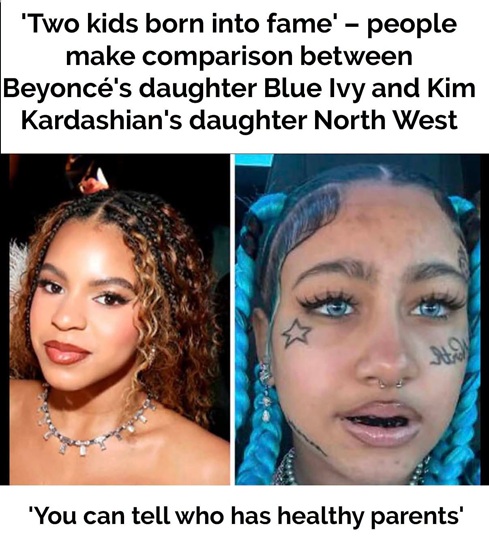
Growing up is complicated enough without millions of strangers watching, but children born into famous families often experience exactly that kind of attention. Blue Ivy Carter, the daughter of Beyoncé and Jay-Z, and North West, the daughter of Kim Kardashian and Ye, formerly known as Kanye West, have both lived with public interest since they were very young. Their clothing, hairstyles, appearances and personalities regularly attract online discussion.
Recently, that attention resulted in a viral comparison between the two girls, prompting a debate not only about their different styles but also about whether people should be making judgments about children and their families based on a handful of photographs. The social-media post placed images of Blue Ivy and North next to each other and attempted to connect their appearances with differences in their family circumstances.
Its caption suggested that having parents together or separated could explain how each child appeared or behaved. The message went further by making a broad claim about children from separated families becoming troubled adults. That conclusion is not something that can responsibly be established from photographs, and many social-media users quickly challenged the comparison. A child’s clothing, hairstyle or costume does not provide reliable evidence about their emotional well-being, upbringing or relationship with either parent.
An important part of the discussion involved the particular photographs selected to represent North. Some images showed her wearing blue hair, facial markings, dark dental accessories and piercings, creating a dramatically different appearance from the photograph of Blue Ivy used alongside them. However, context matters.

North has experimented publicly with temporary accessories, including fake facial tattoos and a faux septum piercing. Kim Kardashian has previously discussed her daughter’s interest in experimenting with different looks, particularly around Halloween. Treating one temporary appearance as a complete representation of North’s everyday life can therefore create a misleading impression.
Many people responding to the comparison focused on exactly that point. Children and teenagers often experiment with clothes, makeup, hairstyles and costumes as they discover their personal tastes. One child may prefer an elegant and understated appearance while another enjoys bold fashion and unconventional accessories. Neither preference automatically reveals anything meaningful about the quality of parenting behind it. Blue Ivy and North are separate individuals, and there is no reason their personalities or styles should develop in identical ways simply because both have internationally famous parents.
The discussion became more controversial when some commenters began criticizing Kim Kardashian and connecting North’s appearance to the separation of her parents. Other users strongly rejected that reasoning. Family relationships are far more complicated than a photograph or social-media caption can communicate. Children can grow up in supportive environments under many different family arrangements, while the presence of two parents in one household does not by itself guarantee a particular outcome. Making sweeping predictions about children because their parents are divorced risks turning a complicated subject into an unfair stereotype.
There is also a basic issue that can easily become overlooked when celebrity stories spread online: these discussions involve young people. Neither Blue Ivy nor North should be expected to represent a particular theory about marriage, divorce or parenting simply because their parents are famous. Public curiosity surrounding celebrity families is understandable, but it becomes more sensitive when children are involved. Comments about their appearance can quickly become personal judgments about their character, even though outsiders generally have very limited knowledge of what their everyday lives are actually like.
Blue Ivy has increasingly established her own public presence, particularly through appearances connected with Beyoncé’s performances and projects. Audiences have watched her develop confidence as a performer while growing up in an extraordinarily visible family. North has attracted attention in a different way, frequently showing an interest in fashion, music, creative expression and distinctive styling. Those differences can simply reflect two young people developing separate personalities. They do not provide an objective measurement of which household is healthier or which parents are doing a better job.
The episode also demonstrates why context is important when consuming viral content. Social-media posts often combine dramatic photographs with short captions designed to encourage immediate reactions. A single image can represent only a moment, yet viewers may begin constructing much larger stories around it. When costume elements or temporary accessories are presented without explanation, audiences can easily interpret them as permanent choices. Once that interpretation spreads widely, speculation can begin replacing the limited facts that are actually available.
It is equally important to separate legitimate discussion from assumptions about people’s private lives. Celebrity parents can certainly face public criticism for decisions they make publicly, just as other public figures do. However, evaluating an entire family based on a child’s hairstyle or costume is very different from discussing verified actions. Responsible commentary should distinguish between documented information, personal opinion and speculation. That distinction becomes especially important when the individuals at the center of the discussion are children who did not choose the circumstances of their fame.
The viral comparison ultimately reveals more about social-media culture than it does about either Blue Ivy or North. Two photographs can look dramatically different while providing almost no meaningful information about the lives behind them. Personal style, costumes and creative experimentation are not reliable indicators of whether someone comes from a happy or unhappy family. Likewise, divorce alone cannot determine how a child will develop. Human relationships and childhood experiences are much more complex than those simple conclusions suggest.
Blue Ivy Carter and North West are growing up under circumstances that relatively few children experience, with their ordinary choices capable of becoming international conversations within hours. Allowing them room to develop their own identities without turning every appearance into a competition is a more balanced way to approach their public visibility. People may naturally notice differences between them, but those differences do not need to become judgments about their families. When discussing celebrity children, keeping the available facts separate from speculation can make the conversation both more accurate and more respectful.

