
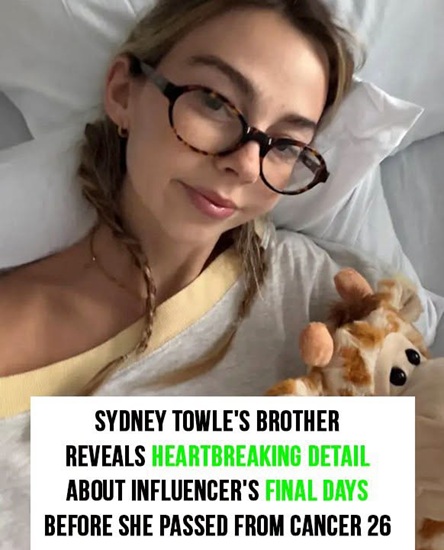
Sydney Towle, the social media creator who openly shared her experience with a rare form of bile duct cancer, died on August 5, 2026, at the age of 26. Her family announced her death the following day, sharing a photograph of Sydney standing on a mountain and remembering the young woman whose determination had inspired a large online community. They described her as an “endless ray of sunshine” and expressed enormous pride in the way she faced nearly three years of serious illness.
Sydney had been diagnosed with cholangiocarcinoma when she was only 23. Cholangiocarcinoma is a cancer that develops in the bile ducts, and Sydney’s disease eventually reached an advanced stage. Her diagnosis came at an age when most young adults are thinking about careers, relationships and future plans rather than cancer treatment. Yet the unexpected diagnosis became a major part of her life and ultimately shaped the online community that grew around her.
Rather than completely withdrawing from social media, Sydney made the personal decision to discuss much of her experience publicly. She shared updates about treatment and medical challenges while continuing to post about fashion, travel, friendships and everyday experiences. Over time, more than one million people followed her across social platforms. Many discovered her because of her cancer journey, but Sydney repeatedly showed that her identity extended far beyond being a patient.
Her family later explained that Sydney died peacefully after almost three years of living with the disease. Her older brother, Austin Towle, became one of the relatives providing updates as her condition became increasingly serious. In the final stage of Sydney’s illness, the family’s priorities gradually changed from pursuing additional treatment possibilities to keeping her comfortable and ensuring that the people she loved could remain close to her.
Sydney Entered Hospice Shortly Before Her Death
Only two days before Sydney died, Austin revealed that his sister had entered hospice care. He shared an emotional photograph showing relatives and friends gathered around her bed. By then, Sydney’s illness had progressed considerably, and the family understood that her remaining time could be limited. Their attention centered on comfort, companionship and making sure she was not alone.
Austin later explained that Sydney had hoped to spend her final days at home. Unfortunately, her physical condition had deteriorated to the point where moving her could have caused significant discomfort. Her family therefore decided that keeping her where she was receiving care was the more compassionate option. Instead of attempting a difficult transfer, loved ones gathered around her and brought the feeling of home to her bedside.
According to Austin, Sydney was extremely exhausted by this stage of her illness. He recalled her reaction when doctors explained that hospice care had become necessary and said she appeared peaceful about what was happening. That description came from her brother’s personal observations during the final days rather than from speculation about Sydney’s private thoughts.
Hospice represented a major transition after years spent pursuing treatment. Sydney had undergone extensive medical care and had continued exploring possible options even when her cancer became increasingly difficult to treat. The move toward hospice did not erase those efforts. Instead, it reflected the reality that her illness had progressed beyond the point where further treatment was considered beneficial.
Her Cancer Journey Began at Only 23
Sydney’s life changed dramatically in 2023 when she was diagnosed with cholangiocarcinoma. She was only 23 at the time. Before the diagnosis, she had graduated from Dartmouth College in 2022 and was entering a period of life typically associated with new opportunities and independence.
Medical testing eventually revealed the cancer, beginning a treatment journey that would continue for nearly three years. Cholangiocarcinoma is more commonly diagnosed among older adults, making Sydney’s young age particularly notable. Her individual case, however, should not be interpreted as evidence that this cancer commonly occurs among people in their twenties.
As treatment became part of everyday life, Sydney increasingly incorporated those experiences into her social media presence. She discussed difficult moments while also continuing to share the interests that existed before her diagnosis. Her posts could move between medical appointments and fashion, or between treatment updates and moments spent with friends.
That approach helped communicate an important part of Sydney’s perspective. Cancer was undeniably a major part of her life, but she did not want the disease to become the only thing that defined her.
Sharing the Difficult and Positive Moments
Sydney’s growing audience watched her navigate a reality most people her age had never experienced. She discussed physical changes caused by treatment and acknowledged the uncertainty associated with serious illness. At the same time, she continued looking for experiences that brought meaning and enjoyment to her life.
Her willingness to share both sides of that experience helped many followers connect with her. Some were dealing with cancer themselves or supporting relatives through treatment. Others simply admired her openness and the way she continued participating in life while facing circumstances beyond her control.
Importantly, Sydney did not suggest that positivity alone could cure cancer. Her medical journey demonstrated the opposite reality: a person can remain hopeful, pursue treatment and receive enormous support while still facing a disease that medicine cannot ultimately control.
Her message was therefore less about guaranteeing a particular medical outcome and more about finding worthwhile moments during uncertainty.
She Continued Searching for Treatment Options
Throughout her illness, Sydney pursued different medical approaches as doctors attempted to control the cancer. Her treatment journey included chemotherapy, surgeries and participation in clinical trials.
As her disease progressed, the available possibilities became increasingly limited. Earlier in 2026, Sydney faced conversations about whether additional treatment could realistically help her. She nevertheless continued seeking medical opinions and exploring whether other options remained available.
Her willingness to continue investigating treatment possibilities eventually contributed to one of the most memorable experiences of her final year.
In May 2026, Sydney traveled to participate in Miami Swim Week.
Given the seriousness of her condition, simply reaching the runway represented a significant achievement for her.
Walking the Runway While Living With Stage 4 Cancer
On May 28, Sydney participated in a fashion show during Miami Swim Week. She modeled as part of The Chemo Club x Post Swim presentation, an event connected with people whose lives and bodies had been affected by cancer and treatment.
Sydney walked the runway while living with stage 4 disease.
The appearance quickly became one of the defining public moments from the final months of her life. Photographs showed Sydney participating confidently in the event despite the medical difficulties occurring away from the runway.
For her family, the achievement became even more meaningful after her death.
Austin later remembered sitting beside his sister during her final days and thinking about what she had managed to accomplish. Among those memories was the remarkable contrast between Sydney’s advanced illness and the fact that she had walked in a major fashion event only months earlier.
He expressed enormous pride in his sister.
The runway appearance was not evidence that her illness had disappeared or become less serious. Instead, it represented Sydney continuing to pursue something meaningful while cancer remained present.
Celebrating Bodies Changed by Treatment
The fashion show also carried a message connected directly with Sydney’s experiences. Cancer treatment can leave scars and create major changes in a person’s body. The event sought to recognize people who had experienced those changes rather than suggesting they needed to hide them.
That theme aligned closely with the openness Sydney had already demonstrated online.
She had allowed followers to see aspects of illness that are often kept private. Treatment did not always produce images that fit the polished world typically associated with social media, but Sydney continued sharing parts of her reality.
At the same time, she maintained her interest in fashion.
Walking the runway therefore brought two sides of her life together: the young woman who enjoyed fashion and the cancer patient whose body had endured years of medical treatment.
Neither identity had to erase the other.
More Than an Influencer With Cancer
Sydney’s large following inevitably meant that many people knew her primarily through social media. Yet her family has emphasized that the person behind those posts was far more important than follower numbers.
Before she became widely known for documenting cancer, Sydney was a daughter, sister, friend and college graduate with ambitions of her own.
Her illness changed her circumstances, but it did not erase those relationships.
This was also reflected in the content she continued producing. Even as treatment became more demanding, Sydney posted about ordinary experiences whenever her health allowed. Those posts helped prevent her social media presence from becoming exclusively a record of medical procedures.
For followers experiencing illness themselves, that distinction could be meaningful. A serious diagnosis may transform someone’s life without removing every other part of their personality.
Sydney’s online presence demonstrated that reality repeatedly.
A Simple Message About Kindness
One of Sydney’s earlier public conversations gained renewed significance following her death. During an interview in 2025, she was asked what message she wanted other people to remember.
Her response centered on kindness.
The idea was straightforward: people rarely know everything another person is experiencing privately, so treating others with compassion matters.
That message reflected circumstances Sydney understood personally.
Despite dealing with cancer, she still encountered negative comments and skepticism online. Publicly discussing serious illness exposed her not only to enormous support but also to criticism from strangers.
Sydney nevertheless continued communicating with the audience that had developed around her journey.
Following her death, her comments about kindness became one of the messages followers shared while remembering her.
Bringing Attention to Cholangiocarcinoma
Sydney’s story also introduced many people to a disease they had never previously encountered.
Cholangiocarcinoma begins in the bile ducts, which are part of the system responsible for carrying bile involved in digestion. The disease can be difficult to treat, particularly when discovered after it has already advanced.
Sydney’s diagnosis at 23 was unusual because the disease is generally associated with older age groups.
Her experience should therefore be understood as an individual case rather than a reason for young people to assume that common symptoms necessarily indicate this rare cancer. Medical symptoms can have many causes, and diagnosis requires professional evaluation.
What Sydney accomplished through her openness was awareness rather than diagnosis.
Followers who had never heard the word “cholangiocarcinoma” became familiar with it because they were following a real person’s experience.
The Final Days Became About Family
As Sydney’s health deteriorated, social media became less important than the people physically surrounding her.
Family and friends gathered around her bedside.
Austin talked to his sister even as she became less responsive. He recalled memories, described things she had accomplished and reminded her of experiences that had made the family proud.
The Miami runway was among them.
For Austin, it represented something extraordinary about his sister’s final years. She had experienced an extremely serious disease but had still managed to create moments that nobody could have predicted when she first received her diagnosis.
Eventually, those conversations became part of the family’s goodbye.
Sydney died on August 5.
She was 26 years old.
Her Family Announced the Loss
The following day, Sydney’s family publicly confirmed her death.
They shared a photograph showing her standing on a mountain and identified her as Sydney Elizabeth Towle, born November 15, 1999.
Their message remembered Sydney with affection and emphasized how proud they were of her determination throughout nearly three years of cancer treatment.
Austin and their mother also addressed the online community that had followed Sydney’s journey.
They thanked people for supporting her.
For the family, those messages mattered because followers had been present through many stages of Sydney’s experience—from treatment updates and encouraging developments to increasingly difficult news.
After her death, the same community responded with condolences and memories.
What Her Family Hopes People Remember
Austin has spoken about wanting people to take something hopeful from his sister’s experience.
That hope should not be misunderstood as suggesting that determination guarantees recovery from cancer.
Sydney fought her disease for nearly three years and pursued numerous medical possibilities. Ultimately, those efforts could not prevent her death.
The lesson her family has emphasized is different.
A devastating diagnosis does not necessarily mean that every meaningful experience immediately disappears.
During her illness, Sydney continued creating memories.
She traveled when she was able.
She spent time with friends and family.
She created content.
She connected with strangers experiencing similar challenges.
And only months before her death, she walked a runway during Miami Swim Week.
Those moments did not cure her cancer.
But they mattered.
A Legacy Beyond Her Final Days
It would be easy for Sydney’s story to become defined entirely by the final photographs from hospice or the announcement of her death.
Her family has encouraged people to remember much more.
The nearly three years following her diagnosis contained painful medical realities, but they also included friendships, travel, fashion, humor, personal milestones and an online community that grew around her honesty.
Her final days represented only one part of that larger experience.
Sydney died at an age when most people reasonably expect decades of life still ahead. That fact makes her story particularly difficult for those who followed her and especially painful for the relatives and friends who knew her personally.
Yet her family’s memories emphasize the person who existed throughout those circumstances rather than reducing her identity to the illness that ultimately ended her life.
Sydney Towle was 23 when cancer unexpectedly changed the direction of her future.
She spent almost three years confronting that reality publicly and privately.
By 26, she had reached more than a million people online, participated in a major fashion event while seriously ill and helped bring attention to a rare cancer unfamiliar to much of her audience.
Her family was beside her when treatment was no longer an option.
They remained with her as her focus shifted toward comfort.
And after her death, they thanked the people who had supported her throughout the journey.
Sydney’s story does not offer a simple ending or promise that optimism can overcome every illness.
Instead, the message her family has chosen to emphasize is more grounded: even during extraordinarily difficult circumstances, moments of connection, accomplishment and happiness can still have meaning.
For the people who discovered Sydney through social media, those moments now form part of what they remember about her.
For her family, however, she was never simply an influencer or a young woman with cancer.
She was Sydney—the daughter, sister and loved one they describe as a source of light in their lives, whose memory extends far beyond the illness she spent nearly three years confronting.

