
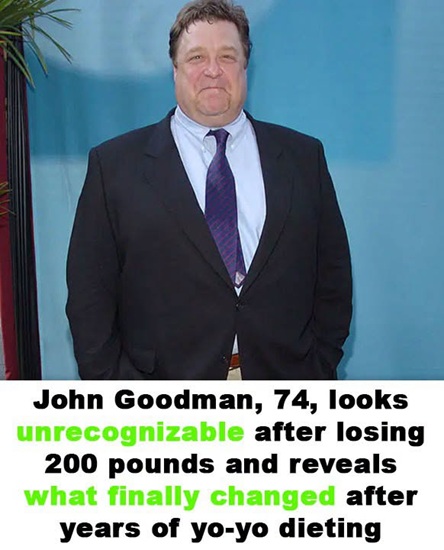
John Goodman has been a familiar presence on television and movie screens for decades, earning generations of fans through performances in Roseanne, The Big Lebowski, Monsters, Inc., The Conners and The Righteous Gemstones. In recent years, however, another part of the actor’s life has repeatedly attracted attention: his dramatic physical transformation. Now 74, Goodman has lost roughly 200 pounds compared with his heaviest years and has managed to maintain much of that change over a long period.
Recent photographs have once again surprised some people who remember Goodman primarily from his earlier roles. The difference is certainly striking, but describing his appearance as the result of a sudden transformation would be misleading. Goodman began making major changes many years ago, and his weight loss developed gradually rather than through a single crash diet or short-term program.
At his heaviest, Goodman has said he was approaching 400 pounds. For years, he struggled with a pattern familiar to many people attempting to manage their weight: he would make an intense effort, lose a significant amount, and eventually return to his previous habits.
Goodman has spoken candidly about that cycle. During breaks from Roseanne, he could sometimes lose 60 or 70 pounds. Instead of treating those changes as the beginning of a permanent routine, however, he said he would eventually reward himself and fall back into old patterns. The weight would return. Sometimes he would gain even more. Eventually, Goodman realized that repeating the same process was not producing the kind of lasting change he wanted.
The solution, at least for him, was not another temporary diet.
He needed to reconsider his everyday habits.
One particularly important change occurred when Goodman stopped drinking alcohol in 2007. He has spoken publicly about his previous difficulties with alcohol, and sobriety became an important part of the broader lifestyle changes he made during the years that followed.
Food was another major area of focus.
Goodman has described a previous habit of eating throughout the day without always paying close attention to hunger or portions. Over time, he became more deliberate about what and how much he ate.
Reports about his long-term program have described a Mediterranean-style approach emphasizing foods such as vegetables, fruit, fish, nuts and olive oil.
He also significantly reduced his sugar intake.
However, Goodman’s story should not be reduced to a particular list of foods.
The larger change involved consistency.
Instead of following an extremely restrictive plan for several months and then abandoning it, Goodman worked toward habits he could continue for years.
Physical activity became increasingly important as well.
Goodman worked with health and fitness coach Mackie Shilstone, who helped him develop a structured approach to exercise and nutrition.
At various stages, his routine reportedly included considerable amounts of walking, with daily step goals sometimes reaching around 10,000 to 12,000 steps.
He also used exercise equipment such as treadmills and elliptical machines.
Later, Goodman explored activities including boxing and walking his dogs.
The important point is that he kept moving.
Goodman has explained that age itself became one of his motivations. As he grew older, he became increasingly aware that remaining inactive was not helping him feel the way he wanted.
His acting career provided another incentive.
Film and television productions can involve long hours, travel and physically demanding schedules. Goodman said regular activity helped give him more energy for work.
His motivation was also deeply personal.
In a 2016 interview, Goodman described reaching a point where he had become tired of seeing himself continue down the same path.
He recalled looking in the mirror and realizing he did not want to continue living in a way he believed was becoming dangerous.
Rather than describing the transformation as an attempt to satisfy Hollywood’s expectations, Goodman framed it in terms of his own quality of life.
“I wanted to live life better,” he explained.
That distinction matters.
Goodman had already built an extraordinary career before losing the weight.
His talent was never dependent on becoming thinner.
As Dan Conner on Roseanne, Goodman became one of the most recognizable television fathers of his generation. His performance combined humor, frustration and warmth and helped make the character central to the show’s success.
Then came roles that demonstrated how much range he possessed.
In the Coen brothers’ The Big Lebowski, Goodman created the unforgettable Walter Sobchak, a character whose intensity and unpredictable personality became one of the film’s defining elements.
For another generation, Goodman’s most recognizable performance may not involve his face at all.
He voiced James P. “Sulley” Sullivan in Pixar’s Monsters, Inc., giving warmth and personality to the enormous blue creature.
His career continued through countless other films and television productions.
More recently, Goodman appeared as family patriarch Eli Gemstone in The Righteous Gemstones and continued playing Dan Conner in The Conners.
Throughout those later projects, audiences could gradually see his appearance changing.
By 2023, Goodman publicly discussed having lost approximately 200 pounds.
That figure attracted significant attention because it represented nearly half of his previously reported maximum weight.
But the number did not represent a transformation completed within a few months.
It represented years.
That timeline is one of the most important details when discussing Goodman’s experience accurately.
His weight-management journey was not perfectly linear either.
Goodman has acknowledged periods when he became less consistent with exercise.
Rather than presenting himself as someone who discovered effortless discipline, he has spoken in a way that recognizes the difficulty of maintaining habits indefinitely.
That makes the transformation considerably different from many dramatic celebrity weight-loss stories.
There was no single moment when the work ended.
Maintenance became part of the process.
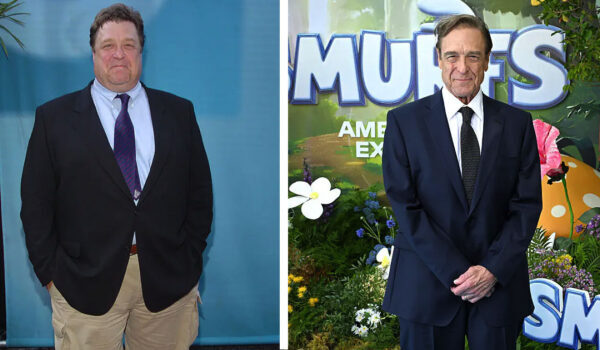
Goodman’s later public appearances demonstrated that he had managed to keep much of the weight off.
At the 2025 Los Angeles premiere of Smurfs, his slimmer appearance again attracted headlines.
In August 2026, another photograph generated renewed attention when actor David DeLuise encountered Goodman and shared a picture with him.
Some social-media users described Goodman as almost unrecognizable.
For longtime fans remembering his appearance during the early years of Roseanne, the difference was understandably dramatic.
But the photograph did not reveal a new or sudden weight loss.
It showed the continuation of a transformation that had already been visible for years.
That context also helps prevent misleading speculation.
Whenever a celebrity experiences substantial weight loss today, online discussions frequently assume that medications such as Ozempic, Wegovy or other GLP-1 drugs must be responsible.
Goodman has not publicly confirmed that these medications explain his transformation.
Attributing his weight loss to them without evidence would therefore be speculation.
The changes Goodman himself has publicly discussed include quitting alcohol, changing his eating habits, reducing sugar, increasing physical activity and working with a professional coach.
His transformation also began long before the current widespread public discussion surrounding GLP-1 weight-management medications.
Another point deserves emphasis: Goodman’s personal experience should not become a universal weight-loss prescription.
Bodies differ.
Medical histories differ.
Age, medications, genetics, sleep, mobility and numerous other factors can influence body weight.
Someone who needs or wants to lose a substantial amount of weight may benefit from individualized advice from qualified healthcare professionals rather than copying a celebrity’s routine.
There is also no need to treat Goodman’s former body as something deserving ridicule.
His earlier weight was part of his life, not a moral failure.
Similarly, his current appearance does not make him more valuable as an actor or person.
The meaningful aspect of his story is that Goodman himself wanted to change how he was living and found an approach he was able to sustain much longer than his earlier attempts.
Previously, he described losing substantial amounts and then returning to the habits that caused him to regain the weight.
Later, he approached the process differently.
He stopped treating weight loss as a temporary project.
Exercise became part of ordinary life.
Food choices became more deliberate.
Sobriety became a long-term commitment.
And setbacks did not automatically mean abandoning the entire effort.
That approach eventually produced the transformation audiences see today.
At 74, Goodman remains instantly connected with characters that span several generations of popular culture.
Older viewers may immediately think of Dan Conner.
Film fans may picture Walter Sobchak.
Families may hear Sulley’s voice.
More recent television audiences may know him as Eli Gemstone.
Across those decades, Goodman’s appearance has changed enormously.
His career, however, demonstrates that his presence on screen was never defined simply by his size.
That is perhaps the most useful perspective from which to understand the recent attention.
Yes, John Goodman lost approximately 200 pounds.
Yes, the difference between photographs taken decades apart is remarkable.
But this was not an overnight celebrity makeover.
It was a long process involving years of changes, previous failed attempts, greater physical activity, changes in eating habits and sobriety.
Goodman himself provided the clearest explanation for why he kept going.
He wanted to live better.
Rather than promising a secret formula or quick solution, his experience illustrates something much simpler: for Goodman, the changes that lasted were the ones he stopped treating as temporary.
Years after beginning that process, the results remain visible.
And while photographs may continue generating headlines about how different he looks, the more substantial achievement is not merely losing the weight.
It is that, after years of struggling with repeated cycles of loss and regain, Goodman found a way of living that he has been able to continue.

