
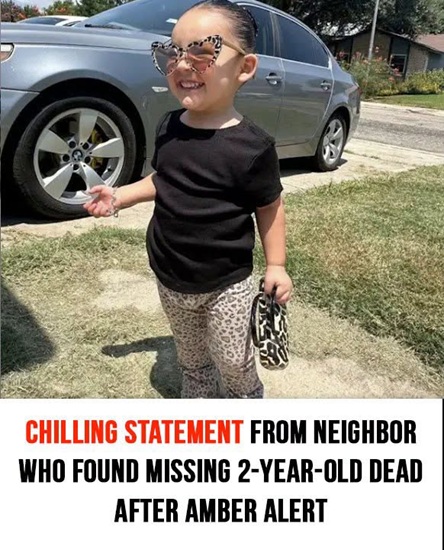
A San Antonio community was left grieving after the search for 2-year-old Aryana Trevino Martinez ended tragically. The toddler disappeared from the area around her home on Sunday evening, August 2, 2026, prompting an urgent search involving law enforcement officers, relatives and local residents. An AMBER Alert was issued as authorities worked to locate her. Several hours after she was reported missing, Aryana was found unresponsive in a nearby creek or drainage area and was later pronounced dead.
According to local reporting, San Antonio police responded at around 8 p.m. to the 4700 block of Allegheny Drive on the city’s Northwest Side after receiving the report of a missing child. Aryana had reportedly last been seen earlier that evening and was described as wearing a black shirt and leopard-print pants. Because she was only two years old, authorities and residents understood that finding her as quickly as possible was critical.
As investigators gathered information, surveillance footage provided clues about the direction Aryana may have traveled. Reporting from the San Antonio Express-News indicated that investigators believed the toddler may have left through a back gate. Doorbell-camera footage reportedly captured a young child walking through a nearby alley, apparently without shoes. Authorities began using the available information to reconstruct the route she might have taken.
The search quickly expanded beyond Aryana’s immediate family. Police officers searched the surrounding neighborhood while residents volunteered to help. Local reporting estimated that approximately 100 people eventually became involved. Darkness and difficult terrain made the effort especially challenging, with tall grass, brush and a creek or drainage area complicating visibility.
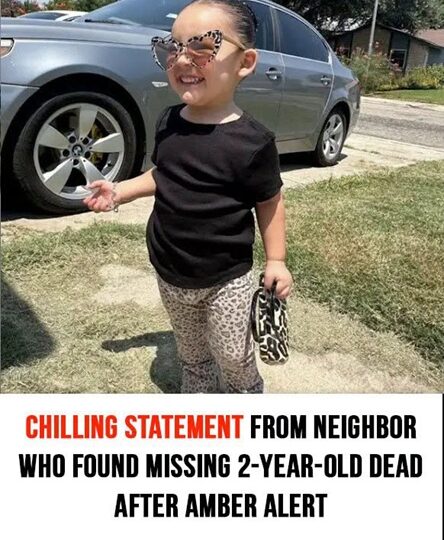
Among those who joined the search was 22-year-old neighbor Uriel Ramirez. His mother, Anna Marie Ramirez, later told KSAT that their family learned about the missing toddler and immediately felt they needed to help. They did not have to know Aryana personally to understand the urgency. A very young child was missing nearby, and neighbors were determined to search anywhere she might have wandered.
Uriel focused part of his search around the creek. The vegetation surrounding the area was difficult to navigate, particularly at night. According to the account later provided to local media, he climbed onto rocks to gain a better view of the water and surrounding terrain.
Then he saw something below.
Uriel realized he had found Aryana.
He entered the water and brought the toddler out. His mother later described the devastating moment when he returned and told her simply that he had found the missing child. The discovery ended hours of uncertainty, but it was not the outcome the family, police or volunteers had desperately hoped for.
Aryana was unresponsive when she was discovered. Emergency personnel responded, but she could not be saved. According to information reported from the Bexar County Medical Examiner’s Office, she was pronounced dead shortly after midnight Monday.
Uriel later struggled to explain what had prompted him to search that particular location. Speaking with KSAT, he said he felt as though something had directed him toward Aryana and described the experience as an unusually strong instinct about where he needed to look.
His statement should be understood as his personal interpretation of what he experienced, rather than as a conclusion established by investigators. There is no official finding that a supernatural force guided him to the toddler. What is established is that Uriel continued searching difficult terrain and ultimately located Aryana.
The discovery had a profound effect on him and his family.
For everyone involved, the search had begun with hope that Aryana would be located safely and returned to her relatives. Instead, a neighbor who had volunteered to help found himself facing an experience that would be difficult for anyone to process.
The tragedy also left residents asking how a two-year-old child could have traveled from her home to the location where she was eventually discovered. Local resident David Alcantar was among those who publicly expressed that question following the incident.
It is a natural question, but it is also one investigators are still responsible for answering.
Authorities have been examining how Aryana left the home area, the route she traveled and the circumstances surrounding her death. Until those inquiries are complete, it would be inappropriate to assign responsibility or speculate about whether another person contributed to what happened.
The location where Aryana was found has also been described somewhat differently in various reports. Some coverage referred to a creek, while other accounts described the area as a drainage ditch or brushy location near Belle Ellen Drive. Reports have also differed slightly regarding the precise distance from her home.
For that reason, claims that she was found exactly 500 yards away should be treated cautiously. Reliable local reporting has described the location as relatively close to her home, with the Express-News reporting a distance of approximately half a mile.
These differences are not unusual during the first days of a developing investigation. Early reports often rely on information gathered while police are still reconstructing events. The central sequence, however, has remained consistent: Aryana disappeared Sunday evening, authorities launched a search, an AMBER Alert was issued, and she was found unresponsive several hours later.
Another important question concerns the toddler’s cause of death.
As of the latest reliable reporting surrounding the case, authorities had not publicly announced a final determination establishing exactly how Aryana died. Although she was discovered in a creek or drainage area, that fact alone should not be converted into a definitive medical conclusion.
The Bexar County Medical Examiner’s Office is responsible for determining the cause and manner of death based on medical evidence. Until those findings are publicly released, statements claiming a specific cause should be avoided.
The same caution applies to assumptions about Aryana’s family.
The circumstances naturally raise difficult questions about how the child was able to leave the area around her home. But an unanswered question is not evidence of wrongdoing. Investigators must determine what happened based on surveillance footage, witness accounts, physical evidence and other relevant information.
In the days following Aryana’s death, grief spread throughout the Northwest Side community.
Residents who had searched for the toddler returned to the area under very different circumstances. Instead of carrying flashlights and calling her name, they gathered to remember her.
A candlelight vigil was held Tuesday evening near the area where she was found. Local reporting indicated that approximately 100 people attended. Family members, friends, neighbors and community members gathered with candles, flowers, balloons and stuffed animals.
The gathering provided people with an opportunity to mourn together.
For Aryana’s relatives, no community gathering could remove the enormity of losing a two-year-old child. Yet the turnout demonstrated how deeply her disappearance and death had affected people who had never met her before Sunday night.
The vigil also reflected the extraordinary community response that had developed during the search itself.
Neighbors left their homes and joined officers in looking through streets, alleys, grass and brush. Some had no connection to Aryana’s family. They simply knew that a toddler was missing and wanted to help.
Uriel Ramirez became one of the people most directly affected by that effort.
His description of feeling guided toward the location where he found Aryana has received substantial attention online. It is understandable why such a statement resonates emotionally, particularly after a tragedy involving a child.
Still, accuracy requires separating someone’s personal belief from scientifically or officially established information.
Uriel can accurately describe how the experience felt to him. Authorities can establish where Aryana was found and what evidence explains how she reached that location. Those are different kinds of statements and should not be presented as interchangeable facts.
Aryana’s case has also led to discussion about missing-child notification systems in Texas. Following the tragedy, local media examined the differences between an AMBER Alert and an Endangered Missing Persons Alert and how authorities determine which system is appropriate.
Such discussions may eventually contribute to greater public understanding of emergency alerts. For Aryana’s family, however, the immediate reality remains far more personal.
Their daughter disappeared.
A community searched for her.
Several hours later, she was found unresponsive.
Those facts are heartbreaking without adding speculation or sensational claims.
Because Aryana was only two years old, responsible reporting should also respect her dignity and her family’s privacy. Public interest in understanding the circumstances does not require spreading unsupported accusations or turning incomplete information into conclusions.
The investigation may eventually provide answers to the questions residents continue asking.
Authorities may establish more precisely how Aryana left the home area and what route she followed. Medical examiners may determine the exact cause and manner of her death. Additional surveillance footage or other evidence could also help investigators reconstruct her final hours.
Until then, those questions should remain questions.
What can currently be reported with confidence is that Aryana Trevino Martinez disappeared from her San Antonio neighborhood on Sunday evening, triggering an urgent search and AMBER Alert. Neighbor Uriel Ramirez joined that search and ultimately discovered her unresponsive in a nearby creek or drainage area several hours later.
He later described feeling strongly drawn toward the place where he found her.
That was his personal account of an extraordinarily difficult experience.
The community subsequently gathered for a candlelight vigil, remembering a little girl whose disappearance had mobilized neighbors throughout the area.
For the residents who participated in the search, Sunday night will likely remain difficult to forget. They began with the shared goal of bringing a missing child home safely and ended the night confronting a devastating loss.
Aryana’s family is now left with grief while investigators work to answer the questions surrounding what happened.
Until those answers arrive, the most respectful approach is also the simplest: remember the child, rely on verified information, allow investigators and medical professionals to complete their work, and avoid turning uncertainty into accusation.
Aryana was only two years old.
Behind every alert, police update and headline was a little girl whose family wanted her home.
And behind the continuing investigation is a community still trying to understand how an ordinary Sunday evening ended in such profound heartbreak.

