

The human brain is remarkably efficient at interpreting the world around us. Every second, our eyes collect enormous amounts of visual information, yet the brain processes only the details it considers most important. This extraordinary ability allows us to recognize familiar faces, identify objects, and react to changing environments within fractions of a second. Although this system works exceptionally well in everyday life, it can occasionally produce surprising errors.
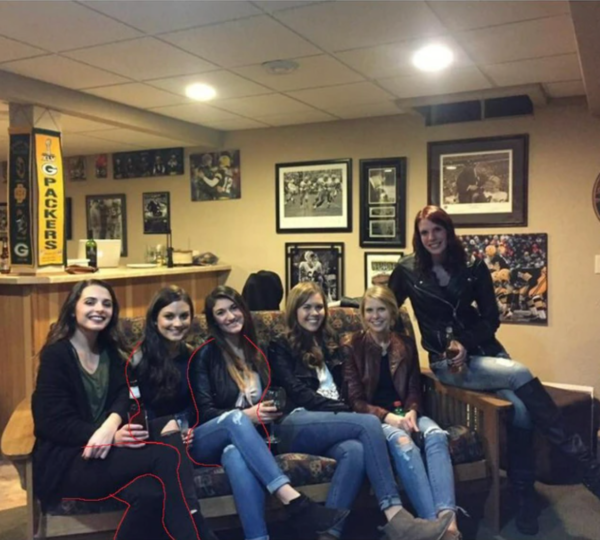
Optical illusions demonstrate that what we believe we see is not always an exact representation of reality but rather the brain’s best interpretation of available visual information. Among the many optical illusions shared online in recent years, one particular photograph has attracted widespread attention across social media platforms, discussion forums, and news websites. The image appears simple at first glance. It shows six young women sitting closely together on a sofa while smiling toward the camera.
However, after only a few seconds, many viewers notice something that seems impossible. Instead of clearly seeing six pairs of legs, the image appears to contain only five. This unusual observation has prompted millions of people to pause, look again, and attempt to understand what they are missing. The popularity of the image illustrates why optical illusions remain fascinating across cultures and generations.

Unlike puzzles that require mathematical calculations or specialized knowledge, visual illusions challenge one of our most fundamental abilities: perception. They remind us that seeing does not depend solely on healthy eyesight. Instead, perception results from continuous cooperation between the eyes and the brain, with each contributing important information before we consciously recognize what appears in front of us.
Scientists studying visual perception explain that the brain constantly searches for familiar patterns. Rather than analyzing every individual line, color, and shape independently, it groups visual elements together to create meaningful scenes. This process, sometimes described as predictive perception or pattern recognition, enables rapid decision-making. Without it, ordinary activities such as reading, driving, or recognizing friends would require significantly more time and mental effort. However, these same shortcuts occasionally create misunderstandings when images are carefully designed to challenge our expectations.
The photograph of the six women is an excellent example of this phenomenon. At first glance, the arrangement of clothing, body positions, and overlapping legs encourages the brain to combine separate visual elements into a simplified interpretation. Because several individuals are sitting very close together, certain legs partially overlap while others become visually aligned with neighboring bodies. Instead of carefully identifying which leg belongs to each person, the brain initially accepts the scene as complete, even though something appears inconsistent.
This type of misunderstanding is closely related to a psychological concept known as perceptual grouping. According to researchers, the brain naturally organizes nearby objects into coherent patterns based on proximity, similarity, and continuity. These organizational principles usually help people understand complex environments quickly. In specially designed photographs, however, they can cause unrelated visual elements to appear connected, producing illusions that seem impossible until examined more carefully.
Another important concept involved is selective attention. Human attention has limited capacity, meaning people cannot consciously analyze every detail within a complex scene simultaneously. Instead, attention shifts toward the most noticeable features, often overlooking smaller inconsistencies. In the viral photograph, many viewers initially focus on the faces, clothing, and overall composition rather than carefully tracing the position of each individual’s legs. As a result, the apparent mystery remains hidden despite being visible throughout the entire image.
Researchers have demonstrated similar effects through numerous psychological experiments over several decades. One of the best-known examples shows that people concentrating on one visual task frequently fail to notice unexpected events occurring directly in front of them. These findings suggest that perception depends as much on attention as it does on eyesight. The eyes may capture the information, but conscious awareness depends on whether the brain considers that information important enough to examine in detail.
The widespread popularity of visual puzzles also reflects the natural curiosity people have about their own minds. When an illusion challenges expectations, viewers often experience a brief moment of surprise followed by a strong desire to solve the mystery. That experience encourages closer observation, repeated examination, and discussion with others. For this reason, optical illusions frequently become viral on social media, where users enjoy comparing their interpretations and discovering details they initially overlooked.
Although many people describe optical illusions as tricks, neuroscientists emphasize that they actually demonstrate how efficiently the brain normally operates. Rather than exposing weakness, these puzzles reveal the remarkable speed with which the human mind organizes visual information. The occasional mistake is simply the result of a system designed to prioritize efficiency over exhaustive analysis. In everyday life, this balance serves people extremely well, even if it occasionally allows cleverly designed images to create temporary confusion.
The photograph featuring six women on a sofa therefore represents much more than an entertaining internet puzzle. It provides a practical example of how perception, attention, memory, and pattern recognition interact to create our understanding of the visual world. By slowing down and carefully examining each detail, viewers discover that the apparent mystery has a perfectly logical explanation. More importantly, they gain insight into the fascinating ways the human brain interprets information every single day.
As more people examined the now-famous photograph, discussions quickly spread across social media platforms, online forums, and psychology communities. Viewers offered different explanations for the apparent mystery, carefully tracing the position of each person’s legs and comparing their observations with others. While many initially believed that one pair of legs was somehow missing, closer inspection revealed that the illusion was created by perspective, overlapping body positions, and the brain’s tendency to group nearby visual elements together. The image itself had not been altered in an impossible way; instead, it successfully exploited the normal processes of human perception.
The explanation behind the illusion is surprisingly simple once the brain shifts its perspective. Several of the women are seated very close to one another, causing their legs to overlap almost perfectly from the camera’s angle. Differences in clothing, body posture, and the direction of each person’s legs make it difficult to immediately determine which legs belong to which individual. As viewers spend more time studying the image, the confusing arrangement gradually becomes easier to understand, and the apparent mystery disappears without any need for digital manipulation or hidden editing.
This moment of suddenly recognizing the correct arrangement is something neuroscientists often describe as a perceptual shift. At first, the brain organizes the information using one interpretation because it appears to fit the available visual clues. When additional details are noticed, however, the brain reorganizes the same information into a more accurate mental model. Nothing in the image changes—the only change occurs in the observer’s understanding. This process demonstrates how flexible and adaptable human perception can be when presented with new evidence.
Psychologists also associate these experiences with cognitive flexibility, an important mental ability that allows people to reconsider first impressions and adjust their thinking when new information becomes available. Cognitive flexibility plays a valuable role in everyday life, supporting learning, problem-solving, creativity, and decision-making. Observation challenges provide simple opportunities to exercise this ability by encouraging people to question initial assumptions instead of accepting the first explanation that comes to mind.
Visual puzzles have become especially popular in the digital age because they combine entertainment with curiosity. A single image can invite millions of people to pause, examine details carefully, and compare observations with friends or family. Unlike competitive games that require specialized knowledge, optical illusions are accessible to almost everyone regardless of age or educational background. This broad appeal explains why such images are frequently shared across social media and continue generating discussion long after they first appear online.
Researchers studying attention emphasize that these puzzles also demonstrate the limits of human concentration. Every moment, the brain receives far more sensory information than it can consciously analyze. To function efficiently, it filters information automatically and focuses on what appears most important. While this strategy allows rapid decision-making, it also means that unexpected details may temporarily escape conscious awareness. Optical illusions simply make this natural characteristic visible in a way that people can easily experience for themselves.
The practical value of careful observation extends well beyond visual puzzles. In medicine, physicians often review diagnostic images repeatedly to identify subtle changes that could influence treatment decisions. Engineers inspect equipment for small irregularities before they develop into larger problems. Pilots perform detailed safety checks before every flight, while scientists carefully analyze research data to ensure accurate conclusions. In each of these professions, paying attention to seemingly minor details contributes directly to successful outcomes and public safety.
Observation skills are equally useful in everyday situations. Reading important documents carefully, noticing changes in the environment, recognizing subtle facial expressions during conversations, or identifying small household problems before they become expensive repairs all rely on the same ability to observe details thoughtfully. Developing these habits encourages more careful decision-making while reducing the likelihood of overlooking important information.
Modern neuroscience continues to improve our understanding of how perception works. Using advanced brain imaging technologies, researchers can observe how different regions of the brain cooperate while people solve visual challenges. These studies suggest that perception involves not only the eyes but also memory, attention, previous experience, expectation, and decision-making processes. Together, these systems create the rich and efficient understanding of the world that most people experience every day.
Another valuable lesson provided by optical illusions is the importance of intellectual humility. Most people naturally trust what they see, yet these images demonstrate that first impressions can sometimes be incomplete. Recognizing this encourages a more thoughtful approach not only to visual information but also to learning, communication, and everyday decision-making. Taking a moment to examine evidence carefully before reaching conclusions is a habit that benefits many areas of life.
Ultimately, the viral photograph reminds us that the human brain is both extraordinarily powerful and wonderfully complex. Its remarkable ability to recognize patterns allows us to navigate daily life with incredible efficiency, yet those same mental shortcuts occasionally create surprising moments of confusion when presented with carefully arranged visual information. Rather than exposing a weakness, these illusions reveal the sophisticated processes that normally help us understand the world with remarkable speed.
Whether someone enjoys optical illusions simply as entertainment or appreciates them as demonstrations of cognitive science, they offer an engaging opportunity to explore how perception truly works. Every puzzle encourages curiosity, patience, and closer observation while reminding us that reality is often richer than our first glance suggests. By slowing down, examining details carefully, and remaining open to new perspectives, we strengthen skills that extend far beyond visual challenges and enrich the way we understand the world around us.

