
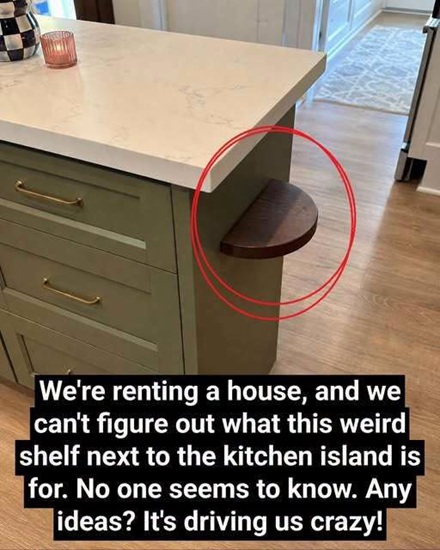
Kitchen islands have become one of the most recognizable features of modern homes. They often serve as the center of food preparation, casual dining, conversation, homework, and family gatherings. Because they are used for many different activities throughout the day, designers frequently include additional features intended to improve convenience, organization, and the overall flow of the kitchen. One feature occasionally found on traditional and transitional kitchen islands is a small rounded side shelf or curved extension attached to one end of the island.
At first glance, this rounded shelf may appear to be purely decorative. Its curved shape softens the appearance of the island and creates a smoother transition between the island and surrounding walkways. Rounded corners can also make large furniture pieces appear less bulky, particularly in kitchens where space is limited. While appearance is certainly one reason designers may include this detail, it is not necessarily the only purpose. In many homes, the shelf can also provide additional usable surface space for lightweight everyday items.
Unlike the primary countertop, which is usually reserved for meal preparation, cooking, or serving food, the side shelf can function as a secondary surface for objects that do not require direct access to the main work area. Some homeowners choose to place decorative items such as a small vase, framed photograph, seasonal decoration, cookbook stand, or houseplant on the shelf. Others use it for practical purposes, including temporarily placing keys, mail, sunglasses, or a reusable water bottle after arriving home.
Interior designers often encourage homeowners to think carefully about how different parts of the kitchen are used during everyday routines. Rather than allowing the main countertop to become crowded with miscellaneous belongings, creating designated locations for frequently used personal items can help maintain a cleaner workspace. Although the rounded shelf is not specifically designed as a universal “drop zone,” some households naturally find that it serves this purpose because it is separate from the primary food preparation surface.
Another practical advantage is improved organization while cooking. During meal preparation, keeping ingredients, cutting boards, and kitchen utensils together on the main countertop allows work to proceed more efficiently. Meanwhile, personal belongings such as mobile phones, wallets, notebooks, or unopened mail can remain on the side shelf instead of occupying valuable preparation space. This separation may also help reduce unnecessary clutter around food preparation areas.
The shelf may also become useful when family members or guests gather around the island. Kitchen islands often serve as informal meeting places where people enjoy coffee, conversations, or light snacks while someone prepares a meal. A small auxiliary shelf can provide convenient space for a cup, a small serving dish, folded napkins, or other lightweight items without interfering with the cook’s primary workspace. The exact use depends entirely on the available space and the household’s daily habits.
From a design perspective, curved shapes can influence how furniture is perceived within a room. Straight lines and sharp corners often create a more formal or contemporary appearance, while rounded elements may contribute to a softer visual transition. In kitchens with narrow walkways, curved edges may also reduce the likelihood of bumping into sharp countertop corners during everyday movement, although homeowners should always ensure adequate walking space regardless of countertop shape.
The construction of these shelves varies considerably between manufacturers. Some are supported by cabinets underneath, while others extend outward using concealed brackets or structural supports integrated into the island. Because construction methods differ, the amount of weight a particular shelf can safely support also varies. Homeowners should therefore follow the manufacturer’s recommendations rather than assuming every decorative shelf is intended to hold heavy appliances or large storage containers.
In many professionally designed kitchens, visual balance is just as important as functionality. A shelf crowded with numerous unrelated objects can make even a spacious kitchen appear cluttered. For that reason, many interior designers recommend displaying only a few carefully selected decorative pieces or keeping the shelf available for temporary everyday use. This approach allows the feature to remain visually attractive while still providing practical flexibility whenever additional surface space is needed.
Ultimately, the small rounded shelf is best understood as a versatile design feature rather than a component with one fixed purpose. Depending on the home’s layout, it may serve decorative, organizational, or practical functions—or a combination of all three. The most effective use is the one that complements the homeowner’s daily routine while preserving a comfortable, organized, and functional kitchen environment.
A small rounded shelf can become more useful when it is treated as a limited-purpose surface rather than an additional storage cabinet. Its size usually makes it better suited to lightweight objects that are used briefly or displayed intentionally. A small bowl, a compact vase, folded napkins, or a frequently used personal item may fit comfortably without making the shelf appear crowded. The goal is to preserve access and visual balance instead of filling every available centimeter.
One of the simplest ways to use the shelf is as a temporary landing place for items carried into the kitchen. Keys, sunglasses, or a phone may be placed there for a short period, particularly when the main countertop is being used for cooking. This arrangement can help separate personal belongings from ingredients and utensils. However, households that regularly accumulate mail, receipts, and packages may benefit from adding a proper organizer elsewhere so that the shelf does not become a permanent pile of clutter.
Food-safety considerations are also relevant when deciding what belongs on the shelf. Personal items such as phones, wallets, handbags, and keys can carry dirt from frequently touched public surfaces. Keeping them away from cutting boards and areas where food is prepared may support cleaner kitchen habits. The small shelf can provide some separation, but it should still be cleaned regularly, especially if it is close to cooking activity or is sometimes used for serving food.
When the shelf is used for beverages or snacks, stability becomes important. Cups and glasses should be positioned well away from the curved outer edge, where they may be easier to knock over. A small nonslip coaster or tray can help contain spills and keep several light items together. Any serving piece should fit fully on the surface rather than extending into the walkway, where it could be struck by a passing person.
The shelf may also be useful during informal gatherings, although it should not be treated as a substitute for a full serving station. A bowl of wrapped snacks, a stack of napkins, or a small plate of appetizers may be appropriate when space permits. Hot cookware, sharp utensils, unstable bottles, and heavy serving dishes are generally better placed on a larger, more secure countertop. This reduces the risk of spills, burns, or damage to the shelf.
Households with children should consider both the height and location of the extension. A low shelf near a walkway may be within easy reach of a young child, making candles, glass objects, medicines, alcohol, knives, or small choking hazards unsuitable choices. Decorative items should be stable and difficult to pull down. If the shelf projects into an active route through the room, keeping it mostly clear may be the safest and most practical option.
Pets create another set of considerations. Food placed on a low side shelf may be accessible to a dog or other animal, and certain common foods can be harmful to pets. Plants should also be chosen carefully because some popular houseplants are toxic if chewed. A shelf that looks attractive with greenery may therefore require a pet-safe plant, a secure container, or a different decorative approach altogether.
Before placing an appliance on the extension, homeowners should verify its load capacity. Coffee makers, stand mixers, air fryers, and large ceramic containers may be heavier than they appear, particularly when filled. A cantilevered shelf with hidden supports may have very different limits from one resting on a cabinet or decorative leg. Visible sagging, loose fasteners, cracks, movement, or separation from the island are signs that the shelf should be emptied and inspected.
Electrical use also requires care. A shelf near an outlet may seem convenient for charging a phone or operating a small device, but cords should not cross walkways, cooking surfaces, sinks, or hot appliances. Extension cords should not be treated as permanent kitchen wiring, and damaged chargers should not be used. Where a charging station is desired, a licensed electrician or qualified installer can help determine whether a safer built-in solution is appropriate.
Decoration works best when the size of the object matches the scale of the shelf. A single small arrangement often looks more intentional than a collection of unrelated pieces. A short vase, modest plant, candle used only under supervision, or seasonal ornament may soften the island without obstructing movement. Very tall decorations can block sightlines, while wide objects may make a compact shelf appear even smaller.
The finish of the shelf should guide cleaning and maintenance. Stone, sealed wood, laminate, and painted surfaces require different products and levels of moisture. Abrasive cleaners may scratch some materials, while prolonged exposure to water can damage unsealed wood or cabinet joints. Cleaning instructions supplied by the countertop or cabinet manufacturer are safer than using a strong household product without checking its compatibility.
Spills should generally be wiped up promptly, especially when the shelf is made from natural stone or wood. Coffee, wine, oil, citrus juice, and strongly colored foods may stain or affect certain surfaces if left in place. Coasters, trays, and small protective pads can reduce wear, but they should be lifted periodically so moisture and debris do not collect underneath. Regular inspection also helps identify loose supports or deterioration before the problem becomes serious.
The curved shape itself can improve circulation in some layouts, but it cannot correct inadequate spacing around an island. Kitchen walkways need enough room for people to pass, open appliances, and work safely. If the shelf repeatedly catches clothing, bags, or elbows, the problem may be excessive decoration, unsuitable furniture placement, or an island that is too large for the available area. A qualified kitchen designer can assess the layout more accurately than general online advice.
Not every rounded extension is technically a shelf. Some designs are intended as display ledges, countertop transitions, breakfast-bar supports, decorative end caps, or components of custom cabinetry. Others may have been added during a renovation without a documented purpose. Looking underneath the feature, checking original plans, or contacting the installer may provide more reliable information about what it was built to do.
Homeowners planning a renovation should decide how they want the feature to function before it is constructed. Someone who needs a charging area may require outlets and cable management. A household that wants display space may prefer integrated lighting or a finish that matches nearby cabinetry. Those seeking additional food-preparation space may be better served by a larger continuous countertop instead of a narrow decorative extension.
Accessibility should also influence the design. A shelf that protrudes into a pathway can create difficulties for someone using a wheelchair, walker, or mobility aid. Rounded edges may reduce the severity of an accidental impact, but sufficient clearance remains essential. Designers should consider the needs of everyone who uses the room rather than relying only on appearance.
For renters or homeowners who cannot alter the island, removable organizers may improve usefulness without permanent construction. A small tray can define the area and make it easier to clear when needed. Adhesive accessories should be selected carefully because they may damage paint, laminate, or wood finishes. The property owner or lease terms should be consulted before drilling, attaching hardware, or making structural changes.
There is no requirement that the shelf be occupied at all times. Leaving it empty can highlight the island’s shape, maintain an open walkway, and provide flexible space when guests arrive or cooking becomes busy. In many rooms, an uncluttered surface looks more deliberate than one filled simply because space is available. Functionality sometimes comes from preserving empty space rather than assigning it a permanent object.
A useful household routine is to clear the shelf at the end of each day. Items that belong elsewhere can be returned to drawers, entryway organizers, offices, or charging stations. This prevents the surface from gradually becoming a collection point for objects with no permanent home. A brief routine may be more effective than purchasing additional organizers that eventually become cluttered themselves.
It is also helpful to distinguish between temporary use and long-term storage. A coffee cup placed there during a conversation is different from leaving stacks of paperwork on the shelf for weeks. Temporary use allows the feature to remain adaptable, while permanent accumulation reduces its value and may interfere with cleaning. Assigning a clear rule, such as “only items being used today,” can make the space easier to manage.
The shelf should never be used as a seat, step, handhold, or support for a person’s body unless it was specifically engineered for that purpose. Leaning heavily on an unsupported extension may loosen brackets, damage cabinetry, or cause sudden failure. Children should not be allowed to climb or hang from it. Even a shelf that appears solid may not have been designed for dynamic loads.
Ultimately, the best use depends on the household rather than an alleged hidden design secret. In one kitchen, the extension may hold a small decorative object. In another, it may temporarily support a drink, phone, or napkins. A third household may choose to leave it completely clear. All of these uses can be reasonable when they match the shelf’s construction, location, and the needs of the people using the room.
The broader lesson is that successful kitchen design comes from observing daily behavior and assigning space thoughtfully. Small architectural details can improve convenience, but only when they are used safely and without exaggerated expectations. A rounded island shelf does not solve every organization problem, yet it can provide flexible, attractive surface area when treated with restraint and care.
Rather than viewing the feature as wasted space or assuming it has one secret purpose, homeowners can evaluate it practically. They can consider weight, traffic flow, hygiene, accessibility, cleaning, and the objects they genuinely use each day. That measured approach preserves both the appearance of the island and the overall function of the kitchen.

