
Optical illusions have fascinated people for generations because they demonstrate something remarkable about the human brain: two individuals can look at exactly the same image and notice different details within the first few seconds. These differences often spark curiosity, friendly discussions, and debates about why our minds process visual information in different ways. Although many online personality quizzes claim to reveal hidden truths based on what someone notices first, psychologists generally caution that such activities should be understood primarily as entertaining exercises rather than scientifically validated psychological tests.
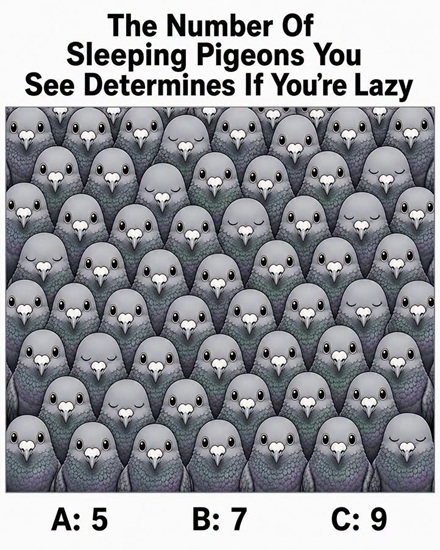
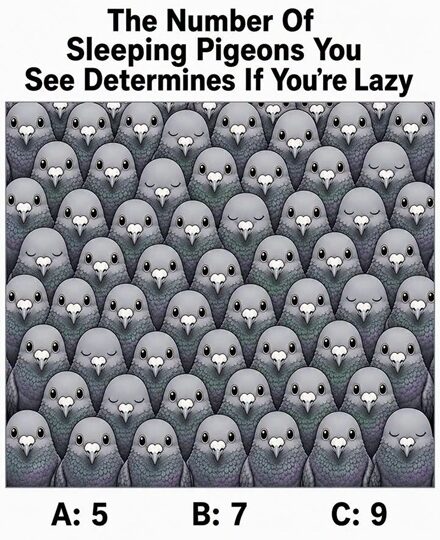
One popular illusion asks viewers to count the number of sleeping pigeons—or birds—that they can immediately identify in a complex illustration. Social media posts often attach bold claims to the results, suggesting that seeing a certain number of birds means someone is exceptionally intelligent, highly observant, naturally optimistic, or destined to become a leader. While these descriptions may be enjoyable to read, researchers emphasize that there is currently no scientific evidence showing that counting birds in a single image can accurately measure personality, intelligence, leadership ability, or future success.
What the exercise can demonstrate is how visual attention works. Human vision does not record every detail equally. Instead, the brain constantly filters enormous amounts of incoming information, selecting what appears most relevant at a particular moment. This process, known as selective attention, allows people to focus on important tasks without becoming overwhelmed by countless visual details. Because every person’s experiences, expectations, and current focus differ slightly, individuals may naturally notice different parts of the same picture before others.
Scientists studying perception explain that the brain actively interprets visual information rather than simply copying what the eyes receive. Our previous experiences, expectations, lighting conditions, and even temporary distractions can influence what stands out first in an image. This is one reason optical illusions remain valuable educational tools. They illustrate that perception is not always a perfect representation of reality but instead reflects the brain’s effort to organize complex visual information into meaningful patterns as efficiently as possible.
Many viral social media posts describe these images as “psychological tests” or “subconscious personality scanners.” However, professional psychologists distinguish between entertaining visual puzzles and standardized psychological assessments. Clinical personality tests undergo years of scientific research to evaluate their reliability and accuracy across large populations. Optical illusions designed for social media do not follow those rigorous scientific standards and therefore should not be interpreted as diagnostic tools or definitive measures of character.
That does not mean such images are without value. On the contrary, they encourage people to slow down, observe carefully, compare perspectives, and discuss how perception differs from person to person. They also provide an opportunity to learn about important psychological concepts such as attention, perception, pattern recognition, and cognitive processing. Rather than revealing fixed personality traits, these activities remind us that our brains constantly make rapid judgments while interpreting the world around us.
For example, someone who immediately notices several birds may simply have focused on a particular section of the illustration first, while another viewer may naturally scan the image from a different direction or at a different pace. Lighting, screen size, viewing distance, visual experience, and even whether someone has seen similar illusions before can all influence the initial count. None of these factors necessarily reflects intelligence, creativity, leadership ability, or emotional characteristics.
Researchers in cognitive psychology continue studying how humans recognize objects, detect patterns, and allocate visual attention. These investigations have practical applications far beyond puzzles, including medicine, aviation, education, transportation safety, and computer vision technologies. Understanding how people process visual information helps scientists improve warning systems, develop better educational materials, and design environments that support faster and more accurate decision-making.
Another reason these visual puzzles remain popular is that they encourage self-reflection. Even though the personality descriptions accompanying many online quizzes are not scientifically validated, readers often enjoy considering whether certain characteristics sound familiar. This process can spark thoughtful conversations about individual strengths, habits, and ways of approaching everyday challenges. When viewed in that spirit—as an enjoyable conversation starter rather than a factual psychological diagnosis—the activity becomes both entertaining and educational.
It is also worth remembering that personality itself is far more complex than any single image could measure. Modern psychology recognizes that personality develops through a combination of genetics, life experiences, education, relationships, environment, and countless individual experiences over many years. No single photograph, optical illusion, or quick internet quiz can accurately summarize the richness of an individual’s character or predict how they will respond in every situation.
Ultimately, the real value of bird-counting illusions lies not in assigning labels but in encouraging curiosity about how the human mind works. They remind us that perception is an active process shaped by attention, experience, and context. While every viewer may begin by noticing something slightly different, the shared experience of exploring the image often becomes far more interesting than the number itself—and that may be the most meaningful lesson these illusions have to offer.
Although there is no scientific evidence that the number of birds someone identifies in an optical illusion reveals their personality, psychologists acknowledge that activities like these can encourage people to think about how they observe the world around them. Rather than providing definitive conclusions about character, they offer opportunities to reflect on individual habits of attention, perception, and decision-making. When interpreted responsibly, these exercises become enjoyable demonstrations of how differently human minds process the same visual information.
Some viewers quickly focus on the overall structure of an image before noticing smaller details. Others naturally examine one section at a time, carefully searching for hidden shapes or subtle visual cues. Neither approach is inherently better than the other. Different strategies may simply reflect the way individuals temporarily allocate their visual attention during a specific task. Factors such as fatigue, lighting, screen size, previous experience with puzzles, and even the amount of time spent looking at the image can influence what someone notices first.
Researchers studying visual perception explain that the brain constantly balances two complementary processing styles. One emphasizes the overall pattern or “big picture,” while the other concentrates on individual details. Most people naturally shift between these approaches depending on the situation they are facing. For example, recognizing a familiar face in a crowd often relies on rapid pattern recognition, whereas proofreading a document typically requires close attention to small details. Everyday life regularly demands both kinds of thinking.
This flexibility helps explain why perception can vary even for the same person. Someone who counts five birds during an initial glance might identify additional birds after examining the illustration more carefully. That change does not necessarily indicate a shift in personality; instead, it reflects how attention evolves as more time is devoted to observing the image. Visual perception is an active process that continuously updates as new information becomes available.
Many viral internet posts attach specific personality descriptions to different bird counts, suggesting that one result represents optimism while another reflects analytical thinking or balanced judgment. Although these descriptions may sound appealing, psychologists generally caution against interpreting them as scientific conclusions. Human personality is influenced by numerous biological, psychological, social, and environmental factors that cannot be measured accurately through a single visual puzzle. Responsible interpretation requires distinguishing entertainment from evidence-based psychological assessment.
Nevertheless, these illustrations continue to attract millions of participants because they encourage curiosity about how the brain works. They remind us that people often notice different aspects of the same situation, both in pictures and in everyday life. This diversity of perception can be valuable. Teams solving complex problems frequently benefit when individuals contribute different perspectives, observations, and approaches instead of all noticing exactly the same thing.
The popularity of optical illusions has also encouraged greater public interest in cognitive psychology and neuroscience. Scientists continue investigating how the brain recognizes patterns, filters information, interprets visual signals, and constructs meaningful representations of the surrounding world. Findings from these fields contribute to advances in medicine, education, transportation safety, computer vision, and many other disciplines where understanding human perception is important.
For educators, optical illusions can serve as useful teaching tools because they demonstrate that perception is not simply a passive recording of reality. Instead, the brain actively organizes incoming information based on previous experiences, expectations, context, and attention. This concept helps explain why eyewitness accounts, first impressions, and rapid judgments should sometimes be interpreted cautiously, especially when important decisions depend on complete and accurate information.
Another valuable lesson from these exercises is the importance of remaining open to alternative perspectives. Discovering that another person notices different details in the same image encourages respectful discussion and curiosity rather than immediate assumptions. In many professional and personal situations, listening to different viewpoints can improve understanding and reduce misunderstandings. Visual puzzles offer a simple reminder that multiple observations may coexist without one necessarily being incorrect.
Ultimately, the greatest value of optical illusions is not discovering a hidden personality label but developing greater appreciation for the remarkable complexity of human perception. They encourage careful observation, thoughtful discussion, and curiosity about the extraordinary ways our brains interpret visual information. While the exact number of birds someone notices may differ from one viewer to another, the experience itself demonstrates something genuinely fascinating: every human mind processes the world in its own unique way.
Rather than viewing these images as tests that define who we are, it is more accurate to see them as invitations to explore how perception works. Science shows that attention, experience, context, and cognitive processing all contribute to what we notice first. Understanding those principles helps us become more thoughtful observers, more careful decision-makers, and more appreciative of the many different ways people experience the world around them.

