

An 18-year-old traveler from New Zealand has become the focus of international attention after being arrested in Thailand over allegations involving a wristwatch left behind at an airport security checkpoint. The case has drawn widespread interest because the item involved was reportedly worth less than $100, yet the legal consequences under Thai law are significantly more serious than many travelers might expect. It has also highlighted the importance of understanding that laws and legal procedures can vary considerably from one country to another.
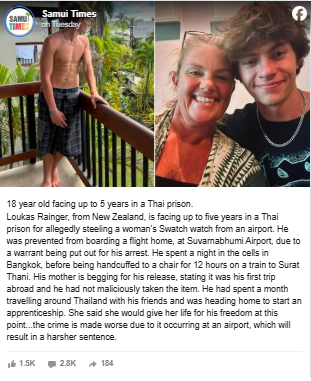
As of the latest public reports, the legal proceedings remain ongoing, and no final verdict has been reached. According to publicly reported court documents and statements from those involved, Loukas Rainger, an 18-year-old from Tauranga, New Zealand, had been traveling across Thailand with a friend for approximately one month. The trip was intended to be his first major overseas adventure before beginning an electrician apprenticeship back home. Family members described the holiday as an opportunity to experience another culture and enjoy time abroad before starting the next stage of his education and career.
The incident at the center of the investigation reportedly occurred on July 3 at Surat Thani Airport in southern Thailand. Authorities allege that another passenger removed her silver Swatch wristwatch while passing through airport security and accidentally left it behind in an inspection tray. Investigators say security camera footage later showed Rainger collecting his belongings and leaving the checkpoint with the watch. After the owner reported it missing, police reviewed surveillance footage and eventually obtained an arrest warrant. These allegations remain part of an active legal case and have not yet resulted in a final court judgment.

Rainger was reportedly unaware that an investigation had been opened. Nearly two weeks later, while preparing to fly home through Bangkok’s Suvarnabhumi Airport, immigration officers stopped him before departure and informed him that there was an outstanding warrant connected to the earlier incident. Instead of boarding his scheduled flight, he was taken into custody by Thai authorities. According to reports, the arrest came as a surprise to both the teenager and his family.
His mother, Natasha Rainger, later described the experience as deeply distressing. In interviews with New Zealand media, she said her son told her he had been “completely confused” when officers informed him of the allegations. She stated that he maintained he had not intended to steal anyone’s property and believed the watch had been collected together with his own belongings during the security screening. Her comments represent the family’s account of the events and should not be interpreted as findings of fact by the court.
Following his arrest in Bangkok, Rainger was reportedly held overnight before being transported back to Surat Thani for questioning. His mother told reporters that he spent many hours handcuffed during the transfer before eventually being interviewed by investigators. Court documents reported by New Zealand media indicate that he denied the allegations during questioning. The investigation then proceeded under Thailand’s legal system, where cases involving alleged offenses at airports may carry penalties different from ordinary theft cases.
Rainger’s lawyer explained that the charge being investigated is legally classified as theft at an airport, an offense that can carry significantly higher penalties than ordinary theft under Thai law. Public reports state that, if convicted, the maximum penalty could include up to five years in prison along with a financial penalty. However, it is important to note that a maximum possible sentence is not the same as an actual sentence, and any outcome depends on the evidence presented and the court’s eventual decision.
The reported value of the watch has also attracted attention. According to family statements cited by multiple news outlets, the silver Swatch watch was estimated to be worth approximately US$80 to US$100. While the monetary value has been widely discussed, legal experts have noted that criminal cases are determined by applicable laws rather than by the item’s value alone. Consequently, the seriousness of the proceedings reflects the legal classification of the alleged offense rather than simply the cost of the watch itself.
As news of the case spread, Rainger’s family worked to obtain legal representation and understand the procedures required under Thai law. His mother described the situation as overwhelming and emotionally exhausting, saying she had struggled to sleep while trying to secure assistance for her son. Family members also sought support from New Zealand authorities and legal professionals familiar with Thailand’s judicial system while waiting for decisions regarding detention and possible bail.
Reports also indicated that an apology was delivered to the owner of the watch after it had been returned. According to the lawyer involved in the case, the owner accepted the written apology, and arrangements regarding financial compensation were discussed. However, those developments did not automatically end the legal proceedings because criminal investigations remain subject to the decisions of the relevant authorities and courts.
The case has generated discussion among international travelers because it illustrates how unfamiliar legal systems can produce outcomes that surprise visitors. Legal experts often encourage travelers to become familiar with the laws of the countries they visit, particularly regarding airports, customs procedures, and security checkpoints. Understanding local regulations, carefully checking personal belongings before leaving screening areas, and immediately reporting any uncertainty to airport staff can help reduce the risk of misunderstandings during international travel.
At the time of writing, the case remains before the Thai courts, and no final verdict has been announced. Because legal proceedings are still underway, it is important to distinguish between allegations, statements made by family members, and facts that have been officially confirmed by the authorities. Future court hearings will determine the legal outcome based on the evidence presented through Thailand’s judicial process.
Following several days in custody, Loukas Rainger’s family continued working with legal representatives in Thailand in an effort to secure his temporary release while the case proceeded through the country’s judicial system. According to multiple published reports, the process required extensive legal documentation, communication with local authorities, and financial guarantees before bail could be granted. The case attracted considerable attention in both Thailand and New Zealand because it involved a young traveler facing serious legal proceedings in a foreign country, far from his family and familiar support network. (sunlive.co.nz)
Court proceedings eventually allowed Rainger to be released on bail after approximately 3,000 US dollars was provided as part of the conditions established by the Thai court. News reports described an emotional reunion between Loukas and his mother after several difficult days apart. Natasha Rainger later told reporters that seeing her son again after his release was one of the most emotional moments of her life. Her comments reflected the family’s personal experience during the legal process and not the outcome of the criminal case itself, which remains unresolved. (sunlive.co.nz)
Despite being released from detention, the legal process did not end. Under the bail conditions reported by New Zealand media, Loukas and his mother were required to remain in Thailand while the investigation and court proceedings continued. Reports stated that they secured accommodation on the island of Ko Samui and were instructed to report regularly to local police as required by the court. Such bail conditions are designed to ensure that defendants remain available for future hearings while legal proceedings continue. (sunlive.co.nz)
The case also received attention because of the significant difference between the reported value of the watch and the potential legal penalties associated with the alleged offense. Legal professionals familiar with Thai criminal law have explained that offenses committed within airports may fall under specific legal provisions that differ from ordinary theft cases. As a result, public discussion has frequently emphasized that legal consequences are determined by the applicable laws rather than solely by the financial value of the property involved. Any sentence, however, would only follow a conviction after judicial proceedings have been completed. (ladbible.com)
Throughout the proceedings, Loukas’ legal team continued presenting his position regarding the incident. According to statements reported by the media, his lawyer indicated that the teenager maintained he had not intended to steal the watch and that the circumstances surrounding the collection of his belongings at the airport security checkpoint would form part of his defense. These statements represent the defense’s position and should not be interpreted as findings made by the court. The final determination of the facts remains the responsibility of the Thai judicial system. (ladbible.com)
Public reports also indicated that the watch had been returned to its owner and that Loukas had provided a written apology. According to comments attributed to his mother, the owner accepted both the apology and proposed financial compensation. Nevertheless, criminal proceedings were not automatically discontinued because, under many legal systems, the return of property or compensation does not necessarily eliminate criminal liability if authorities determine that a criminal offense may have occurred. Whether those circumstances influence the final outcome is a matter for the court to consider under applicable law. (sunlive.co.nz)
The situation has prompted broader discussion about international travel and the importance of remaining attentive when passing through airport security. Security checkpoints often require travelers to remove watches, phones, wallets, electronics, and other personal belongings, sometimes placing them together in trays used by multiple passengers within a short period of time. Travel experts commonly recommend checking every item before leaving the screening area and immediately informing security personnel if any uncertainty exists regarding personal belongings or property that may have been left behind.
Legal experts also note that criminal procedures differ significantly from one country to another. Travelers are generally encouraged to familiarize themselves with local laws before visiting another country, particularly when traveling through airports, border crossings, or customs facilities. Understanding local regulations, respecting instructions provided by airport authorities, and seeking assistance whenever confusion arises can help reduce the likelihood of misunderstandings during international travel.
For Loukas Rainger and his family, the weeks following the arrest have reportedly been marked by uncertainty as they await future court hearings. His mother has publicly described the emotional strain of remaining overseas while supporting her son through unfamiliar legal procedures. At the same time, the legal process continues independently of public opinion, with the courts responsible for evaluating the evidence presented by both prosecutors and the defense before reaching any final decision.
Cases involving foreign visitors frequently attract international attention because they illustrate the challenges that can arise when legal systems, languages, and procedures differ from those familiar to travelers. At the same time, legal experts consistently emphasize the importance of respecting judicial processes and avoiding assumptions before courts have completed their review of the evidence. The principle that a defendant is presumed innocent until proven guilty remains an important part of fair legal proceedings in many jurisdictions.
As of the latest publicly available reports, no final judgment has been announced in Loukas Rainger’s case. The court proceedings remain ongoing, and any future outcome will depend on the evidence examined during the judicial process. Until a final decision is issued, it is important to distinguish between allegations, statements made by those involved, and facts confirmed through official court proceedings. Responsible reporting requires acknowledging that the legal process is still active and that the ultimate resolution has not yet been determined.
Beyond the individual circumstances of this case, the story serves as a reminder of the importance of careful attention while traveling internationally. Small oversights at airports can sometimes lead to complex legal situations, particularly when travelers are unfamiliar with local laws and procedures. Remaining attentive, communicating promptly with airport staff whenever uncertainty arises, and respecting local regulations are practical steps that may help travelers avoid unnecessary complications while abroad.

