
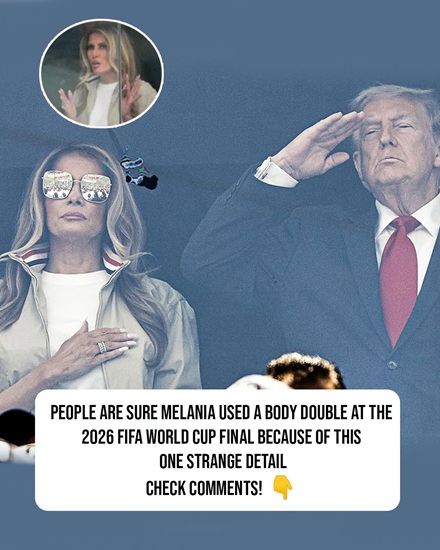
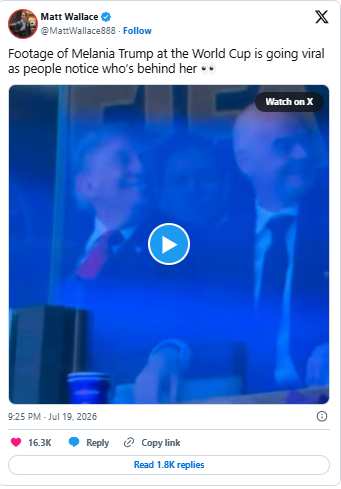
As the video continued circulating across social media platforms, attention increasingly shifted away from the football match itself and toward the brief moments captured inside the VIP seating area. Millions of viewers watched short clips, paused individual frames, and shared screenshots while offering their own interpretations of what they believed they had noticed. Although the footage generated significant online engagement, many of the claims circulating alongside the video were based on speculation rather than verified information.
This distinction became especially important as the discussion spread across multiple platforms and reached audiences around the world. One of the most widely shared topics involved an unidentified woman seated several rows behind Melania Trump. Various social media posts questioned her identity and suggested different theories about why she appeared in the background of the video.
However, no official source identified the woman, and no publicly available evidence indicated that her presence was connected to anything unusual. As a result, responsible reporting has distinguished between verified facts—such as the attendance of invited guests—and unsupported speculation that emerged through online discussion.
Another claim that gained attention suggested that the woman visible in the foreground was not actually Melania Trump but a body double. Similar theories have appeared online for many years whenever photographs or videos show her from unfamiliar angles. However, no credible evidence has supported those claims. Experts who study misinformation have repeatedly noted that lighting conditions, camera lenses, facial expressions, sunglasses, image quality, and viewing angles can significantly alter how a person appears in photographs and video recordings. Previous fact-checks have likewise found no evidence supporting longstanding body-double claims.
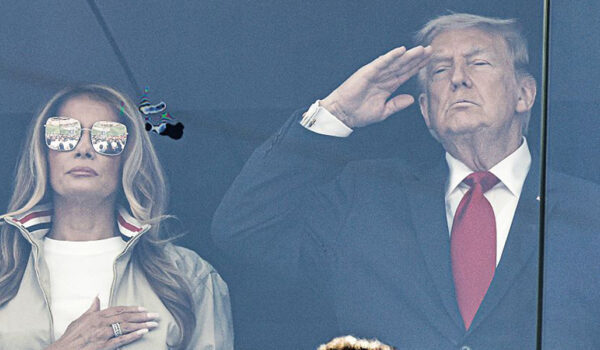
The unusual appearance of Melania’s oversized mirrored sunglasses became another talking point. Reflections from stadium lighting combined with the blue illumination inside the VIP suite created visual effects that some viewers described as unusual or futuristic. Photography specialists frequently explain that reflective lenses can distort facial features depending on the surrounding light, camera angle, and image compression used when videos are shared online. These optical effects can sometimes contribute to misunderstandings, particularly when short clips are viewed without broader context.
Despite the attention surrounding social media speculation, the official purpose of the event remained the 2026 FIFA World Cup Final. Melania Trump attended alongside President Donald Trump, FIFA President Gianni Infantino, and numerous international dignitaries who gathered to watch Spain defeat Argentina after extra time. The event represented one of the largest sporting occasions of the year, bringing together political leaders, athletes, entertainers, and guests from many countries to celebrate the conclusion of the tournament.
Melania Trump has frequently attracted attention for her fashion choices during public appearances, and the World Cup final was no exception. Fashion commentators noted her light-colored jacket, white top, and oversized mirrored sunglasses, with many describing the overall look as a blend of casual sporting style and formal elegance appropriate for an international event. As has often been the case throughout her years in public life, discussions about her appearance quickly spread across entertainment and fashion media.
The World Cup appearance also followed another widely discussed public appearance at the White House earlier in the summer. On that occasion, photographs of Melania Trump generated numerous online comments regarding her outfit and appearance. Public figures often experience this level of scrutiny, particularly when attending internationally televised events where images are shared widely across news organizations and social media platforms. While fashion remains a common subject of discussion, speculation regarding a person’s appearance should not be confused with verified factual reporting.
Over the years, Melania Trump has publicly addressed speculation regarding cosmetic procedures. During a 2016 interview, she stated that she had not undergone cosmetic surgery or used Botox and said she preferred to “age gracefully.” Since then, discussions about her appearance have periodically resurfaced whenever new photographs or videos receive widespread attention. However, absent confirmed statements or verified medical information, claims regarding cosmetic procedures remain speculative and should not be presented as fact.
The rapid spread of the World Cup video also illustrates how modern social media can transform a brief moment into a global topic of conversation within hours. Short video clips often circulate independently of their original context, encouraging viewers to draw conclusions based on limited information. Media literacy experts encourage audiences to distinguish between verified reporting, personal opinions, edited clips, and unsupported theories, particularly when videos involve public figures or major international events.
Ultimately, the discussion surrounding Melania Trump’s appearance reflected how closely internationally televised events are examined in the digital era. While online speculation generated substantial attention, the verified facts remain straightforward: Melania Trump attended the 2026 FIFA World Cup Final alongside other invited guests, appeared in official photographs and video coverage from the event, and her appearance prompted extensive public discussion across social media.
Beyond those confirmed details, many of the theories circulating online have not been supported by credible evidence. Careful reporting therefore separates documented facts from speculation, allowing readers to distinguish between what has been confirmed and what remains simply part of the broader online conversation.
Another aspect of the discussion highlighted how quickly social media users can focus on small visual details that might otherwise go unnoticed during a live broadcast. High-profile sporting events are filmed using dozens of cameras positioned throughout a stadium, each capturing different angles, lighting conditions, and perspectives. As individual clips are later shared online, viewers often examine single frames in isolation, which can sometimes create impressions that differ from what was visible during the original live broadcast.
Digital imaging specialists have long explained that factors such as compression, zoom, motion blur, reflections, and changing light conditions may alter facial features or the appearance of people captured on camera. Reflective sunglasses, in particular, can influence how facial expressions are perceived because they conceal the eyes, which are one of the primary features people rely on when recognizing faces. These optical effects are well documented in photography and should not be interpreted as evidence supporting unverified claims.
The discussion surrounding the unidentified woman seated behind Melania Trump also demonstrated how quickly ordinary individuals can become the subject of public speculation after appearing in widely viewed footage. During major international events, VIP sections frequently include government officials, security personnel, invited guests, diplomats, sports executives, sponsors, and their accompanying family members. Unless official information identifies those individuals, responsible reporting avoids speculation about their identities or roles.
Media analysts often note that viral content performs best when it creates curiosity or invites viewers to guess what they believe they have discovered. Headlines suggesting that audiences have “noticed something unusual” frequently generate millions of views because they encourage users to watch clips repeatedly while searching for details. However, the popularity of a social media post should not be confused with confirmation that its claims are accurate.
Throughout her years in public life, Melania Trump has remained one of the most photographed women in the world. Every public appearance is documented by professional photographers, television crews, and spectators using smartphones. Because thousands of images are captured during a single event, slight differences in posture, lighting, facial expression, hairstyle, or camera position can naturally produce photographs that look noticeably different from one another without indicating anything unusual.
The FIFA World Cup Final itself remained one of the year’s most significant international sporting events. Spain’s victory over Argentina concluded a tournament watched by audiences across the globe, while the trophy presentation brought together athletes, FIFA officials, heads of state, and invited guests. Although discussion surrounding public figures attracted considerable online attention, the central focus of the event remained the achievements of the competing teams and the celebration of world football.
Communication researchers have observed that viral discussions frequently evolve through repetition rather than new evidence. Once a theory begins circulating, subsequent posts often repeat earlier claims without independently verifying them. This process can create the impression that a claim has been confirmed simply because it is widely repeated, even when no additional factual evidence has emerged. For this reason, journalists and fact-checking organizations encourage readers to distinguish between verified reporting and speculation that spreads through social media.
Fashion commentators also pointed out that Melania Trump’s choice of attire reflected a more relaxed style than many of her previous official appearances. Her light-colored jacket, white top, and mirrored sunglasses suited the informal atmosphere of an outdoor sporting event while remaining consistent with her preference for tailored clothing. As with many internationally recognized public figures, her fashion choices often become topics of discussion independent of the events she attends.
Ultimately, the widespread attention generated by the World Cup footage illustrates how major international events now unfold simultaneously in stadiums and across digital platforms. Millions of viewers experience the same moments through different cameras, edited clips, screenshots, and online commentary, often leading to conversations that extend well beyond the original event. While those discussions may include a variety of opinions and interpretations, careful reporting remains focused on information that can be independently verified. By separating confirmed facts from speculation, audiences are better equipped to understand what actually occurred while avoiding conclusions unsupported by credible evidence.

