
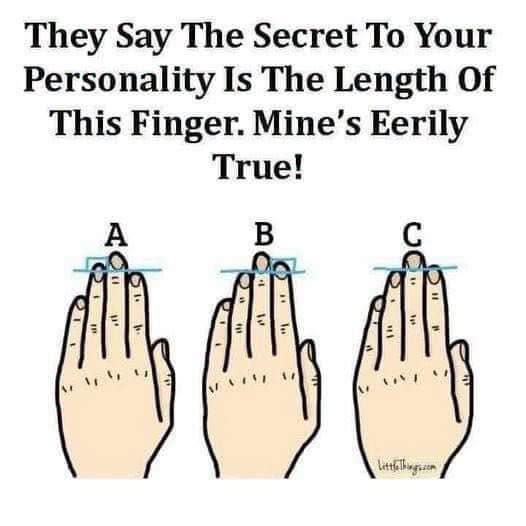
For generations, people have looked for clues about personality in unexpected places. Some traditions have suggested that facial expressions reveal emotions, while others have claimed that handwriting, voice, or body language can provide insights into character. Among these long-standing curiosities is the idea that the length of a person’s fingers—particularly the relationship between the index finger and the ring finger—might reveal something about who they are.
The topic has gained renewed attention in recent years through social media, magazine articles, and online personality quizzes, where millions of people have compared their hands simply out of curiosity. One of the most widely discussed ideas involves what researchers call the 2D:4D ratio, which compares the length of the index finger (the second digit) with the ring finger (the fourth digit).
Some scientists have explored whether this ratio may be associated with hormone exposure before birth, particularly prenatal testosterone and estrogen. Although this area of research has attracted scientific interest for decades, experts emphasize that the evidence remains mixed. Associations observed in some studies are generally weak and do not allow anyone to accurately predict an individual’s personality, talents, or future based solely on their fingers.
Outside the scientific community, however, the topic has become something of a modern-day folk belief. Many people enjoy comparing their hands with those of friends and family, discussing whether certain finger patterns appear to match familiar personality traits. These conversations are usually light-hearted and are often treated as an entertaining way to reflect on human differences rather than as a serious psychological assessment. Much like traditional personality quizzes, the appeal comes from curiosity rather than certainty.
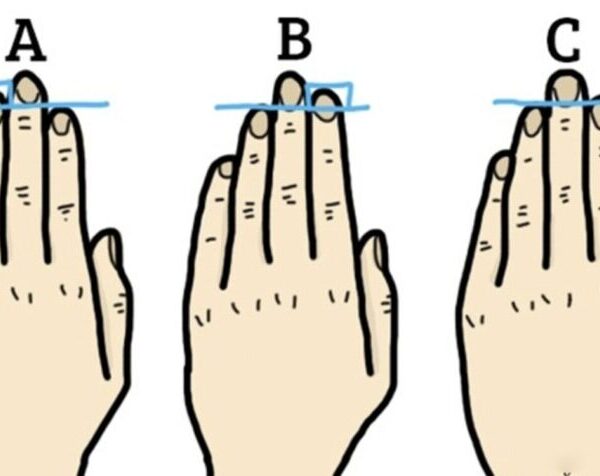
According to this popular belief, individuals whose ring finger appears slightly longer than their index finger are sometimes described as outgoing, confident, and adventurous. Supporters of this idea often suggest that such people enjoy taking on new challenges, adapting to unfamiliar situations, and feeling comfortable in social environments. They are sometimes portrayed as energetic communicators who enjoy meeting new people and embracing opportunities. It is important to remember, however, that these descriptions are opinions commonly found in popular discussions and should not be interpreted as scientifically established facts.
Another common belief focuses on people whose index finger is longer than the ring finger. In many online articles and informal discussions, these individuals are described as thoughtful, organized, and dependable. Some personality enthusiasts suggest they naturally enjoy planning ahead, solving problems carefully, and taking responsibility in group situations. Others believe they tend to remain calm under pressure and prefer making decisions after considering all available information. Again, these descriptions represent popular interpretations rather than conclusions accepted by psychological science.
A third group includes people whose index and ring fingers are nearly the same length. Within popular culture, they are often portrayed as balanced individuals who appreciate cooperation and harmony. They are sometimes described as patient listeners who value fairness and prefer resolving disagreements peacefully. Supporters of these interpretations often believe such individuals enjoy building strong relationships and creating comfortable environments for the people around them. While these ideas can be enjoyable to discuss, they should not be used to judge someone’s abilities or character.
Scientists who study human behavior generally agree that personality is extraordinarily complex. Modern psychology has shown that our thoughts, behaviors, and emotional responses develop through a combination of genetics, childhood experiences, education, family environment, culture, health, and countless life events. No single physical characteristic—including finger length—can capture the richness and diversity of human personality. For this reason, researchers encourage people to approach simple personality claims with healthy curiosity while recognizing their limitations.
The popularity of finger-length discussions demonstrates something interesting about human nature itself. People naturally enjoy finding patterns and making connections between physical features and behavior. Throughout history, cultures around the world have developed stories, traditions, and observations about how appearance might relate to personality. Many of these traditions continue today as entertaining conversation starters rather than scientifically verified methods of understanding people.
Even within scientific research, experts continue studying many aspects of human development because the human body and brain are remarkably complex. Some investigations have found statistical associations between biological traits and certain behaviors, while other studies have failed to reproduce similar findings. This is a normal part of scientific progress. Researchers refine their methods, compare new evidence, and continue asking questions rather than assuming that one early finding provides a complete answer. As a result, conclusions often become more accurate over time.
Ultimately, perhaps the most valuable lesson from discussions like these is not whether our fingers reveal our personalities, but how easily people become interested in understanding themselves and others. Exploring ideas, comparing observations, and learning about scientific research can all be enjoyable experiences when approached with an open mind and a willingness to separate evidence from speculation. Curiosity has always been one of humanity’s greatest strengths, especially when paired with critical thinking and respect for reliable evidence.
One reason the discussion about finger length has remained popular is that people naturally enjoy learning about themselves. Personality quizzes, optical illusions, and lighthearted self-reflection exercises have entertained readers for decades because they encourage conversation and curiosity. Finger-length comparisons have become part of that tradition. For many people, the activity is simply an enjoyable way to compare observations with friends or family members, without expecting the results to provide a complete or scientifically verified description of who someone is.
Researchers who study human behavior generally agree that personality develops through a combination of many influences rather than a single physical characteristic. Genetics play an important role, but so do family relationships, education, culture, life experiences, health, and the environment in which a person grows up. Every individual follows a unique path throughout life, making personality far more complex than any single measurement or physical feature could explain. This is why psychologists continue using comprehensive methods rather than simple physical traits when studying personality.
The scientific studies involving the 2D:4D finger ratio have primarily investigated possible statistical associations rather than direct cause-and-effect relationships. Some research has explored whether prenatal hormone exposure might be linked with certain biological or behavioral tendencies later in life. However, the results have often been inconsistent, and many studies have reached different conclusions. Because of these differences, scientists emphasize that finger length cannot reliably predict someone’s confidence, intelligence, leadership ability, kindness, or future success.
Despite these limitations, many people continue enjoying finger-length comparisons because they encourage self-reflection instead of certainty. Reading a description that seems familiar may inspire someone to think about their own strengths, habits, or goals. At the same time, another person with exactly the same finger proportions may have a completely different personality. This illustrates why broad personality descriptions should always be interpreted carefully and never treated as facts about an individual.
Another important point is that people naturally change throughout their lives. Experiences such as education, career development, friendships, travel, family responsibilities, and personal challenges all contribute to shaping character over time. Someone who appeared shy during adolescence may become confident as an adult, while another person may discover new talents after years of practice and learning. These changes demonstrate that personality continues developing throughout life and cannot be permanently defined by physical characteristics present at birth.
Experts also encourage caution when reading personality claims shared online. Social media often presents simplified explanations because they are easy to understand and enjoyable to share. While many of these posts are intended as entertainment, readers should distinguish between evidence-based information and ideas presented mainly for curiosity. Checking reliable scientific sources and considering multiple perspectives helps people develop a more balanced understanding of topics that become popular on the internet.
Interestingly, the popularity of finger-length discussions reveals something meaningful about human curiosity itself. People have always searched for ways to better understand themselves and those around them. Throughout history, different cultures developed traditions involving facial expressions, handwriting, dreams, body language, or other physical features. Many of these ideas continue to attract attention today because they encourage conversation and self-exploration, even when scientific evidence remains limited or uncertain.
Modern psychology approaches personality from a much broader perspective. Researchers often study long-term behavioral patterns using carefully designed assessments that evaluate multiple characteristics instead of relying on one physical measurement. These methods recognize that every individual possesses a unique combination of strengths, preferences, motivations, and experiences. Such complexity cannot be reduced to a single feature like finger length, eye color, or any other isolated characteristic.
If you decide to compare your own fingers or those of friends and family, it is best to approach the activity as an enjoyable conversation rather than a personality test. You may notice interesting similarities, surprising differences, or amusing coincidences, but those observations should never replace getting to know someone through genuine conversation, shared experiences, and mutual understanding. Real relationships are built through communication, trust, empathy, and respect—not physical measurements.
Ultimately, the enduring popularity of finger-length theories reminds us that people enjoy exploring questions about identity and personality. Scientific research continues investigating many aspects of human development, and new discoveries may improve our understanding in the future. Until then, the most responsible approach is to appreciate these theories as interesting topics for discussion while recognizing that personality is shaped by countless influences working together throughout a person’s lifetime.
Whether your ring finger is slightly longer, your index finger is longer, or both appear nearly equal, one thing remains clear: no simple measurement can define your character, your abilities, or your potential. Kindness, perseverance, honesty, creativity, and resilience are qualities that develop through choices, experiences, and relationships over time. Those qualities are far more meaningful indicators of who we are than the length of any finger.

