
For twenty years, I lived in a wheelchair after one single moment completely changed my life. It happened the day I jumped into a lake to save a drowning child. In that instant, I didn’t think about danger or consequences—only about saving her. I still remember the freezing water, the struggle against the current, and the sudden impact that ended everything I knew about my life. After that day, I became known as the man who saved a life but lost the ability to walk. People called me a hero, but those words often felt heavier than comfort.
I learned to smile and accept them because explaining the truth was more difficult than living with it. My wife, Claire, stood beside me through every stage of my recovery and adjustment, helping me rebuild a life that looked completely different from what I once imagined. Years passed, and I adapted to a new routine. Work, meetings, and daily responsibilities filled my days, but the memory of the accident never fully disappeared. Every so often, I found myself thinking about that moment in the lake—the sound of water, the shock, and the life that changed in seconds.
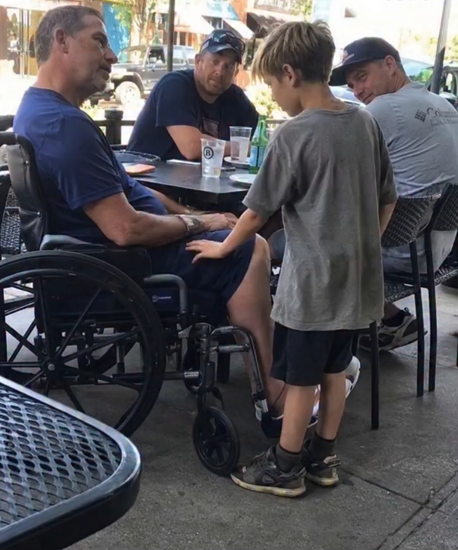
One morning, I was sitting in a busy café with my business partners, Mark and Greg. The place was filled with noise and movement, but I remained in my wheelchair, listening to their conversation while thinking about contracts and business plans. Everything seemed ordinary, just another day, until something unusual happened.
A young boy suddenly appeared beside our table. He looked no older than ten, thin, quiet, and carrying a worn backpack. Unlike a child who might be lost or curious, he seemed focused and serious. His eyes were fixed not on my face, but on my legs.
Then he said something that made the entire table fall silent.
“I can make you walk again.”
At first, it sounded impossible. Mark and Greg immediately laughed, assuming it was a joke. Even I smiled, because it felt easier than reacting seriously to something so unrealistic. But the boy didn’t move, didn’t laugh, and didn’t look away.
Instead, he calmly knelt down beside my wheelchair.
“Count with me,” he said.
Before I could respond, he placed his hand gently on my foot.
“One,” he said.
Nothing happened at first. I had lived in this condition for twenty years—there was no reason to expect anything different.
“Two.”
A strange feeling filled the air. My focus sharpened, and I found myself gripping the edge of the table without realizing why.
“Three.”
Then it happened.
My toes moved.
At first, I thought it was my imagination. But then it happened again—clearer this time. A small movement inside my shoe, something I hadn’t felt in years. My foot shifted slightly, and suddenly the entire café felt completely still.
Even the sound around me seemed to disappear.
My business partners stopped laughing. Their expressions changed instantly.
I couldn’t speak. I just stared at the boy.
“My name is Eli,” he said quietly.
Before I could respond, I felt a presence behind me. Someone had approached without me noticing.
A woman’s voice spoke softly.
“You don’t remember me, but I remember you very clearly.”
She introduced herself as Sarah.
She explained that years ago, I had saved her life in the same accident that caused my paralysis. That moment, she said, had shaped her entire future. She went on to become a specialist in rehabilitation medicine.
Then she told me something that changed everything.
She had reviewed my medical records and found signs that my nerves had shown gradual recovery over time. According to her, this was never properly communicated or followed up as it should have been.
The idea was difficult to process.
I immediately thought of Dr. Voss, the physician who had treated me for two decades. He had always told me the same thing—that my condition was permanent and irreversible.
Sarah did not accuse him directly. Instead, she simply encouraged me to check the records myself.
That same day, I decided to confront him.
Dr. Voss greeted me in his office as usual, calm and confident. When I placed the file on his desk and mentioned Sarah’s findings, his expression briefly changed, though he quickly tried to dismiss the concerns.
He suggested that the information might be misinterpreted and that early signs of recovery were uncertain. But as the conversation continued, it became harder to ignore the contradictions.
Still, I left without clear answers.
I needed confirmation.
A second medical opinion was arranged. After reviewing my scans, the specialist confirmed that there was evidence of long-term nerve regeneration—slow, but real.
It meant my body had not been completely static as I was told.
And no one had told me.
The realization was overwhelming. It wasn’t only about walking again—it was about twenty years of assumptions and missed possibilities.
When I confronted Dr. Voss again, this time with Sarah present, the discussion became more intense. He defended his decisions, claiming caution and uncertainty. But the medical reports told a different story.
Eventually, I realized I would not get honest answers from him in that moment.
I left and reported the situation to the medical board.
Months later, his license was suspended pending investigation. Other patients began reviewing their own cases, and questions started to spread.
But by then, my focus had already shifted.
With Sarah’s guidance and Eli’s quiet encouragement, I began rehabilitation. Progress was slow at first—small movements, careful exercises, and moments of doubt.
Then, one day, everything changed.
In my garden, I stood between parallel bars surrounded by roses. Claire watched nearby, holding her breath. Sarah stood to one side, while Eli quietly counted.
“One… two… three…”
I let go.
One step.
Then another.
After twenty years, I was no longer defined only by a wheelchair.
I looked at the people around me, at the boy who started it all, and at the life I thought I had lost forever.
And I walked forward—into a future I never believed I would have again.

