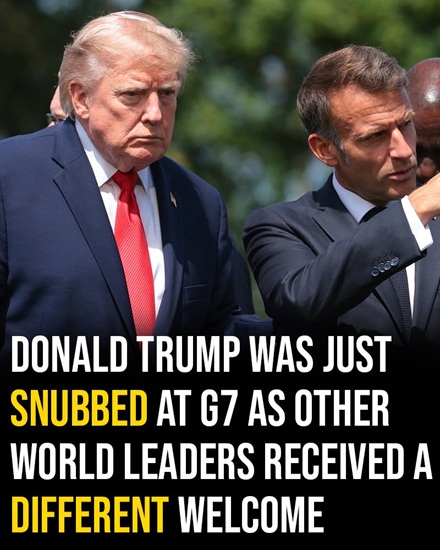
President Donald Trump drew attention at the Group of Seven (G7) summit held in Evian-les-Bains, France, where world leaders gathered to discuss major global political and economic challenges. The summit, which began on June 16, brought together representatives from Canada, France, Germany, Italy, Japan, the United Kingdom, and the United States, along with invited leaders from several partner countries.
Although Ukraine is not a formal member of the G7, President Volodymyr Zelensky was invited to participate in selected discussions due to the ongoing war in Ukraine. In addition, other nations including Brazil, India, Kenya, and South Korea were also involved in specific sessions focused on global cooperation and regional stability.
During one of the working sessions, footage showed President Trump entering the room slightly ahead of French President Emmanuel Macron and Ukrainian President Volodymyr Zelensky. After arriving at a large central table, Trump briefly stood alone, appearing to take in the surroundings before the other leaders joined him. The moment was widely circulated as cameras captured the informal dynamics among the world leaders.
A moment that attracted particular attention occurred when European Commission President Ursula von der Leyen approached the group. She first greeted President Trump with a handshake and exchanged a few brief words before moving on. Shortly afterward, she greeted President Macron in a noticeably warmer manner, including a smile and a traditional cheek-kiss greeting, which is commonly used in European diplomatic settings.
Images and video from the summit also showed von der Leyen warmly greeting other leaders, including President Zelensky and Canadian Prime Minister Mark Carney. These differences in greeting styles were noted by observers and quickly became a topic of discussion across media coverage and social platforms.
Earlier, during a bilateral meeting on June 15, President Trump stated that he had recently spoken with both Ukrainian President Volodymyr Zelensky and Russian President Vladimir Putin. He indicated that, after addressing other international priorities, greater focus would soon return to the ongoing conflict in Ukraine and related diplomatic efforts.
The broader summit agenda included discussions on global security, economic stability, and tensions in the Middle East. Leaders also addressed concerns related to rising energy prices and disruptions in global shipping routes, particularly those passing through the Strait of Hormuz, a key passage for international trade and oil transportation.
Representatives from countries such as Egypt, Qatar, and the United Arab Emirates were expected to take part in discussions focused on Middle Eastern stability. These talks aimed to explore ways to reduce regional tensions and strengthen cooperation on humanitarian and economic issues.
The summit took place amid a complex diplomatic environment, with reported differences between the United States and some of its allies regarding recent foreign policy decisions. These disagreements, particularly over military actions and international strategy, have contributed to a more cautious and measured tone in certain interactions.
Despite these challenges, G7 leaders continued to emphasize the importance of cooperation in addressing shared global concerns. In a joint statement released ahead of the summit, France, Germany, Italy, the United Kingdom, and Canada welcomed what they described as diplomatic progress involving the United States, Iran, and international mediators.
The statement described the developments as a potential opportunity to improve regional stability and support the global economy. Leaders stressed that continued negotiations would be necessary to ensure that any agreements reached are fully implemented and sustained over time.
They also highlighted the importance of maintaining open maritime routes, especially the Strait of Hormuz, and ensuring freedom of navigation for commercial shipping. The statement further expressed readiness to support these efforts through coordinated international measures, including defensive operations and maritime safety initiatives.
Overall, the G7 summit in France reflected both cooperation and underlying diplomatic complexity among world leaders. While there was clear alignment on several major global issues, subtle differences in interactions and policy perspectives also highlighted the ongoing challenges of international diplomacy.
