
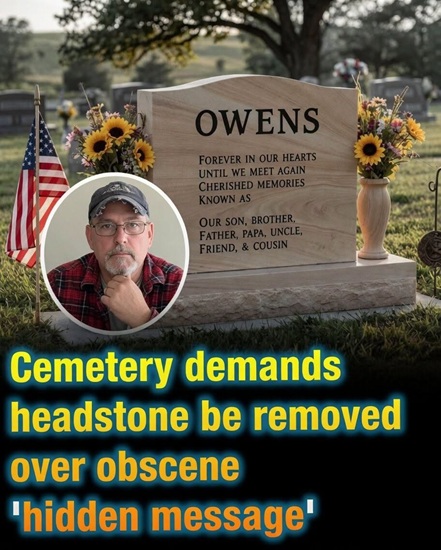
In a quiet cemetery in Iowa, an unusual situation has drawn attention far beyond the small local community and sparked a wider debate about memory, expression, and respect in public burial spaces. What began as a simple gravestone for a deceased man gradually turned into a controversy that raised questions about how far personal tributes can go when placed in shared public environments. The story centers on Steven Paul Owens, a man remembered by his family as humorous, witty, and unapologetically individualistic.
Those who knew him described him as someone who often used humor even in serious situations, refusing to take life too seriously. When he passed away, his family wanted his memorial to reflect not only formal details of his life but also the personality that defined him. At first glance, the headstone appeared traditional and respectful. It included standard inscriptions, dates, and carefully chosen wording that blended naturally into the rows of other graves in the cemetery.
However, beneath this ordinary appearance, the family reportedly included a hidden acrostic message formed by the first letters of each line of text, creating a secondary phrase not visible to casual observers. This type of acrostic design is subtle and requires intentional reading to detect. To most visitors, the stone looked completely normal and consistent with surrounding memorials. It was only when someone carefully analyzed the structure of the inscription that the hidden message became apparent.
When cemetery officials eventually discovered the coded message, concerns were immediately raised. According to reports, the acrostic formed a phrase that was considered inappropriate under cemetery guidelines. This led administrators to question whether the headstone violated rules meant to maintain respect, dignity, and neutrality within the burial grounds.
Cemetery trustees argued that cemeteries serve as shared spaces for grieving families and the wider public. Because of this, they maintained that all memorials must meet certain standards of decency and appropriateness. In their view, allowing hidden or coded messages with controversial meanings could set a problematic precedent for future memorials.
Officials also expressed concern that if one hidden message was permitted, it could encourage others to include similar inscriptions that might carry offensive or divisive meanings. They emphasized that cemeteries are intended to provide comfort and peace, and therefore must remain free from elements that could disrupt that purpose.
The family of Steven Owens strongly disagreed with the decision. They argued that the message was intended as a private tribute that reflected his personality and sense of humor. From their perspective, the inscription was not meant to harm or offend anyone but to serve as a personal and meaningful farewell.
They also pointed out that the hidden message was not immediately visible and could only be discovered through deliberate analysis. Because of this, they believed it did not affect the overall appearance or atmosphere of the cemetery for ordinary visitors. To them, the reaction from officials felt excessive and misaligned with the intent behind the memorial.
As the disagreement continued, the situation began to attract broader public interest. People outside the local area started discussing the issue online and in community forums, debating whether personal expression should be restricted in burial spaces or whether families should have full creative freedom when designing headstones.
Supporters of the family’s position argued that memorials are deeply personal and should reflect the identity of the individual being remembered. They believed that restricting artistic or symbolic expression could lead to overly uniform and impersonal grave markers that fail to capture the uniqueness of a person’s life.
On the other hand, those who supported the cemetery’s stance emphasized the importance of maintaining shared standards in public spaces. They argued that cemeteries are not only private family areas but also communal environments where people from different backgrounds come together during emotionally sensitive moments.
As debate continued, the headstone itself became a focal point of discussion and reflection. Visitors reportedly began stopping at the grave not only to pay respects but also to consider the larger questions it raised about memory, expression, and boundaries in public spaces.
The controversy also highlighted a deeper philosophical issue: how individuals should be remembered after death, and who ultimately has the authority to shape that memory. Should a person’s personality and humor be preserved exactly as they were in life, or should memorials follow broader social expectations of respect and uniformity?
Over time, the headstone evolved from a simple marker into a symbol of this unresolved tension. It represented the balance between personal legacy and communal responsibility, showing how even small design choices in a memorial can carry significant meaning.
Despite ongoing disagreement, the gravestone remains in place, continuing to draw attention and spark conversation. For some, it stands as a tribute to individuality and creative expression. For others, it raises concerns about boundaries and the purpose of shared sacred spaces.
In conclusion, the story of Steven Paul Owens’ headstone reflects a broader cultural debate about how we honor the dead and define respect in public environments. It shows that even after life ends, questions about identity, expression, and meaning continue to shape how people are remembered.
Ultimately, what began as a private family decision has grown into a wider discussion about values, tradition, and freedom of expression—proving that even the smallest details in a memorial can leave a lasting impact on those who encounter it.

