Across the internet, millions of people often find themselves looking at the same strange and fascinating images that appear simple at first but quickly spark curiosity and discussion. These visuals are widely shared on social media because they play with human perception in unexpected ways. What is interesting is not just the image itself, but how differently people interpret it. One person may immediately recognize one shape, while another is completely convinced they are seeing something else entirely.
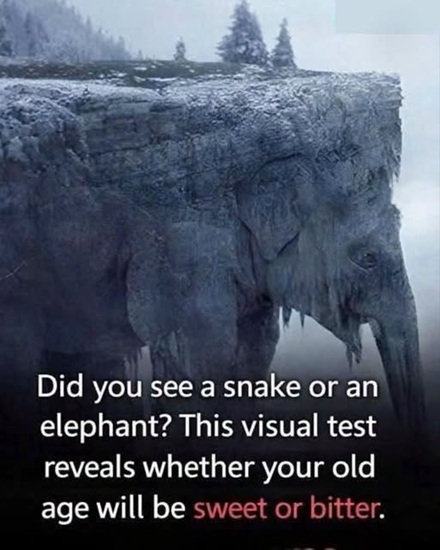
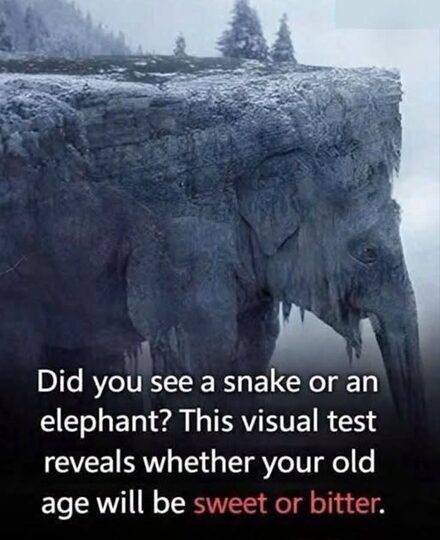
This difference in perception often leads to debates and curiosity about how the human mind works. One common type of viral visual puzzle involves hidden figures placed within complex natural scenes or abstract patterns. These images usually challenge viewers to identify what they see first, such as animals, faces, or objects concealed within detailed backgrounds. A well-known example shows a snowy or icy landscape where two interpretations seem to compete.
Some viewers claim they clearly see the form of a snake stretching across the terrain, while others believe they notice the outline of an elephant shaped by rocks, shadows, or contours. Both interpretations can appear convincing depending on how the viewer focuses their attention.
What makes these illusions so compelling is the fact that there is no single fixed way to interpret them at first glance. Human vision does not function like a simple recording device. Instead, the brain constantly interprets visual signals using patterns, experience, and expectation. When confronted with unclear or complex images, the brain quickly tries to match shapes with familiar objects stored in memory. This happens almost instantly, before conscious thinking even begins.
Optical illusions have long been studied in psychology and neuroscience because they reveal important details about perception. Researchers have shown that seeing is not just about the eyes receiving information, but about how the brain organizes and understands that information. Elements such as contrast, lighting, shape, and past experience all influence what a person notices first. This is why two individuals can look at the same image and genuinely describe two different things.
On social media, these illusions are often paired with personality descriptions or fun interpretations. For example, some posts suggest that people who see one object first may be more detail-focused, while those who notice another may think more broadly. However, there is no scientific evidence that optical illusions can accurately measure personality traits or predict behavior. These interpretations are created mainly for entertainment and engagement rather than psychological analysis.
Even without scientific backing for personality claims, these illusions remain highly popular because they encourage people to think and compare experiences. Users often enjoy sharing what they saw first and comparing it with friends or strangers online. This creates discussions about perception and highlights how differently individuals can interpret the same visual information.
When someone immediately sees a snake-like shape, it is usually because their brain quickly identified a long, curved form and matched it with a familiar object. This is a natural example of pattern recognition, which is one of the brain’s most important functions. The human mind constantly simplifies complex visual data into recognizable forms to process information more efficiently.
In contrast, those who first notice a larger structure, such as an elephant-like shape, may be focusing on overall outlines rather than small details. This also reflects a normal way of seeing and interpreting visual input. Some people naturally process images by looking at the bigger picture first, while others focus on finer elements before identifying the whole. Neither approach is correct or incorrect—they are simply different cognitive styles.
The brain uses both “bottom-up” and “top-down” processing when interpreting what we see. Bottom-up processing relies on raw visual details such as edges, lines, and contrast. Top-down processing, on the other hand, is influenced by expectations, knowledge, and prior experience. Optical illusions often work because they confuse or overlap these two systems, causing different people to focus on different parts of the same image.
Attention also plays a major role in what we notice first. The brain receives far more visual information than it can consciously process, so it filters and prioritizes certain elements. This means that what stands out to one person may not stand out to another, depending on where their attention is directed at that moment. Factors like focus, distraction, and environment can all influence perception.
Emotional state and mental focus can also slightly affect how an image is interpreted. A person who is relaxed and attentive may notice more details, while someone who is distracted may only see the most dominant shape. However, these effects are temporary and do not define personality or long-term traits.
Optical illusions are widely used in research and education because they clearly demonstrate that perception is not a perfect reflection of reality. Instead, what we see is a constructed interpretation created by the brain. These studies help scientists better understand how humans process visual information and how the brain fills in missing details.
In everyday life, perception plays an essential role in nearly everything we do. From recognizing faces to reading signs and navigating environments, the brain constantly makes fast decisions based on incomplete information. Optical illusions simply make this invisible process more obvious and easier to observe.
Ultimately, the reason these snake-or-elephant illusions become so popular is not because they reveal hidden truths about personality, but because they highlight how differently people can interpret the same image. They remind us that perception is subjective and shaped by many small cognitive factors.
Whether someone sees a snake first, an elephant first, or both at different times, it reflects how the brain processes visual information rather than any deeper meaning. The image itself does not determine personality or future behavior, but it does offer a glimpse into how complex human perception truly is.
In the end, optical illusions are best appreciated as demonstrations of how the mind works. They show that reality is not always perceived in the same way by everyone, and that each person’s brain constructs meaning in a slightly different way. While they may not reveal hidden truths, they do reveal something just as interesting—the remarkable flexibility of human perception.
