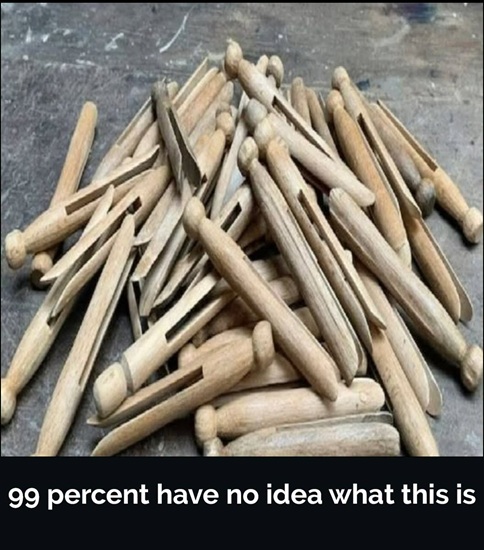
Long before modern machines took over household chores, everyday life depended on simple tools that were designed through necessity rather than convenience. One of those tools was the wooden clothespin, an object so ordinary that most people today barely notice it. Yet behind its simplicity lies a long history of human adaptation, shaped by changing lifestyles, technology, and domestic needs. What appears to be just a small piece of wood was once an essential part of daily survival routines in homes across the world.
In the earliest periods of human domestic life, drying clothes was a slow and weather-dependent process. Without electricity or indoor drying systems, people relied entirely on outdoor conditions. Clothes were hung on ropes, fences, or branches, exposed to wind and sunlight. However, wind often created problems, blowing garments away or causing them to fall into dirt or water. This created a practical need for a simple fastening tool that could hold fabric securely in place.
Early versions of clothespins were not standardized and varied widely across regions. People used whatever materials were available, including small carved pieces of wood, bone fragments, or flat stones. These primitive tools were functional but inconsistent. Some worked only under ideal conditions, while others damaged fabric or failed under pressure. Despite their limitations, they represented an early attempt at solving a very practical household problem.
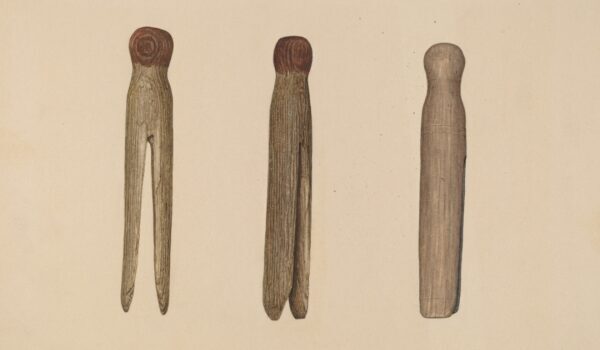
As societies developed and craftsmanship improved, the idea of a reusable fastening tool began to take shape more clearly. By the 18th and 19th centuries, household items were increasingly being refined through small-scale innovation. People began to experiment with two-piece wooden designs that could grip fabric more effectively. These early improvements laid the foundation for what would eventually become the modern clothespin.
The major breakthrough came when inventors introduced a spring-based mechanism. This design allowed two wooden arms to be pressed together with consistent pressure, holding fabric more securely than earlier friction-based methods. The addition of a simple wire or metal spring transformed the clothespin from a basic wooden clip into a reliable household tool. This innovation significantly reduced the problem of clothing being blown away during drying.
One of the most recognized developments in clothespin history occurred in the mid-19th century, when inventors refined the design into a more durable and practical form. The improved version featured two symmetrical wooden pieces connected by a spring, allowing for repeated use without losing tension. This design became the foundation for modern clothespins still used today in many parts of the world.

As industrialization expanded during the 19th century, the production of clothespins shifted from handmade crafting to factory manufacturing. This change allowed clothespins to be produced in large quantities at lower costs. Factories typically used durable hardwoods such as maple or birch, which were strong enough to withstand repeated outdoor use. Standardization also meant that clothespins became more uniform in size and performance.
During this industrial period, household laundry practices also changed significantly. More families relied on outdoor drying systems, especially in rural and working-class communities. Clothespins became an essential household item, as they provided a simple and effective way to secure clothing on long washing lines. Their affordability made them accessible to nearly every household, regardless of income level.
Throughout the early 20th century, wooden clothespins remained widely used even as new technologies began to emerge. Washing machines became more common, but drying technology was still limited in many areas. As a result, outdoor drying with clothespins continued to be a standard household practice. Their durability and simplicity ensured that they remained relevant across generations.

In addition to their practical use, clothespins also became associated with daily routines and domestic life. For many families, hanging laundry was a shared responsibility, often involving multiple members of the household. Clothespins became part of this routine, symbolizing cooperation and the rhythm of everyday chores. In some communities, they even became part of cultural memory tied to family life and seasonal routines.
As the century progressed, alternative materials such as plastic began to replace wood in many household tools. Plastic clothespins offered advantages such as lower production costs, lighter weight, and resistance to moisture. This led to a gradual decline in the use of traditional wooden clothespins in some regions. However, the wooden version never fully disappeared due to its durability and eco-friendly nature.
Wooden clothespins continued to be appreciated for their simplicity and environmental benefits. Unlike plastic alternatives, they are biodegradable and often considered more sustainable. This has contributed to a renewed interest in wooden household items in recent years, particularly among people who prioritize eco-conscious living. In this way, a traditional tool has found relevance again in modern sustainability discussions.
Beyond laundry, wooden clothespins have also found new uses in creative fields. They are commonly used in arts and crafts, DIY projects, decorations, and educational activities. Their simple structure makes them easy to modify, paint, or repurpose. This versatility has helped extend their usefulness far beyond their original function.
Today, the wooden clothespin stands as a small but meaningful example of how simple inventions can endure over time. It reflects a period when practical design was driven by necessity and shaped by everyday life rather than advanced technology. Despite centuries of change, the basic concept remains largely unchanged, demonstrating the effectiveness of its original design.
The history of the clothespin also reflects broader patterns in human innovation. Many of the most enduring tools are not complex or technologically advanced, but simple solutions that solve everyday problems efficiently. The clothespin is one of those quiet inventions that continues to serve its purpose without needing constant reinvention.
In modern households, clothespins may no longer be considered essential in the same way they once were, but they still hold a place in many homes around the world. Whether used for laundry, crafts, or decoration, they remain a practical and familiar object. Their continued presence is a reminder of how useful design often stands the test of time.
Ultimately, the wooden clothespin represents more than just a household tool. It tells a story of human adaptation, industrial progress, and everyday creativity. From ancient drying methods to modern eco-friendly practices, its journey reflects how even the smallest objects can carry long and meaningful histories. In its simplicity lies its strength — a quiet invention that continues to connect past and present in everyday life.
