
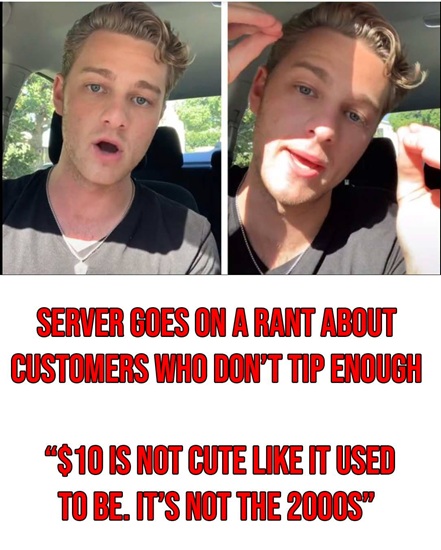
A recent discussion on social media began after a restaurant server publicly expressed frustration about customers who leave what he considered to be low tips. The situation gained rapid attention after he posted a video on TikTok criticizing customers who do not tip around 20% of their total bill. In the video, the server described smaller tips as “not cute,” a comment that quickly triggered mixed reactions online. Many users engaged in debate, with some agreeing with his viewpoint while others strongly disagreed.
The conversation soon expanded beyond the video itself and turned into a wider discussion about tipping expectations and fairness in the service industry. What started as a personal statement quickly developed into a viral topic, drawing attention from thousands of users across different platforms. The server in the video is known on TikTok as @blazikenben, and his name is Ben Raanan. In his content, he spoke directly to viewers about tipping habits and what he believes is appropriate behavior from customers in restaurants.
He argued that small fixed tips, such as $5 or $10 on larger restaurant bills, no longer reflect fair compensation due to inflation and rising living costs. According to him, tipping should better match the total value of the bill rather than being a small, fixed amount. His tone in the video was direct and emotional, which contributed to the content spreading widely and generating strong reactions from viewers.
The 20% Tipping Standard Explained
In his explanation, Ben Raanan emphasized that tipping should generally follow a percentage-based system, commonly around 20% of the total bill. He suggested that customers should calculate their tip based on this percentage instead of leaving random amounts.
He gave an example that on a $50 bill, a $10 tip would equal 20%, which he described as a fair and acceptable amount. However, he criticized cases where customers leave significantly less than that, especially when the total bill is much higher.
He also encouraged servers to be aware of tipping standards and not ignore situations where customers repeatedly leave low tips.
Background of Tipping Culture
Tipping has a long history that dates back several centuries, with early forms of gratuity appearing in Europe during the Middle Ages. Over time, the practice evolved into a more structured system, particularly in countries like the United States.
Today, tipping is commonly seen as an expected part of dining in many restaurants, often ranging between 15% and 20% depending on service quality and location. However, expectations vary widely across different regions and cultures.
In many places, tipping has become an important part of a worker’s income, especially in the restaurant industry where base wages may be lower.
Mixed Reactions on Social Media
After the video went viral, it received a wide range of reactions. Some users supported the server’s opinion, agreeing that tipping should properly reflect service work and effort. Others strongly opposed the idea, arguing that tipping should always remain optional.
Critics of the statement said that customers should not feel pressured to follow a strict percentage rule. Some also suggested that if workers are unhappy with tips, the responsibility should fall on employers to provide better wages rather than customers.
This divide highlighted an ongoing debate about fairness, expectations, and responsibility in the service industry.
Inflation and Economic Pressure
A key point raised during the discussion was the impact of inflation on both customers and workers. Some users pointed out that rising prices make it harder for many people to consistently leave large tips.
At the same time, others argued that service workers are also affected by inflation and often rely heavily on tips as part of their income. This created a balanced but conflicting argument between both sides of the debate.
The conversation showed how economic challenges influence everyday social practices, including how people tip in restaurants.
Customer Perspectives on Tipping
Many users also questioned whether percentage-based tipping is always fair. Some argued that the quality of service does not necessarily change depending on how expensive the meal is.
For example, a server may provide the same level of service to different customers, yet the expected tip amount increases with higher-priced meals. This inconsistency led some people to suggest that tipping systems should be reconsidered or standardized differently.
These opinions reflect a growing discussion about how tipping practices may evolve in the future.
A Broader Debate About Fair Pay
At the center of the discussion is a larger question about how service workers should be compensated. In some regions, tipping plays a major role in income, while in others, service charges or higher base wages reduce reliance on tips.
Supporters of tipping argue that it rewards performance and allows customers to directly express satisfaction. Critics believe it creates inconsistency and unnecessary pressure on both customers and workers.
The viral video simply brought this long-standing debate back into public attention.
The controversy surrounding the server’s TikTok video reflects a much larger conversation about tipping culture, fairness, and economic reality in the service industry. While some people support a standard 20% tipping expectation, others believe the system should be more flexible or even restructured entirely.
Ultimately, opinions differ widely based on personal experience and financial situation. The discussion continues to highlight how social expectations and economic conditions shape everyday interactions between customers and service workers.

