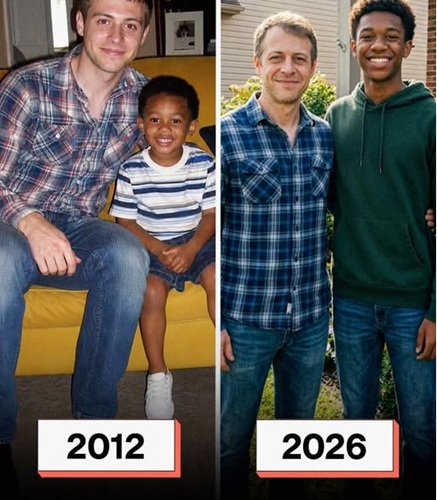
I met Laura when we were both nineteen, at a point in life when everything still felt like it was being figured out rather than fully defined. She had a presence that didn’t demand attention but naturally held it. When she walked into a room, things didn’t become perfect, but they became lighter, easier to breathe through. She had a way of making ordinary moments feel less overwhelming, even when life itself wasn’t simple. At first, we were just friends. Over time, that friendship became something deeper in my mind, even if I never admitted it out loud.
I convinced myself there would be time later, that the right moment would eventually come. But life rarely waits for clarity or courage. By the time I fully understood what I felt, Laura already had a child, Jimmy, and a life shaped by responsibilities she carried mostly alone. She was raising him without a partner in a stable way, dealing with exhaustion, financial pressure, and the constant demands of being a single mother. Even in those difficult conditions, she never stopped showing up for him.
And I never stopped showing up for her, even if my role was undefined. I was simply there, present in whatever ways I could manage, without ever formally placing myself into her life. I was there when Jimmy was born, sitting in a hospital chair through the night while Laura held him for the first time. I remember bringing her coffee she never got to drink and staying longer than I had planned, simply because leaving felt wrong. That moment quietly changed something in me, even though I didn’t have words for it at the time.
As Jimmy grew, I became part of his everyday world. I was there for small but important moments—first steps, minor injuries, sleepless nights, and everything in between. I remember when he was two and tried to eat crayons like food. I remember when he was three and cut his lip on a coffee table, and Laura called me in panic, unable to fully speak through her fear. I was already outside her door before the call even ended.
Over time, my presence became consistent, not because I had planned it that way, but because it felt like the natural thing to do. I helped where I could. I stayed when I was needed. Laura carried most of the emotional and financial burden of raising Jimmy alone, but I supported her in whatever ways I could reach. Still, I never fully stepped into the role I was slowly growing into.
There were moments when Laura and I would sit together after Jimmy had fallen asleep. She would talk about how overwhelming everything felt, how it seemed like everyone else had some kind of guide for life that she never received. I listened, but I rarely told her what I should have. I should have told her I loved her. I should have told her I loved both her and her son. But I stayed silent, telling myself presence was enough.
Then everything changed in a single night.
My phone rang just after midnight. I immediately knew something was wrong before I even answered. A stranger asked if I was Laura’s emergency contact. The words that followed felt distant and unreal at first—accident, hospital, critical injuries. I remember fluorescent lights, the smell of antiseptic, and a doctor speaking carefully in a way that meant there was no easy outcome.
Laura did not survive.
Jimmy was only four years old.
When I took him from the hospital later that night, he was confused and half asleep. He asked where his mother was, and I didn’t have an answer I could give him in a way that made sense. I simply told him we were going home first, even though I wasn’t sure what “home” meant for him anymore. That was the moment everything shifted permanently.
There was no father stepping forward. No clear family structure ready to take responsibility. So I stepped in, not because I had been asked, but because there was no one else prepared to do it. What followed was not simple or immediate. It required legal processes, interviews, home evaluations, and constant questioning about whether I was truly capable of raising a child.
Eventually, I was granted guardianship.
By then, Jimmy had already become part of my daily life in a permanent way. He had a toothbrush in my bathroom, shoes by my door, and a nightlight in the hallway. After Laura’s death, I went through her apartment alone. I packed what I thought Jimmy might need in the future and stored the rest in boxes I couldn’t bring myself to open again. I told myself I would go through them later, but that later never really came.
Raising Jimmy became the center of everything I did. I learned routines I had never paid attention to before. I learned how to prepare meals, manage school responsibilities, and maintain a sense of stability even when I didn’t feel stable myself. I learned that children don’t need perfect answers—they need consistency and presence, even when everything else feels uncertain.
Jimmy grew up asking about his mother in stages. At first, he asked when she would come back. Later, he asked what her voice sounded like. Eventually, he stopped asking out loud, but the questions didn’t disappear—they simply changed form.
I never called myself his father. On official documents, I was his guardian. In reality, I was the one who stayed through everything—school events, illnesses, homework, and late-night conversations about life that neither of us fully understood.
He grew taller. Quieter. More aware of the world.
Then, on his eighteenth birthday, everything changed again.
I walked into the kitchen and found him already standing there with an envelope in his hand. The moment I saw his expression, I felt something shift. He told me he had found something in the attic two weeks earlier. When he handed me the envelope, I recognized the handwriting immediately. It was Laura’s.
Seeing her writing again after so many years felt like time collapsing. My hands shook before I even opened it.
Inside was a letter addressed to me.
Laura wrote that she had known for a long time that she wanted Jimmy to be with me if anything ever happened to her. She had taken steps to ensure that legally. She wrote that she trusted me more than anyone else in her life. Then she said something I never expected: she had loved me too, even if she never said it aloud.
Jimmy then handed me additional documents—adoption papers he had completed himself after reading her letter. He told me it was his decision, made after turning eighteen, exactly as she had intended. It wasn’t about obligation. It was about recognition of what had already existed for years.
We went through the rest of Laura’s letters together in the attic. Each one revealed another layer of her thoughts, her care for Jimmy, and her quiet understanding of the life she would not be able to finish with him. She wrote about small things, advice, and hopes she had for his future. In every letter, there was a consistent belief that I was already part of their family in the deepest sense.
Later, the attorney confirmed what the letters suggested. Laura had begun legal steps to ensure Jimmy would remain with me long before her death. It was not fully completed, but her intention was clear and deliberate.
For years, I believed I had stepped into Jimmy’s life after loss had already defined everything. But I realized something else that day: Laura had chosen me long before I understood I had been chosen.
That night, Jimmy and I sat together in silence for a long time. Eventually, he told me he wasn’t giving me anything I hadn’t already earned. He said he was simply making official what had always been real.
The next morning, we signed the adoption papers.
Later, we visited Laura together. Jimmy placed the documents beside her resting place and stood there quietly. Then he told her that everything was official now, though he believed she already knew.
Standing there, I understood something I had avoided for years. Family is not always defined by blood or timing. Sometimes it is built slowly through presence, responsibility, and quiet consistency until one day it simply exists.
Laura didn’t just leave behind memories.
She left behind a choice.
And in the end, both of us honored it.
