
A young woman arrived at a local animal shelter with a deeply personal goal that had been forming in her mind for a long time. Living with paralysis, she had spent months thinking carefully about what kind of companion would fit into her life and daily routine. For her, the idea of adopting a dog was not just about companionship in a casual sense, but about emotional support, shared routine, and a sense of stability in moments that could otherwise feel isolating. This visit marked an important step toward changing her life in a meaningful way.
As she moved through the shelter in her wheelchair, she was immediately surrounded by a wide range of sounds and movement. Dozens of dogs reacted to her presence in different ways—some barking loudly, others jumping against kennel doors, and many showing excitement at the presence of a visitor. The environment was energetic and unpredictable, filled with constant motion and overlapping noise. Despite the intensity of the atmosphere, she remained calm and observant, carefully taking her time as she moved through each section.
She stopped at multiple kennels, observing each dog closely. Rather than rushing her decision, she focused on quiet observation, trying to understand each animal’s behavior and energy. Some dogs appeared overly excited, while others seemed anxious or restless. A few showed friendly interest, pressing their paws against the metal bars or wagging their tails enthusiastically. However, none of these initial encounters created the sense of connection she had been hoping to find.
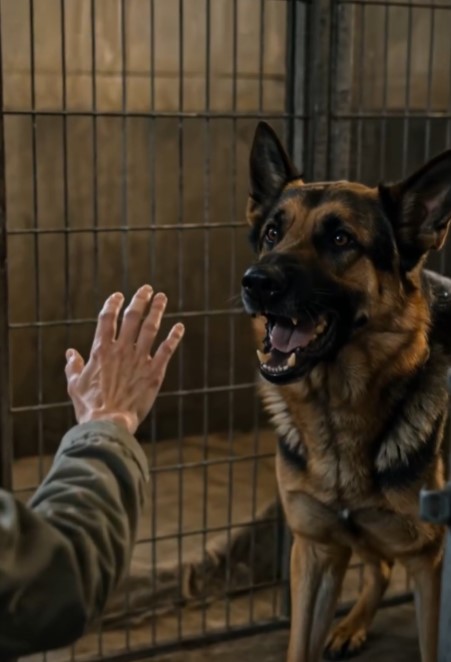
As she continued deeper into the shelter, the atmosphere gradually changed. In a quieter corner of the facility, away from the louder and more active dogs, she noticed a German Shepherd lying still inside its kennel. Unlike the others, this dog did not bark or react to her presence. It remained calm, almost detached from the surrounding activity, observing quietly from a distance. There was a noticeable contrast between this dog and the rest of the shelter environment.
The German Shepherd’s behavior was reserved and controlled. It did not attempt to attract attention, nor did it show signs of excitement or anxiety. Instead, it watched silently, maintaining a steady and focused gaze. Its posture suggested caution rather than aggression, but its size and strong physical presence naturally made it appear intimidating. Still, there was something about its stillness that made it stand out from the rest.
The young woman paused in front of the kennel for a longer moment than the others. She studied the dog’s expression carefully. While many might have been discouraged by its calm but distant behavior, she felt something different—an unspoken sense of curiosity rather than fear. Without fully understanding why, she felt drawn to this particular dog in a way she had not experienced with the others.
After a brief moment of reflection, she made her decision. She pointed toward the German Shepherd and told the shelter staff that this was the dog she wanted to meet. Her choice surprised the staff members, who were familiar with the animal’s history and temperament. They exchanged cautious looks, aware that this dog had previously shown behavior that required careful handling.
A staff member gently explained that the German Shepherd had a history of aggression and unpredictable reactions in certain situations. They emphasized that the dog had been difficult to manage and that interactions needed to be handled with care. Their concern was based on past experiences and was meant to ensure safety for both the visitor and the animal. They suggested considering other dogs with calmer temperaments.
However, the young woman remained calm and firm in her decision. She acknowledged their concerns but explained that she believed every living being had a past that shaped its behavior. She expressed that she was not afraid of the dog’s history and felt that understanding and patience were more important than reputation. Her response was steady and thoughtful, showing a level of emotional confidence that surprised those around her.
After a short discussion, the staff agreed to allow a controlled introduction. The German Shepherd was carefully brought out of its kennel on a leash, and the atmosphere in the shelter changed immediately. Conversations quieted, and people stepped back to observe the situation from a safe distance. There was a clear sense of tension in the air, as no one knew how the dog would respond in this new environment.
The dog stood still at first, observing its surroundings carefully. Its body language showed alertness, with focused attention directed toward the young woman. For a few moments, neither moved. The silence felt heavy, as if everyone in the room was waiting for a reaction. Then, suddenly, the dog barked loudly and took a few steps forward, causing a visible reaction from several people in the room.
For an instant, the situation appeared uncertain. The dog’s movement was strong and direct, and some observers instinctively stepped back. However, what happened next was unexpected. Instead of escalating further, the German Shepherd slowed its pace. Its posture softened slightly, and its approach became more controlled and cautious rather than aggressive.
The young woman remained completely still. She did not retreat or show visible fear. Instead, she maintained steady eye contact and a calm presence. This lack of reaction appeared to influence the dog’s behavior. As it got closer, its movements became slower and more uncertain, as if it was reassessing the situation in real time.
When the German Shepherd finally reached her, it lowered its body slightly and leaned gently against her legs. It began sniffing around her wheelchair and hands, carefully exploring her presence. After a few moments, it settled down and lay at her feet. The shift in behavior was immediate and striking, changing the atmosphere in the entire room.
The young woman slowly extended her hand toward the dog. It did not pull away or react defensively. Instead, it allowed her touch and remained calm. Within moments, the dog appeared to relax fully, releasing tension and resting comfortably beside her. The transformation from alertness to calmness happened quickly and unexpectedly.
The shelter room fell into complete silence. Staff members and visitors watched in disbelief as the situation unfolded. The same dog that had been described as difficult and unpredictable was now calm and peaceful. For those familiar with its history, the change was difficult to process. It was a moment that challenged expectations and assumptions.
The young woman leaned slightly forward and spoke softly to the dog, using a calm and reassuring tone. Her words reflected acceptance rather than control. She expressed a sense of certainty that they would move forward together. In that moment, something unspoken but meaningful appeared to form between them.
By the end of the visit, the adoption process was completed, and preparations were made for them to leave together. The German Shepherd, once considered too challenging for most visitors, walked calmly beside her. What began as a cautious encounter had developed into a moment of connection and trust.
As they exited the shelter, the staff and witnesses were left reflecting on what they had seen. The experience challenged assumptions about behavior, trust, and understanding. It showed that first impressions are not always final and that calm presence can sometimes influence even the most uncertain situations.
The story remains a reminder that connection does not always follow expectations. Sometimes, understanding develops quietly, without explanation, in moments that cannot be predicted. What started as a visit to a shelter became the beginning of a shared path built on patience, trust, and unexpected connection.

