
Michael Phelps is widely recognized as one of the most accomplished Olympians in history. With 28 Olympic medals, including 23 golds, his dominance in swimming reflects not only extraordinary talent but years of discipline, repetition, and personal endurance.
Born in Baltimore, Maryland, in 1985, Phelps entered the world of competitive swimming at a young age. His early introduction to the sport allowed him to develop both technical skill and mental resilience, foundations that would define his career.
Phelps’ rise was gradual yet relentless. While many athletes experience rapid success or brief moments of fame, his path was defined by consistent training, measured progression, and careful refinement of stroke technique over multiple Olympic cycles.
By the time he first appeared at the Olympics in Sydney in 2000, Phelps had already demonstrated potential to compete at the highest level. Though he did not medal, the experience provided a critical foundation for future growth, mentally and physically.
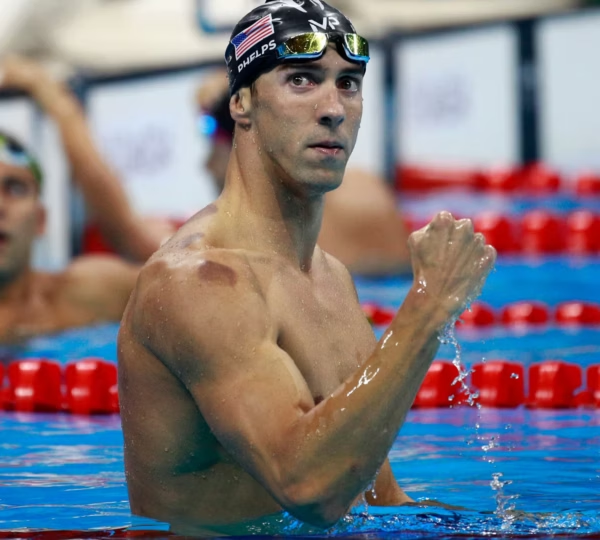
His breakout came in Athens 2004, where he won six gold medals and two bronze. This performance established him as a dominant force, not through a single moment of brilliance, but through a pattern of preparation, resilience, and strategic execution in the pool.
The 2008 Beijing Olympics elevated Phelps to global prominence. He won eight gold medals, surpassing Mark Spitz’s 1972 record of seven in a single Games. Beyond numbers, these performances showcased meticulous attention to technique, pacing, and mental preparation.
Phelps’ training regimen was famously rigorous. He swam upwards of 80,000 meters per week, often starting before sunrise. Workouts combined endurance, sprint training, and strength conditioning, alongside diet and recovery plans tailored to optimize performance.
Beyond physical preparation, Phelps placed significant emphasis on mental conditioning. He worked with sports psychologists to manage pressure, visualize races, and maintain focus, recognizing that Olympic success requires more than sheer physical ability.
Over successive Games, he maintained a level of performance that few athletes in any sport have matched. Beijing, London 2012, and Rio 2016 saw Phelps continually refine his approach, adapt to competition, and overcome injuries while remaining at the pinnacle of swimming.
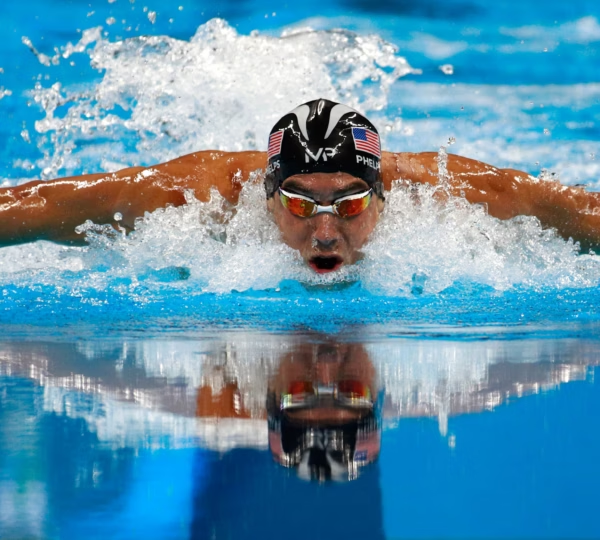
In total, Phelps’ career includes 23 Olympic gold medals, three silver, and two bronze, across eight Olympic Games. His versatility spanned multiple strokes and distances, underscoring a combination of technical mastery and strategic race execution.
Many analysts note that Phelps’ greatest strength was not a single skill, but the cumulative effect of relentless consistency. Day after day, season after season, he honed his craft, gradually pushing the boundaries of what the human body could achieve in water.
Even outside the pool, Phelps’ influence has extended globally. He has become a symbol of excellence, determination, and resilience, inspiring swimmers, athletes, and enthusiasts worldwide to pursue their goals with discipline and purpose.
Phelps’ story is not only about triumph but also about struggle. He has been candid about challenges with mental health, including periods of depression and anxiety, reminding the public that achievement does not erase personal difficulty.
His openness has contributed to broader conversations around athlete mental health, encouraging initiatives that support wellness, resilience, and professional support for competitive athletes facing similar pressures.
Support in his personal life has played a critical role. Phelps married Nicole Johnson, former Miss California USA, in 2016. Their relationship has been characterized by stability, patience, and shared commitment, especially during periods of personal and professional difficulty.
Nicole Johnson has been actively involved in the Michael Phelps Foundation since 2015, supporting programs around water safety, youth development, and mental wellness. This engagement reflects a shift from individual accomplishment toward social responsibility and community impact.
Together, the couple is raising four sons, balancing family responsibilities with public commitments. Parenthood represents a form of consistency distinct from competition, emphasizing presence, guidance, and long-term nurturing rather than measurable achievement.
Phelps has also contributed significantly to global water safety initiatives. Through the Michael Phelps Foundation, he promotes swimming education, drowning prevention, and access to aquatic programs, leveraging his visibility to enhance public safety and wellness.
His philanthropic work complements his sporting legacy, illustrating a broader approach to success: one that encompasses not only personal triumph but also responsibility toward community, youth, and public health awareness.
Phelps’ career was shaped by precise attention to technical detail. His freestyle, butterfly, and individual medley events required mastery of stroke efficiency, turn speed, and start reactions, refined through countless repetitions under expert coaching guidance.
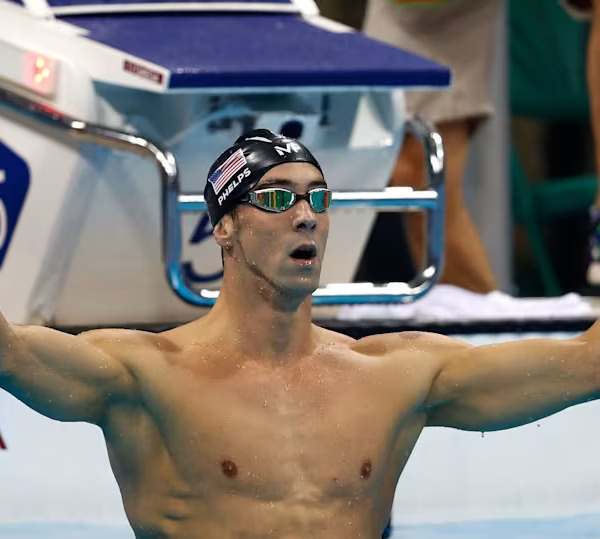
His relationship with coach Bob Bowman has been a central element of his career. Bowman’s guidance provided structured training, tactical insight, and consistent mentorship, enabling Phelps to translate potential into historic achievement through disciplined preparation.
The discipline required for Phelps’ success extended to diet, sleep, and recovery. Meals were carefully calibrated for energy and performance, while rest periods, physiotherapy, and mental recovery were considered integral parts of his training program.
Even in retirement, Phelps remains a public figure whose life lessons resonate. His story illustrates that greatness involves sustained effort, learning from setbacks, and understanding that achievement carries both rewards and responsibilities beyond the spotlight.
Athletic dominance alone does not define legacy. Phelps’ willingness to discuss struggles with mental health, adjust to life transitions, and invest in family and philanthropy adds depth to his impact, modeling resilience and emotional intelligence.
Media portrayal often emphasizes medals and records, yet Phelps’ daily routine, preparation, and persistence highlight the often unseen factors that underpin elite performance. His example demonstrates that extraordinary results are built over time, incrementally.
Phelps’ achievements also underscore the importance of teamwork. While swimming is often viewed as individual, his relay successes reflect collaboration, trust, and synchronization with teammates, reinforcing that personal success can coexist with shared effort.
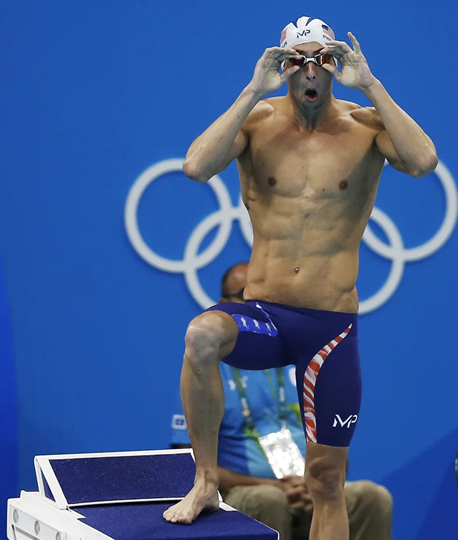
The Rio 2016 Olympics marked the culmination of Phelps’ Olympic career, with five golds and one silver. He retired having achieved more than any swimmer in history, leaving an enduring benchmark for athletes in all disciplines worldwide.
In reflecting on his journey, Phelps emphasizes the dual nature of success: personal satisfaction and public expectation. Managing both requires resilience, self-awareness, and support systems capable of balancing pressure with well-being.
Phelps’ story highlights the intersection of talent and tenacity. While innate ability contributed to early promise, decades of focused training, mental preparation, and adaptive learning enabled him to achieve results previously thought unattainable.
Throughout his career, he faced injuries, competition, and personal setbacks. His ability to recover physically and mentally, learn from mistakes, and return stronger exemplifies the importance of resilience in achieving lasting excellence.
Beyond competition, Phelps’ influence extends into advocacy for mental health, water safety, and youth engagement. He has partnered with organizations to expand access to swimming programs, reduce drowning risks, and promote healthy lifestyle habits.
His example demonstrates that impact is not only measured in medals but also in contribution to society, mentorship, and efforts to ensure others can benefit from skills, resources, and knowledge acquired through personal achievement.
Phelps’ public persona reflects humility alongside excellence. Despite fame, he has maintained focus on process over outcome, practice over recognition, and personal growth over public acclaim, emphasizing the discipline behind extraordinary accomplishment.
The broader narrative of his life combines athletic triumph, personal challenge, and social responsibility. Phelps exemplifies how sustained effort, combined with self-awareness and purpose, can shape a legacy far beyond statistical records or temporary accolades.
In the end, Phelps’ influence transcends the pool. It is visible in conversations about athlete mental health, global swimming participation, and responsible public engagement, creating a model for succeeding while contributing positively to society.
His story serves as a reminder that greatness carries complexity. Success requires effort, sacrifice, and adaptation, while legacy is measured not only by medals but also by integrity, influence, and commitment to others.
Ultimately, Michael Phelps demonstrates that human achievement involves balance: excellence in one domain is complemented by emotional resilience, public responsibility, and nurturing of future generations, offering lessons for both athletes and society at large.
