
Outside, the sun sliced through the haze of early fall, scattering golden light across the sprawling school grounds.
Long shadows stretched lazily over the manicured lawns, shifting as the day slowly edged toward afternoon. The air carried the familiar scent of wet leaves, mingling with the faint aroma of chalk dust from the classrooms inside.
A crisp breeze stirred, tugging at the edges of fallen leaves, sending them skittering across the asphalt walkways. Against this backdrop of calm and seasonal beauty, a solitary figure stood at the edge of the playground, silhouetted in the sunlight.
Straight as a pine, still as the stone monuments he had once stood beside in foreign lands, the man radiated a quiet authority that seemed to demand notice without a single word spoken.
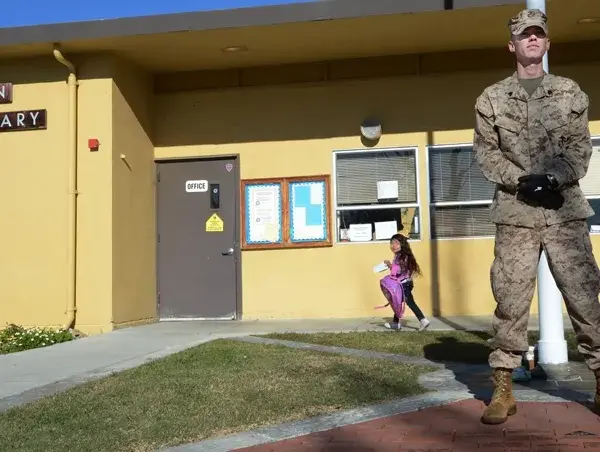
His uniform, meticulously pressed, bore insignias gleaming in the sunlight. Each badge, each stripe told the story of service, discipline, and sacrifice. Yet, beneath the polished exterior was a man who had known both the rigors of military life and the fragile nuances of human emotion.
Though he remained silent, a presence both commanding and protective emanated from him, an unspoken promise that those under his watch would be defended.
In this serene moment outside Room 302, he appeared almost statuesque, a living guardian in a world that often forgot the quiet strength of those who serve.
The soldier was Alex Miller, the older brother of Leo Miller, and fresh from a long deployment overseas. Returning to civilian life had never been easy for him.
The cadence of daily existence—traffic noises, crowded hallways, and the seemingly trivial dramas of schoolchildren—felt distant, almost alien, compared to the life-and-death decisions that had marked the past months.
Yet, Alex had returned with a singular purpose: to reconnect with his family, to surprise Leo, to share a simple lunch, and perhaps to observe the small universe his younger brother inhabited, trying to understand the world that had gone on while he was away.
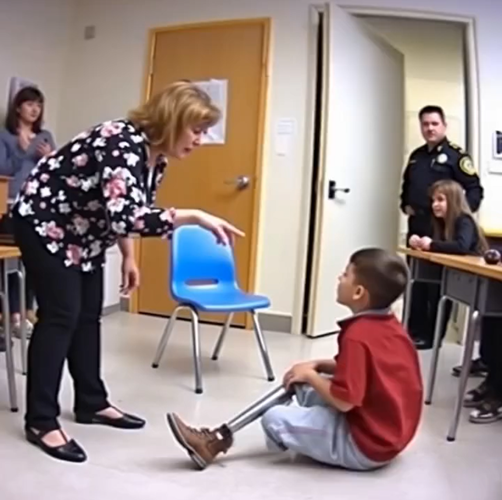
What he found instead was chaos. Inside Room 302, a quiet horror had unfolded—one of those moments that linger long after the physical scene has dissipated.
Misunderstanding, ignorance, and the untempered use of authority had converged, leaving a young boy humiliated in front of his peers.
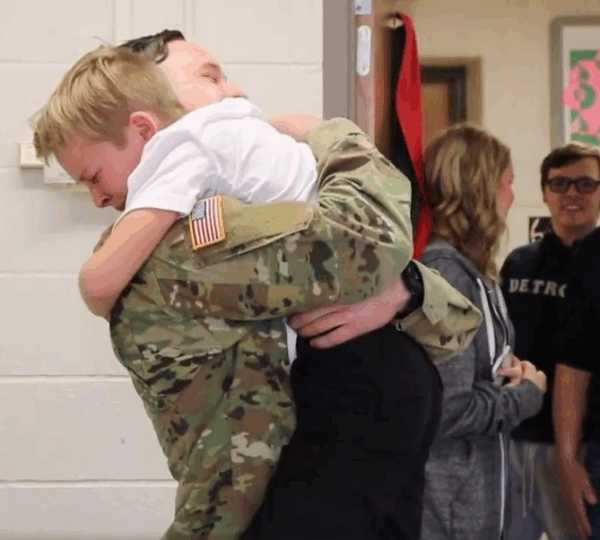
The weight of embarrassment bore down on Leo’s small frame. His shoulders hunched instinctively, not just to hide the prosthetic that had made him the target, but to shield himself from the sting of judgment.
Every glance, every whispered comment, every stifled snicker seemed magnified, echoing in his mind like a drumbeat of shame.
His classmates, trapped between empathy and the instinctive urge to comply with authority, froze. Some eyes mirrored horror; others softened with sympathy, but no one dared challenge the teacher in that moment.
The tension was palpable, a mixture of fear, confusion, and helplessness. It was the kind of silence that only grows heavy with anticipation, the kind that makes even the faintest sound feel like a jolt of electricity.
Then, as if summoned by the unspoken plea for justice, Alex moved. The door to Room 302 swung open, the sudden draft sending papers fluttering and drawing a chorus of startled gasps.
His boots, polished to a reflective sheen, barely whispered against the linoleum, yet each step carried the gravitas of experience and purpose.
The teacher, Mrs. Gable, spun toward the interruption, her face registering shock, then mild irritation, then finally the recognition that the disruption could not simply be dismissed.
“Excuse me,” Alex said, his voice calm, measured, but undeniably firm. It was a voice that brokered no argument, a voice that had once been used to command troops and maintain order in chaotic circumstances. “I believe you owe my brother an apology.”
The classroom held its collective breath. Anticipation hummed in the air, crackling like static. The usual chatter, the subtle shuffling of feet, the nervous coughs—everything ceased.

In that moment, Alex’s presence rewrote the rules of the room. Mrs. Gable’s authority, once seemingly unassailable, was questioned not through confrontation but through the sheer weight of silent, righteous insistence.
“I’m sorry, but who are you?” she managed, her voice trembling slightly as she attempted to regain control of the situation. Her eyes darted to the students, searching for some sign of support, but the room’s collective attention was fixed entirely on the imposing figure of Alex.
“I’m Leo’s brother,” he said evenly, letting the words settle, allowing their significance to take root. “And I don’t see why his having a prosthetic is an issue in a learning environment. Respect should be given, not earned through silent compliance.”
For a moment, the air was taut with tension. The students, many of whom had watched the entire episode unfold, felt a ripple of courage wash through them.
One by one, their postures shifted subtly, a quiet acknowledgment of solidarity. The teacher, confronted not only with Alex’s presence but with the undeniable moral clarity of his words, faltered. Her usual rigidity, the armor she wore so effortlessly, cracked just enough to reveal uncertainty.
Alex’s gaze softened, not for Leo alone, but for the entire room. “This isn’t just about my brother,” he continued, voice low but carrying effortlessly.

“It’s about understanding. It’s about creating a space where mistakes are learning opportunities, where differences are respected, and where no one is made to feel less than because of something they cannot control.”
His words, carefully measured and sincere, rippled across the classroom. The students felt the shift. They had been trained, socialized, conditioned to respect authority without question, but this—this was different.
It was not rebellion; it was clarity. It was the voice of someone who had faced far more dangerous situations, someone whose understanding of discipline was tempered by empathy, someone who knew that true leadership was about protection and respect, not fear and humiliation.
Mrs. Gable opened her mouth, closed it, and then opened it again. For the first time that day, she hesitated, her authority not diminished but transformed into a space of reflection.
The words hung between them, a bridge over the turmoil that had erupted in the classroom. The silence that followed was not empty; it was charged, pregnant with the possibility of understanding, of reconciliation.
Leo, still standing at his desk, felt a wave of relief wash over him. The tension that had coiled tightly in his chest began to unravel, replaced by a burgeoning sense of security.
His brother’s presence, his calm insistence on fairness, had shifted the entire dynamic of the room. The laughter, the sneers, the judgment—all of it faded into the background. For the first time that day, Leo felt seen, protected, and validated.
Alex didn’t stop there. He stepped fully into the room, his boots clicking with authority on the tile floor, and looked around at the students. “You all have a choice every day,” he said, his tone gentle yet unwavering.
“You can follow blindly, or you can stand for what’s right, even in small ways. Today, my brother was unfairly treated, but tomorrow, any one of you could face something similar. Respect each other. Support each other. That’s the lesson here.”
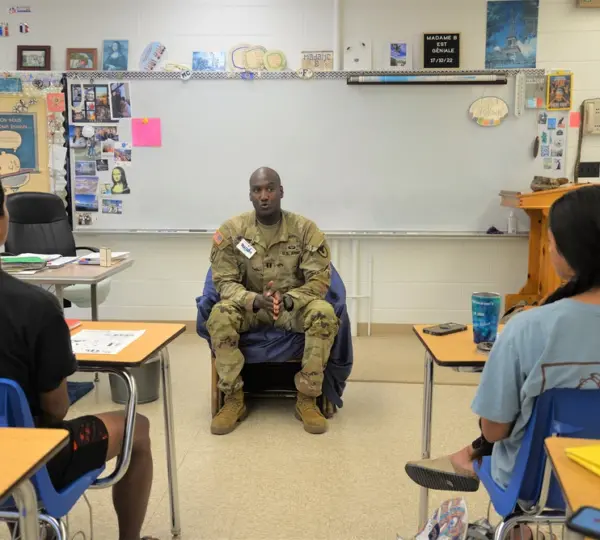
The impact was immediate. Heads lifted, shoulders straightened, and a quiet murmur of understanding passed through the students.
No longer just witnesses, they became participants in a moment of moral clarity. Alex’s words had planted a seed—one that would grow in small, often unseen ways over time, shaping the character of each child in the room.
Mrs. Gable finally spoke, her voice subdued, lacking its earlier forceful edge. “I… I apologize, Leo,” she said, her words hesitant but sincere. “That was unfair, and I let my judgment cloud my actions.”
The room exhaled collectively, the tension breaking like a dam. Alex nodded once, a simple gesture of acknowledgment, before turning to Leo. “You okay, little brother?” he asked softly, placing a reassuring hand on Leo’s shoulder.
Leo nodded, a shy smile breaking through the remnants of his embarrassment. “Thanks, Alex,” he murmured, his voice barely audible but carrying the weight of gratitude and relief.
As the day moved forward, the classroom’s energy shifted. Where there had been fear and tension, there was now a cautious optimism, a sense that fairness and understanding could indeed prevail.
Students began to whisper to one another, sharing reflections on the importance of empathy, the courage to speak up, and the power of standing together in the face of injustice.
Outside, the sun continued its slow descent, the long shadows of autumn stretching further across the playground. Alex lingered at the doorway, a silent sentinel, observing not just his brother but the small, unfolding microcosm of life inside Room 302.
He understood, better than anyone, that battles could be fought in many arenas—not just on distant shores in foreign lands, but here, in hallways and classrooms, where courage and compassion were sometimes just as vital.
In that quiet, sunlit moment, a subtle transformation had occurred. A classroom, a teacher, a young boy, and his peers had witnessed the power of intervention, the importance of advocacy, and the profound difference a single, principled voice could make.
For Leo, for his classmates, and for the teacher who had faltered, the lesson would linger far beyond the walls of Room 302: authority is best exercised with empathy, dignity is unshakable when supported, and courage can manifest in the quietest of acts.
Alex Miller’s presence that day, though brief, became a defining memory—not just for Leo but for all who witnessed it.
A reminder that true strength combines firmness with compassion, that protection and guidance are inseparable, and that standing up for what is right, even in small ways, can alter the trajectory of someone’s life.
As the school bell rang and students filed out of the classroom, the warmth of autumn sunlight still pouring through the windows, Leo felt a renewed sense of belonging and validation.
The day’s earlier humiliation had been replaced with hope, a reminder that he was not alone. His brother’s intervention had transformed a moment of fear into a moment of growth, teaching a lesson that would echo in the classroom for years to come.
And outside, Alex stood quietly, watching, content in the knowledge that sometimes, the most important battles are not fought with weapons or strategy, but with presence, conviction, and the unwavering insistence that every child deserves respect and dignity.
