
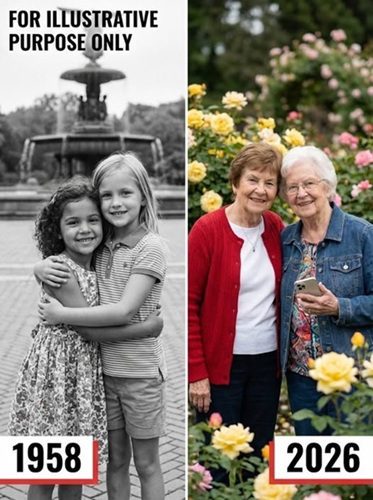
I am seventy-three years old, and when I look back across the length of my life, it has the outline of something missing.
Not dramatically missing, not in a way anyone else would immediately notice — but like a photograph with a corner torn away. You can still see the picture.
You can still recognize the faces. But you know, even if no one speaks of it, that part of the story has been removed. When I was five years old, I became sick with a fever that would not break.
My parents sent me to stay at my grandmother’s house so I could rest in quiet. My twin sister, Ella, stayed home.
I remember lying beneath a thin cotton blanket in the spare bedroom, the curtains breathing in and out with the summer air. I remember the smell of starch and old wood furniture. I remember asking when I could go home.
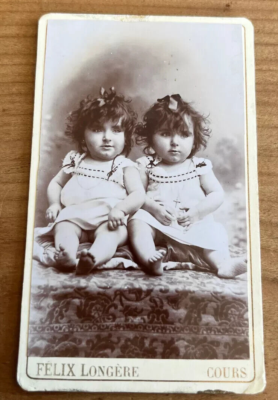
What I do not remember is the moment my childhood ended.
Ella was outside playing that afternoon. She had a red rubber ball — bright and glossy — the kind that bounced too high for small hands to control.
At some point, the house grew too quiet. That is how the story was told to me years later. Too quiet. No laughter. No ball striking the side of the house. No footsteps.
By dusk, neighbors were calling her name.
By nightfall, police officers were walking the edges of the woods with flashlights that cut thin white tunnels through the dark.
They found her red ball first.
Later — much later — they told my parents they had found her body.
I was not there. I was five, feverish and confused, watching adults move around me with swollen eyes and tight mouths. No one explained anything clearly.
I only understood that something irreversible had happened. When my parents came to retrieve me, my mother held my hand too tightly. My father did not speak during the drive home.
There was no funeral that I remember. No graveside service with flowers. If there was one, I was shielded from it. What I know for certain is that Ella’s name disappeared from our home.
It was as though speaking it might summon the pain back into the room, as though grief were something contagious.
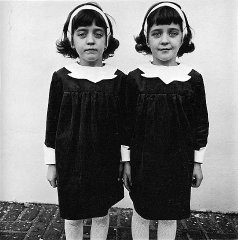
Photographs quietly vanished from frames. Toys were boxed away. The red ball was never mentioned again.
When I asked where Ella was, my mother’s face would close like a door. “We don’t talk about that,” she would say softly, but firmly. “You’re reopening wounds.”
I learned very early that grief, in our house, was something to carry alone.
Children are perceptive in ways adults often underestimate. I understood that my parents were drowning in something they did not know how to survive. So I tried to make myself smaller. Quieter. Easier.
I grew up careful.
Obedient.
Unfinished.
There is something complicated about surviving when someone who shares your face does not. Even at five, I felt a strange guilt I could not name.
Why was I the one in bed with a fever? Why was I the one who came home? I sometimes wondered if I had taken something that was meant for her — time, space, breath.
As we grew older — or rather, as I grew older — the absence became less visible but no less present. On birthdays, there was always an unspoken tension.
My cake held five candles, then six, then ten. But in my mind, there were always twice as many. I sometimes set an extra place at the table without realizing why. My mother would quietly remove it.
Silence settled over our family like dust. It did not shout. It did not argue. It simply layered itself over everything.
I built a life the way many people do. I married a kind man who loved me steadily. We raised children who filled the house with noise — the kind of noise I had once associated with safety.
I attended school recitals and soccer games. I cooked dinners and folded laundry and learned how to move through the years with purpose.
From the outside, nothing seemed broken.
And yet, there were moments — quiet ones — when I felt as though I were walking through the world with only half of myself. I would catch my reflection in a store window and feel startled, as though I were expecting someone to stand beside me.
When strangers remarked that I had “a face you don’t forget,” something inside me tightened. It felt like they were seeing two people instead of one.
Time passed. My parents aged. We never spoke of Ella in any meaningful way. My mother carried her sorrow privately. My father retreated into work and routine. By the time they were gone, the story of my twin felt like something fragile and incomplete — a memory without edges.
I believed that was the end of it.
I was wrong.
The shift came on an ordinary afternoon decades later. I was visiting my granddaughter at her college campus — a bright, hopeful place filled with young voices and possibility.
We walked together to a small café near the edge of campus, the kind with mismatched chairs and the smell of roasted coffee beans hanging thick in the air.
She left me at a table while she stood in line.
That is when I heard it.
A voice behind me.
It was not what she said. It was the cadence. The slight pause before speaking. The softness at the end of a sentence. Something about it felt impossible.
I turned.
Across the room stood a woman who looked like my reflection after decades of living parallel lives. The same cheekbones. The same tilt of the head. Even the same faint crease between the eyebrows when concentrating.
For a moment, I could not breathe.
I watched her move, watched her lift her cup, watched her smile at the cashier. My hands began to shake. My mind scrambled for logic — coincidence, imagination, projection. But the resemblance was too precise.
I stood before I could talk myself out of it.
“Excuse me,” I said, my voice unsteady. “This may sound strange… but is your name Ella?”
She looked surprised. “No,” she said gently. “My name is Margaret.”
There was no irritation in her expression — only curiosity.
I apologized, embarrassed. “You look like someone I once knew.”
She studied my face more closely then. Her expression shifted.
“I was adopted,” she said quietly.
The world seemed to tilt.
We sat down together. Slowly. Carefully. As if any sudden movement might shatter whatever fragile thread had drawn us together. We exchanged dates. Birth years. Cities. Hospitals.
The details began to align in ways that made coincidence increasingly unlikely.
She had been born five years before me.
Her adoption had been arranged privately.
She had always felt a strange pull toward a family she could not see.
When I returned home, I did something I had never done before. I opened the old cedar chest my mother had kept at the back of her closet. It had sat untouched for decades. Inside were papers, photographs, and documents tied with yellowing ribbon.
And there, beneath layers of time, was an adoption file.
Dated five years before I was born.
My mother had been young and unmarried. Pressured by circumstance and family expectation. She had carried a child she was not permitted to keep.
Margaret.
DNA testing confirmed what my heart had already begun to understand.
Margaret is my full older sister.
Ella was real.
Margaret was real.
And I was the one who stayed.
My mother had carried three daughters — one taken by circumstance, one lost to the woods, and one raised in silence.
I do not tell this story to accuse her. I have lived long enough to understand how fear can shape a life. How shame and grief can silence a person into believing that silence itself is protection. She survived in the only way she knew how.
But silence has a cost.
For years, I believed the ache inside me was imagination. That the sense of incompleteness was something I should simply overcome. Discovering Margaret did not erase the pain of losing Ella. It did not undo the decades of unanswered questions.
What it gave me was something steadier.
Clarity.
I was never imagining the absence I felt.
There really was more love than I was allowed to know.
Margaret and I are learning each other slowly now. At our age, there is no urgency — only gratitude. We speak on the phone. We compare childhood stories.
We notice shared habits and laugh at how deeply they run. There is comfort in resemblance, even late in life.
Grief does not disappear when it is hidden. It waits. It shapes decisions quietly. It lives in the background of holidays and birthdays and reflections in glass.
But sometimes, after a lifetime, it loosens its grip just enough to make room for truth. I do not feel entirely whole. I am not certain anyone ever does.
But I feel less alone. And at seventy-three years old, that is a gift I did not know I would still be given.
