
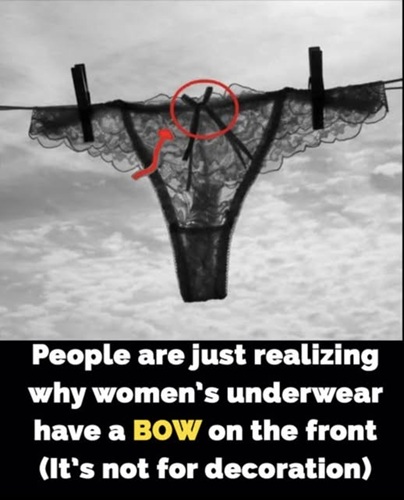
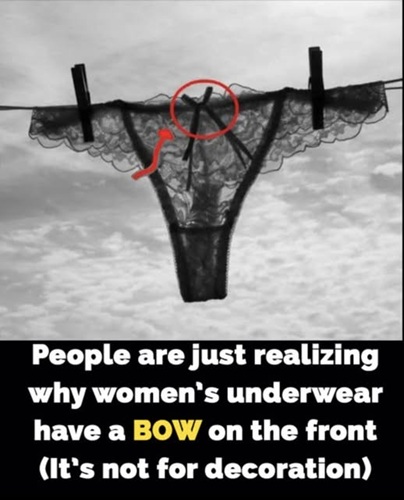
If you’ve ever glanced at a pair of women’s underwear, you may have noticed a small, delicate bow stitched near the waistband.
For many, it appears to be nothing more than a decorative flourish — a tiny, charming accent added by designers to make lingerie look “cute” or feminine.
Yet this tiny bow is far more than a simple embellishment. Its story stretches back centuries, linking modern fashion to practical necessities from a time before elastic waistbands, electricity, and mass-produced clothing.
While today it may seem purely stylistic, the bow carries echoes of a time when women’s garments were more labor-intensive to create, wear, and navigate.
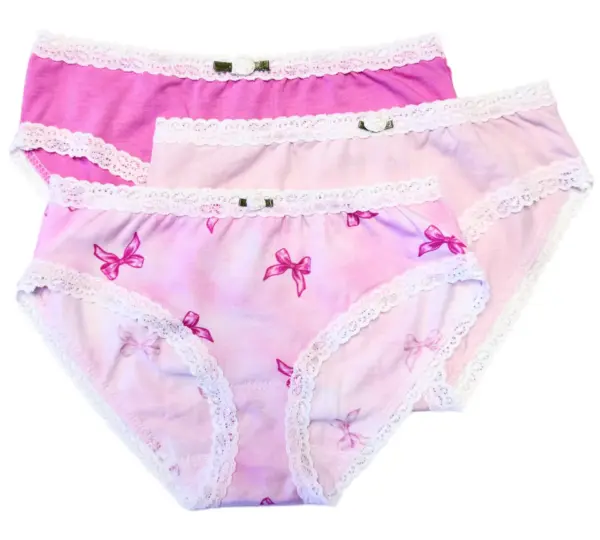
Its presence is a small but meaningful reminder of how clothing evolves, how traditions persist, and how even the simplest details can tell stories about human innovation, culture, and everyday life.
A Detail Most People Never Question
For decades, the bow has quietly adorned briefs, panties, and lingerie across countless brands and styles. It is so ubiquitous that many wearers don’t notice it at all — until someone points it out.
For others, the bow seems like a purely decorative feature or a deliberate signal of femininity, elegance, or playful charm. Some assume it is a branding signature, a way for designers to differentiate their pieces, while others think it is merely a quirk of tradition.
Yet the origins of this tiny loop are far more practical than most people realize. Beneath its delicate threads lies a history of problem-solving, adaptation, and human creativity. It illustrates how a small functional feature can endure even when its original necessity disappears.
Life Before Elastic Waistbands
To understand the bow’s origin, we need to go back to a time when elastic waistbands were not yet available. Before the invention and widespread adoption of elastic, women’s undergarments relied on ribbons, ties, and fasteners to stay in place.
Early drawers, as these garments were often called, were typically made of two separate pieces of fabric sewn together at the waist with a drawstring or ribbon.
The drawstring had to be tied to hold the garment securely, usually at the front of the body. A bow served two practical purposes: it concealed the knot, giving the garment a neat, polished appearance, and it made the undergarment easy to adjust or loosen when needed.
Unlike today’s stretchy, pre-fitted underwear, this system required active engagement — a woman needed to fasten her drawers carefully to ensure they stayed in place.
In essence, the bow we see today is a symbolic remnant of that original fastening method, a visual nod to the practical design solutions of the past. What modern wearers often think of as decoration was once an essential functional feature.
A Practical Tool in the Dark
One of the most intriguing aspects of the underwear bow’s history involves lighting — or rather, the lack of it. Before the advent of electricity, people dressed in dim light, relying on candles, oil lamps, or even moonlight to navigate their homes.
Dressing in low light presented a practical problem: how could a person quickly tell the front of a garment from the back when visibility was limited?
The tiny bow solved this issue elegantly. By feel alone, women could identify the front of their drawers, corsets, or other undergarments without needing to rely on sight.
In this way, the bow was a tactile guide, a small but essential feature that made daily routines more manageable in environments that were often dark or poorly illuminated.
This practical origin underscores how clothing design historically prioritized function alongside aesthetics — a lesson that continues to influence fashion today.
From Function to Fashion
As the 20th century progressed, elastic waistbands became widely available and gradually replaced ribbons and ties in underwear.
The necessity of a front knot disappeared, yet the bow remained. Designers continued to include it, transforming a functional detail into a symbolic one.
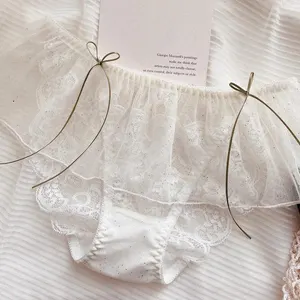
Over time, the bow became associated with softness, femininity, and classic lingerie style. It signaled a gentle, playful charm while maintaining a link to the past.
What began as a practical solution in low-light conditions evolved into an aesthetic choice, showing how elements of design often persist even after their original purpose is obsolete.
The bow also became a subtle marker of craftsmanship. In an era when mass-produced lingerie became increasingly common, small, thoughtful details like the bow conveyed a sense of care and attention, reminding wearers of the artistry involved in creating intimate apparel.
Modern Reactions: Love It or Remove It
Today, opinions about the tiny bow are mixed. Many people adore it, finding it charming, nostalgic, or comforting.
It can evoke memories of family traditions, vintage lingerie, or a simpler time when small details mattered deeply. Others see it as outdated or unnecessary, trimming it away or ignoring it entirely.
Online discussions reveal that learning the bow’s history can be surprising — even “mind-blowing” for some. Fashion enthusiasts and historians alike emphasize that such details, while seemingly minor, offer windows into the evolution of clothing, highlighting how daily life, technology, and cultural habits shaped even the most intimate garments.
Understanding the bow’s origin can transform a simple design element into a meaningful conversation starter, connecting modern wearers to centuries of practical innovation and tradition.
A Window Into Clothing History
Fashion historians note that small details like the underwear bow reveal much about how clothing evolves over time. Functional necessities often become traditions, and traditions eventually become style. The bow exemplifies how technology, habit, and cultural preference interact to shape what we wear.
For example, before electric lighting, tactile markers were essential. Once elastic replaced drawstrings, the bow’s functional role disappeared, but its symbolic and aesthetic value remained.
Today, a tiny bow on the front of underwear connects the modern wearer to generations of women who relied on the same simple detail for practical purposes. It is a subtle but visible trace of history embedded in everyday life.
The underwear bow also highlights how fashion often balances utility and beauty. Even in a small feature like this, designers have maintained elegance, functionality, and tradition.
It demonstrates that design is rarely arbitrary; even seemingly decorative elements often originate in real-world problem-solving.
Why Designers Still Keep It
Despite changing trends in lingerie, the bow remains a popular detail for many designers. Its enduring appeal is multifaceted:
-
Visual balance: The bow provides a focal point, adding symmetry and refinement to otherwise plain garments.
-
Softening effect: It adds a sense of delicacy and charm, softening the look of functional underwear.
-
Intuitive signaling: Even today, it helps indicate the front of the garment, especially for new or unfamiliar designs.
-
Familiarity: Consumers recognize and expect it, creating comfort and continuity in a world of constantly shifting fashion trends.
In these ways, the bow maintains relevance. It shows that design is not only about aesthetics but also about psychological and cultural resonance.
Familiar details, even small ones, foster a sense of connection to tradition and reinforce brand identity without the wearer consciously realizing it.
Cultural Significance and Symbolism
Beyond functionality and design, the tiny bow on underwear carries cultural symbolism. In Western fashion, bows often signify softness, elegance, and femininity.
They appear not just in lingerie but in shoes, dresses, hair accessories, and gift wrapping — all areas where subtle charm is prized.
The underwear bow, therefore, functions on multiple levels. Practically, it once marked orientation and concealed knots. Visually, it provides symmetry and elegance.
Symbolically, it communicates refinement, care, and playfulness. Its persistence illustrates how cultural values influence design choices, embedding meaning into everyday objects.
Moreover, the bow reflects human ingenuity. It demonstrates the ability to merge necessity with beauty, creating solutions that are both practical and aesthetically pleasing. The fact that a tiny loop can endure for centuries speaks to its utility, elegance, and the human desire to combine function with style.
Lessons From a Tiny Detail
The history of the underwear bow teaches broader lessons about design, fashion, and culture. It reminds us that everyday objects often hold hidden histories.
What seems decorative today may once have been essential. It underscores the idea that clothing is not static; it evolves alongside human needs, technologies, and habits.
By examining small details, we gain insight into how people in past centuries solved everyday problems — sometimes with ingenuity, sometimes with elegance, but always with attention to the practical realities of life.
The bow also demonstrates how traditions can persist long after the original need disappears, shaping contemporary aesthetics and consumer expectations.
This perspective invites a deeper appreciation of clothing. Every garment carries stories of the people who made it, the technology available at the time, and the cultural norms that influenced its design. Even something as tiny as a bow can reflect centuries of history, craftsmanship, and human creativity.
Conclusion: More Than Just a Cute Accessory
The bow on women’s underwear is far more than a decorative flourish. It is a centuries-old remnant of a time when garments were tied, worn, and navigated in low light.
It concealed knots, marked orientation, and made daily dressing more manageable. Today, it endures as a symbol of tradition, femininity, and continuity in fashion.
Next time you notice that tiny bow, consider the story it carries. It is a small detail with a long memory, connecting the wearer to generations of women who relied on it for practicality and elegance.
It illustrates the enduring relationship between function and beauty, history and design, and human creativity across time.
Even in a modern world dominated by fast fashion and technological convenience, the bow remains a subtle reminder that the simplest features can hold remarkable histories.
In essence, the bow on underwear is not just decoration; it is a testament to centuries of design thinking, cultural evolution, and human ingenuity.
It shows that even the smallest touches can carry meaning, beauty, and utility — and that the stories woven into everyday objects are often richer than we realize.
So, the next time you notice that tiny loop at the front of your lingerie, take a moment to appreciate its heritage. What seems simple today was once essential, and it continues to remind us of the enduring dialogue between fashion, function, and history.
