
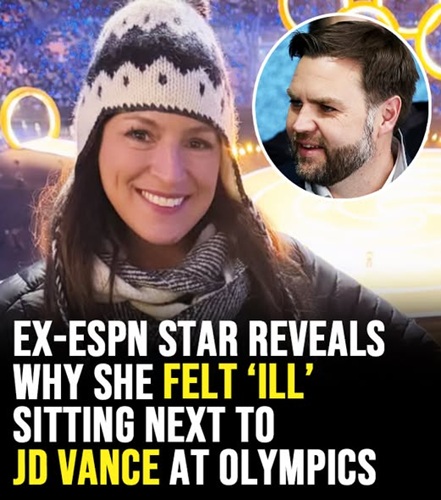
Former ESPN host and renowned sports journalist Sarah Spain recently spoke candidly about a deeply uncomfortable experience she had while attending the Winter Olympics.
An experience that left her both physically uneasy and frustrated at the disruption of what was supposed to be a memorable sporting event.
Spain, who hosts the widely followed podcast Good Game with Sarah Spain, recounted how she felt physically “ill” while sitting just a few meters away from Vice President JD Vance during a women’s hockey game between the United States and Switzerland.
The episode, which Spain described in vivid detail, sheds light not only on the unique challenges of covering high-profile sporting events with political dignitaries present but also on the complex intersection between sports journalism and national politics in highly publicized international competitions.
The Context: Winter Olympics and Political Presence
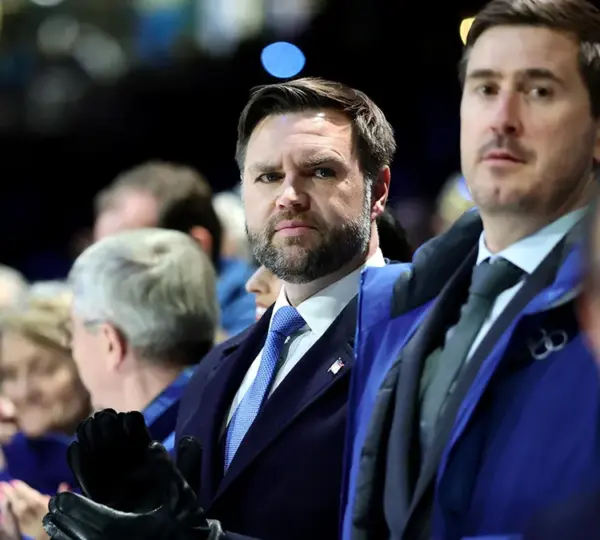
The incident occurred during the 2026 Winter Olympics in San Siro, Italy, which this year brought together athletes from across the globe for the opening ceremony and competitive events.
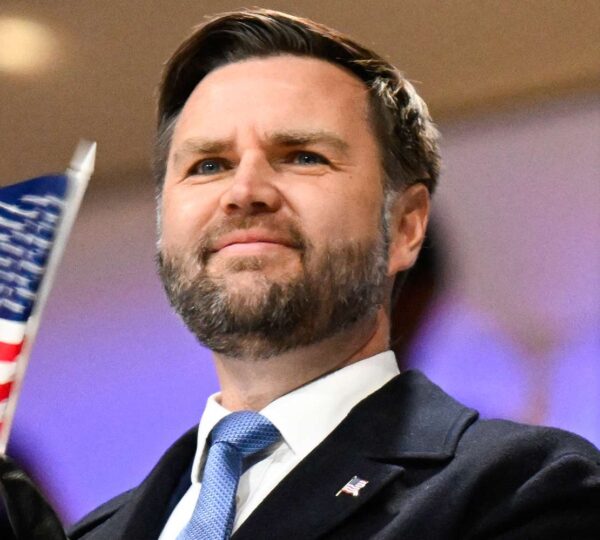
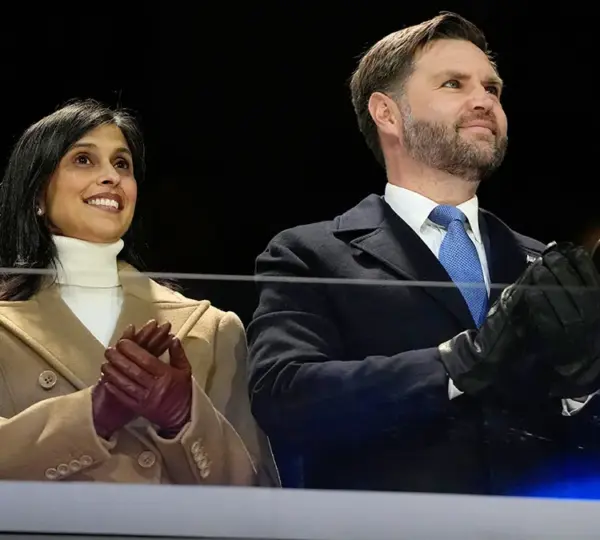
Among the VIP attendees were JD Vance, the sitting Vice President of the United States, and his wife, Usha Vance, who were actively participating in ceremonial duties, waving American flags, and supporting Team USA athletes.
The presence of high-ranking U.S. officials, particularly in politically charged global environments, is not unusual.
Such figures are typically accompanied by extensive security teams, including the United States Secret Service, which is tasked with ensuring the safety of VIPs in highly crowded, international venues.
While this is standard protocol, Spain’s experience demonstrates how such security measures can inadvertently disrupt the experience of other attendees, especially journalists and sports fans who are there primarily to observe and report on the competition.
Sarah Spain’s Proximity to JD Vance
According to Spain, she was seated only about twenty meters away from Vance and Secretary of State Marco Rubio during the U.S. women’s hockey game against the Czech Republic.
Her seating position allowed for what she assumed would be a clear view of the ice. Instead, the proximity to high-level officials, coupled with the sudden influx of Secret Service agents, drastically altered her experience.
In her podcast, Spain recounted the moment vividly: “Twelve minutes into the first period, that area suddenly is awash with large men in suits with earpieces.
And here comes JD Vance carrying a child and a bunch of security, and eventually Marco Rubio.” She emphasized that the sudden presence of Vance, Rubio, and their security detail created a “wall” between her and the hockey action, obstructing her view and detracting from her ability to fully enjoy or report on the game.
A Physical Reaction: Feeling “Ill”
Spain’s discomfort went beyond mere frustration over obstructed sightlines. She described a visceral, almost supernatural reaction to sitting near JD Vance: “When I see JD Vance’s eyeliner face, I literally feel ill, like a basilisk had looked you in the eye and death was awaiting you on the other side.”
The imagery Spain employed is striking. She likened the sensation to encountering a mythical creature whose gaze induces paralysis or fear, underlining the intensity of her response.
She clarified, “I said, ‘I feel like I just looked at a demon,’ like the devil, and I don’t even believe in that. But my body felt like when you’ve been spooked, and you have a little tingle that feels like, ‘ooh, something’s not right.’ That’s what my body felt like. And I was in no way prepared to see him.”
Spain’s candid description highlights the unusual nature of mixing high-level political figures with events traditionally focused on athletic performance and entertainment.
While sports venues are typically spaces of celebration and competition, the addition of VIP political security introduces a layer of tension and discomfort, particularly for journalists whose roles require both observation and documentation.
Security Measures and Frustration
Spain’s frustration was not limited to her physical reaction. She expressed anger over how the Secret Service agents disrupted her view of the game, saying: “It made me so angry.
Not just because his f****** Secret Service were blocking half the ice.. like, we’re trying to watch a hockey game. You ruined it.”
The US women’s hockey team went on to secure a 5-0 victory against Switzerland, demonstrating dominance on the ice. However, Spain emphasized that she could not fully experience the game due to the obstruction caused by security personnel.
For sports journalists and fans alike, such disruptions can detract from the immersive experience of attending a live sporting event and capturing the nuances of gameplay that are essential for reporting.
The Opening Ceremony and Public Reception
The Winter Olympics opening ceremony had already set a politically charged tone. Cameras captured JD Vance and his wife waving American flags, but the reception from the international audience was mixed.
CNN commentators described the scene as “a mix of jeers and applause,” noting that Vance received unexpected boos in some sections of the arena.
One commentator noted: “There is the vice-president JD Vance and his wife Usha — oops, those are not … uh … those are a lot of boos for him. Whistling, jeering, some applause.”
This moment underscored the sometimes unpredictable reactions world leaders receive when attending public events abroad, where domestic political affiliations and policies can influence audience response.
JD Vance’s Engagement with Athletes
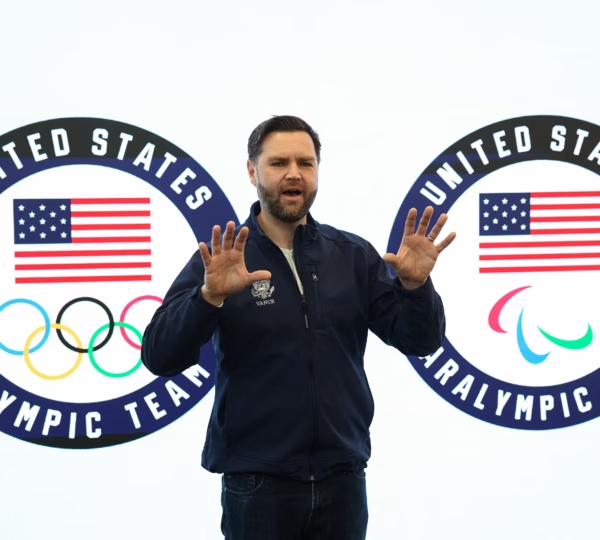
Despite the mixed public reception, Vance actively engaged with Team USA athletes during the games. Ahead of the competition, he spoke to members of Team USA, emphasizing both competitive spirit and the enjoyment of the Olympic experience: “I hope you just soak it all in.
I hope you win as many medals as possible, but most of all, I just hope you enjoy the experience. The whole country — Democrat, Republican, Independent — we’re all rooting for you, and we’re cheering for you, and we know you’re going to make us proud,” he said.
Vance’s comments, intended to motivate and reassure athletes, illustrate the dual role political leaders often play at international sporting events: representing national pride while offering personal encouragement.
For athletes, these interactions can be meaningful, but for journalists and spectators, the same interactions may introduce logistical challenges or heightened security constraints.
The Role of Political Figures at Sporting Events
The presence of high-profile political figures such as JD Vance at the Olympics is part of a broader tradition of combining sports, diplomacy, and public relations.
Heads of state and vice presidents often attend international competitions to showcase support for national athletes, foster diplomatic relations, and participate in ceremonial roles.
These appearances are symbolic, emphasizing the connection between national identity, international representation, and athletic achievement.
However, Spain’s experience highlights the unintended consequences of such appearances, particularly for journalists.
The need for stringent security measures, including Secret Service deployments, can obstruct visibility, interfere with media coverage, and create discomfort for those in close proximity to VIPs.
Sarah Spain’s Perspective and Commentary
Through her podcast, Sarah Spain has established herself as a candid and insightful commentator on sports and culture.
Her account of the Winter Olympics experience reflects her ability to blend personal reaction with broader analysis, exploring how political and security dynamics intersect with live sports coverage.
Spain’s description of feeling “ill” and her frustration with obstructed sightlines also offers a rare glimpse into the behind-the-scenes realities of attending events with political figures present.
While many viewers may focus on the spectacle of the Olympics or the political significance of VIP appearances, Spain’s perspective underscores the human dimension — the emotional, physical, and psychological responses of those navigating these unique circumstances.
Public Reaction and Media Coverage
Following Spain’s podcast, the story gained attention across social media and news outlets. Many readers and listeners sympathized with her frustration, recognizing that attending live events with significant political presence can be disruptive.
Others debated the appropriateness of her colorful metaphors describing her physical reaction to Vance’s presence, but the overwhelming consensus acknowledged the genuine challenges journalists face in such environments.
This episode also sparked broader conversations about the intersection of sports, politics, and media. It raised questions about how much influence VIP attendees and their security personnel should exert on public access, visibility, and journalistic integrity during international events.
Reflection: Sports, Politics, and Media Responsibility
Spain’s account offers a lens into the delicate balance between sports, politics, and media. Sporting events are, at their core, about athletic excellence and human achievement, yet the presence of political figures introduces a layer of complexity.
Journalists, tasked with documenting and analyzing these events, must navigate not only the competition itself but also the constraints imposed by security measures, public relations protocols, and diplomatic considerations.
By sharing her experience, Spain brings attention to these challenges and encourages dialogue about how best to preserve the integrity of sports coverage while accommodating the symbolic presence of political leaders.
Her candid reflections highlight the need for thoughtful planning and consideration, ensuring that the enthusiasm of spectators and journalists is not inadvertently compromised.
Conclusion
Sarah Spain’s unsettling experience sitting near Vice President JD Vance at the 2026 Winter Olympics serves as a unique case study in the intersection of sports, politics, and media.
From the moment Vance and his security detail arrived, Spain experienced a combination of physical discomfort and professional frustration, illustrating the real-world challenges of reporting in politically charged environments.
Her vivid descriptions, ranging from feeling physically “ill” to the obstruction of her view by Secret Service agents, emphasize the emotional and logistical complexities journalists face.
Meanwhile, Vance’s role as a national representative and supporter of Team USA athletes demonstrates the ceremonial and diplomatic functions political figures often fulfill at global sporting events.
Ultimately, Spain’s story underscores the human dimension of live sports coverage. It reminds audiences and leaders alike that while international competitions are stages for athletic excellence and national pride, the experiences of those observing, documenting, and participating are equally valuable.
The episode has sparked conversations about media access, event management, and the balance between security and spectator experience — conversations that will remain relevant as sports, politics, and journalism continue to intersect on the world stage.
Through her podcast and public commentary, Spain has once again shown her willingness to speak honestly about her experiences, offering insight into the challenges of modern sports journalism while highlighting the complex realities of attending events with high-profile political figures present.
