
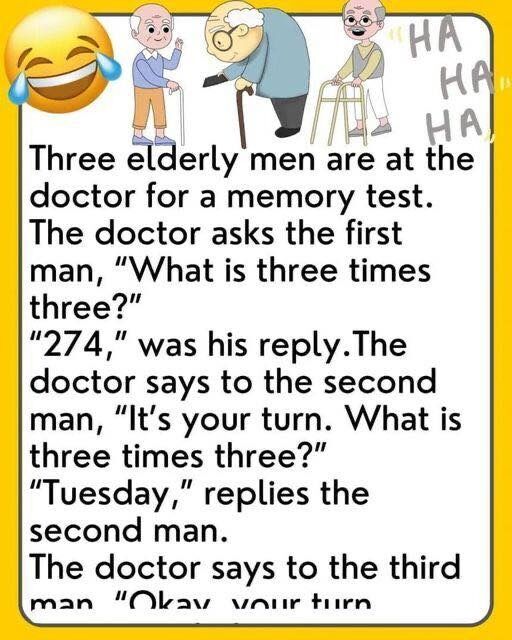
Three lifelong friends, now in their later years, arrived at their doctor’s office for a routine memory assessment, unaware that what seemed like a simple clinical visit would soon evolve into a deeply heartwarming and memorable experience.
The doctor greeted them warmly, explaining that the test was a routine check to monitor cognitive health and memory retention. The men listened attentively, though their eyes twinkled with the subtle mix of curiosity and apprehension typical of first-time assessments.
The first question was straightforward: “What is three times three?” The first gentleman, confident yet slightly mischievous, responded without hesitation, “274,” as though he were revealing a secret only he could interpret.
The doctor maintained a professional demeanor, jotting notes while quietly wondering how the man had arrived at such an unexpected number. Behind his calm exterior, he admired the man’s bold creativity, even if the answer defied logic.
Turning to the second friend, the doctor repeated the same question. The second man smiled broadly, leaning back slightly, and replied, “Tuesday,” as though numeric calculations and days of the week were naturally connected in his mind.

Suppressing a smile, the doctor nodded politely, recording the response. Though unconventional, he recognized that humor and imagination often accompany aging, reflecting the way individuals process information differently over time.
Finally, the question reached the third gentleman. The nurse observing from the doorway struggled to hide her amusement, anticipating another surprising answer in the pattern of his friends’ previous responses.
The third man paused thoughtfully, then spoke clearly: “Nine.” The doctor’s eyes brightened, finally seeing a conventional answer, while the nurse breathed a quiet sigh of relief at the familiar arithmetic solution.
But before anyone could celebrate, the man added with a proud grin, “I used your calculator when you weren’t looking.” The room fell into a momentary, light silence before erupting in shared laughter.
Although the answer had been borrowed, it revealed an important truth: each man was navigating the complexities of aging in his own unique way, employing humor, creativity, and curiosity to soften potentially discouraging moments.
Recognizing the levity’s power to transform the atmosphere, the doctor shifted away from strict testing. He invited the men to share memories from their younger days, aiming to tap into the richness of their lived experiences rather than numerical accuracy alone.
The first man began by describing his childhood fascination with electronics, recalling how he would build radios from spare parts. He explained that the crackle of static always felt like opening a door to a broader, unseen world.

The second man recounted his adventures traveling from town to town with little more than a backpack, a sense of curiosity, and an eagerness to meet new people. His stories were punctuated with laughter and nostalgia for unplanned encounters.
The third friend spoke about repairing clocks, emphasizing how each tiny gear and spring taught him patience, precision, and resilience. He explained that even when time seemed to slow, pause, or skip unexpectedly, life had a way of moving forward.
As the men shared their stories, the room filled with warmth, joy, and gentle nostalgia. The doctor realized that memory assessments, while useful, could never capture the richness of lived experiences and the wisdom accumulated over decades.
The first man’s stories of tinkering with electronics highlighted a lifetime of curiosity and problem-solving. The small triumphs of building radios mirrored broader lessons about perseverance and adapting to challenges.
The second man’s travel tales painted vivid images of open roads, bustling marketplaces, and quiet villages, each journey reflecting courage, independence, and a zest for exploration that had never faded despite advancing age.
The third man’s clock repair anecdotes resonated deeply, symbolizing how attentiveness, consistency, and care could preserve order even as life’s pace accelerated or slowed unpredictably. His passion reflected a commitment to precision and patience.
The doctor, struck by the depth and color of these memories, decided to create a new space within the clinic—a “Memory Circle” where seniors could gather weekly, share experiences, and maintain cognitive engagement in a supportive environment.
He believed that such gatherings could complement traditional assessments, promoting emotional wellbeing, social connection, and mental stimulation while fostering a sense of community and mutual respect among participants.
Soon, the clinic’s once-quiet waiting room transformed into a lively space filled with laughter, storytelling, and camaraderie. Seniors began to look forward to sessions not as tests but as opportunities to reconnect with life and each other.
The first man often brought photos of old radios and early projects, prompting discussions about ingenuity, experimentation, and the thrill of discovering how things worked, reinforcing a sense of pride and accomplishment.
The second man contributed maps, journals, and anecdotes from his travels, encouraging others to share their own stories of exploration, adventure, and personal growth, creating a rich tapestry of collective memory.
The third man introduced small mechanical puzzles and clocks, sparking curiosity and problem-solving among the group while reinforcing lessons about patience, attention to detail, and the importance of maintaining skills over a lifetime.
Together, the three friends became informal leaders of the Memory Circle, demonstrating through example that humor, creativity, and social engagement are critical components of cognitive health and emotional wellbeing.
The sessions also allowed participants to reflect on how challenges of aging could be met with grace, ingenuity, and shared support, rather than fear or resignation. Humor became a bridge between memory lapses and meaningful engagement.
Through storytelling, seniors recalled triumphs and mistakes alike, recognizing that life’s most significant lessons often come not from perfection but from resilience, curiosity, and the connections forged along the way.
The doctor observed that the Circle’s impact extended beyond cognition. Members reported improved mood, reduced anxiety, and a renewed sense of purpose, demonstrating that mental health, social connection, and memory are deeply intertwined.
Interestingly, even small memory lapses became sources of amusement rather than frustration. Participants learned to embrace mistakes, knowing that humor and shared reflection could transform perceived failures into opportunities for bonding.
The three friends often recounted their earlier responses to the simple arithmetic question, laughing over the absurdity and creativity in their answers. These recollections became symbolic of the joy and freedom that come with accepting one’s unique approach to life.
The first man’s number “274” prompted group discussions about imagination, pattern recognition, and the ways cognitive processes can be unconventional yet meaningful in older age, fostering mutual understanding and empathy.
The second man’s “Tuesday” answer encouraged conversations about associations, memory cues, and the playful ways the brain links concepts over decades, reinforcing the importance of creativity and perspective in mental agility.
The third man’s “nine,” humorously aided by the calculator, reminded the group that assistance, tools, and adaptability are not weaknesses but strategies that reflect intelligence and resourcefulness in navigating life’s challenges.
The Memory Circle soon became a hub of intergenerational learning. Families, caregivers, and volunteers joined to listen, support, and learn from the seniors’ experiences, enhancing community cohesion and fostering respect for older generations.
By embracing storytelling, laughter, and shared history, the men demonstrated that memory is not only about recall. It is also about the joy of connecting, reflecting, and celebrating life’s cumulative experiences.
The doctor noticed that participants who engaged in creative storytelling showed improved cognitive flexibility, stronger social bonds, and enhanced emotional resilience, suggesting that holistic approaches can complement medical assessments in aging populations.
These sessions also addressed loneliness and isolation, common challenges among seniors. By offering a welcoming space, the Circle promoted social interaction, companionship, and a sense of belonging—critical factors in maintaining mental health and quality of life.
The group explored topics ranging from childhood adventures to professional accomplishments, personal passions, and humorous misadventures, ensuring that every voice was valued and every memory honored, fostering mutual respect and validation.
The three friends’ example encouraged others to embrace humor as a tool for coping with aging. Laughter became a way to navigate confusion, memory lapses, and the inevitable challenges of growing older with dignity.
Over time, the Circle inspired similar initiatives at neighboring clinics and community centers. The simple idea of sharing stories and experiences grew into a movement promoting cognitive health, social engagement, and emotional support for seniors.
The doctor reflected on the importance of holistic care, understanding that assessments and tests provide data, but meaningful interaction, encouragement, and validation contribute just as much to overall wellbeing.
The group discovered that growing older does not diminish their worth. Their laughter, curiosity, and engagement illustrated that life continues to hold meaning, adventure, and joy well into later years, regardless of memory lapses.
The Memory Circle also emphasized mentorship. Seniors shared lessons with younger generations, illustrating that knowledge, experience, and life skills are invaluable resources, and that wisdom extends beyond rote memorization or clinical measures.
In these sessions, the seniors discovered a renewed sense of purpose. They realized that their stories, insights, and humor could positively impact peers, families, and the broader community, reaffirming their relevance and contribution.
By the end of each session, participants left with not only renewed cognitive stimulation but also feelings of connection, joy, and validation, underscoring the power of shared experiences in fostering emotional and mental health.
The initial visit, which began as a routine memory test, evolved into a transformative experience. It highlighted that the heart of memory resides not only in accurate recall but also in meaningful connections, shared stories, and laughter.
Through friendship, humor, and reflection, the three men and their fellow Circle members embraced the present confidently. They proved that while memory may fade, the ability to create joy, share wisdom, and connect deeply endures.
Ultimately, the Memory Circle became a model of holistic elder care, emphasizing that cognitive health is nurtured not only by testing but also by engagement, creativity, and social support, illustrating a more humane approach to aging.
The lessons extended beyond the clinic walls. Families and caregivers reported positive changes at home, observing that seniors engaged in storytelling, humor, and memory games showed improved mood, confidence, and willingness to interact socially.
By fostering such environments, communities honor older adults’ contributions, recognize their unique perspectives, and challenge societal assumptions about aging, highlighting that age does not define creativity, wisdom, or value.
The three friends’ journey reinforced a universal truth: memory is inseparable from experience, emotion, and connection. What we recall is important, but what we continue to create together is even more meaningful.
Even as the men occasionally forgot numbers or days of the week, they discovered that shared laughter, companionship, and purpose offer a richness unmatched by any assessment, proving that aging can be joyful, meaningful, and vibrant.
In the end, the doctor understood that true care extends beyond the clinic. It involves cultivating spaces that celebrate life, nurture curiosity, and honor individual approaches to aging, turning routine visits into experiences of human connection.
The Memory Circle’s success demonstrated that when seniors are empowered to share, laugh, and teach, society benefits. The clinic became not only a place of assessment but a sanctuary of stories, wisdom, and shared humanity.
The three men’s playful answers, inventive thinking, and warm reminiscences inspired everyone who attended, illustrating that humor, creativity, and social engagement are vital tools in navigating life’s later stages successfully.
As weeks turned into months, the Circle grew in attendance, attracting participants from diverse backgrounds. Its expansion highlighted the universal appeal of storytelling, social connection, and laughter in fostering cognitive, emotional, and social wellbeing.
In reflection, the doctor noted that memory, while measurable, cannot be fully captured in tests. The richness of life emerges through stories, relationships, and shared experiences, reminding all that aging is an opportunity for growth, joy, and community.
The three friends, once patients in a clinical setting, became teachers of a valuable lesson: living fully, laughing often, and connecting deeply are as essential to cognitive health as any formal assessment or test.
Through this experience, it became evident that growing older does not diminish intelligence, creativity, or emotional depth. On the contrary, embracing humor, reflection, and friendship can transform aging into a period of renewed vitality and purpose.
