
At first glance, the jungle illustration appears to be nothing more than a beautifully rendered forest scene. Thick, gnarled roots twist across the damp earth,.
Vines hang in intricate patterns from high branches, and layers of overlapping leaves form a dense, seemingly impenetrable green canopy.
Sunlight filters through breaks in the foliage, casting dappled shadows that give the forest depth and a sense of realism. For most viewers, it looks like a lush, serene, and immersive natural environment—until they start to notice something more.
Embedded within this richly detailed setting are several carefully camouflaged animals, so well integrated into the textures of the forest that they often go unnoticed at first glance.
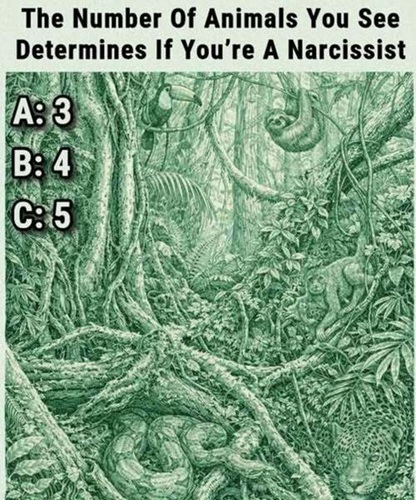
Over the years, versions of this image have circulated widely online, accompanied by headlines claiming that the number of animals a viewer can spot in the illustration correlates with their personality—specifically, whether they are narcissistic.
Common options in these quizzes or viral posts suggest seeing three, four, or five animals, each supposedly linked to traits like self-focus, confidence, or a strong sense of individuality.
While the idea may be intriguing, it is important to clarify from the outset: these claims are not grounded in scientific fact. The number of animals someone notices in a visual illusion does not indicate narcissism or any other personality disorder.
The notion is a playful, attention-grabbing tactic designed to provoke curiosity, spark conversation, and encourage sharing on social media, rather than a legitimate psychological assessment.
Examining the Animals in the Image
Careful observation reveals that the illustration hides multiple animals, each blending seamlessly into its surroundings. A close look might uncover:
-
A toucan, perched high along a branch, its bright beak partially obscured by leaves. Its vibrant colors create contrast, but even then, the bird’s head and body often merge with the shapes and hues of the foliage.
-
A sloth, dangling lazily from a limb, almost indistinguishable from the surrounding vines and branches. Its slow, relaxed posture makes it particularly easy to overlook.
-
A snake, coiled along the forest floor or winding around a tree, camouflaged with brown and green tones. Its slender form may appear as just another root or vine at first glance.
-
A monkey, partially concealed among overlapping leaves, showing only a glimpse of its face or tail. Its presence often becomes apparent only after viewers’ eyes adjust to the image’s complexity.
-
A big cat, such as a jaguar or leopard, resting in a shadowed corner of the forest. Its spotted fur blends with the dappled light on the ground, making it one of the most difficult animals to spot.
Some viewers immediately notice three of these animals, while others may slowly uncover four or five as they focus, scan different areas, and adapt to the intricate visual layering.
In more detailed illustrations, there may be additional creatures hidden even more subtly—frogs, insects, or small birds—bringing the total count well beyond what casual observers initially report.
Why Perception Varies Among Individuals
The wide variation in what people perceive in the jungle illustration is a testament to the complexity of human visual processing, attention, and cognitive style.
The illustration is a form of optical illusion, designed to exploit how the brain interprets incomplete or overlapping visual information.
In cognitive psychology, this phenomenon is well-documented: the brain automatically tries to make sense of ambiguous stimuli by identifying patterns, grouping objects, and filling in gaps based on prior experience.
-
Attentional focus: Some people scan the entire image broadly, noticing larger shapes and obvious contrasts first, which may lead them to spot the most prominent animals immediately. Others focus on minute details, spending more time observing subtle textures, color shifts, and irregular shapes, eventually discovering smaller, well-hidden creatures.
-
Visual acuity and patience: Individuals with a keen eye for detail or greater patience in observation often see more animals. Those who glance quickly may report fewer animals because they have not explored all corners of the image.
-
Pattern recognition skills: People differ in how quickly they can differentiate figure from ground, a fundamental cognitive skill. Those adept at separating overlapping shapes from their background may identify hidden objects faster than others.
These differences in perception are entirely normal and reflect attentional patterns and cognitive strategies, not personality pathology.
The Misconception About Narcissism
The viral headlines suggesting that seeing a certain number of animals indicates narcissism tap into widespread fascination with personality psychology.
In clinical terms, narcissism refers to a spectrum of traits related to self-focus, confidence, and a desire for admiration.
-
Mild to moderate narcissistic traits: These can manifest as healthy self-esteem, assertiveness, and a willingness to lead. Such traits are adaptive in social, professional, and personal contexts.
-
Higher levels of narcissism: Individuals may exhibit grandiosity, entitlement, reduced empathy, and a strong need for validation. At these levels, behaviors can become disruptive to relationships and work environments.
-
Narcissistic Personality Disorder (NPD): This is a diagnosable mental health condition assessed through clinical evaluation, interviews, and behavioral observation, not through the results of a single online quiz or optical illusion.
It is therefore misleading to suggest that spotting three or five animals in a jungle illustration can reveal whether someone is narcissistic.
The connection between visual perception and personality traits is tenuous at best. While it is true that certain cognitive patterns may reflect aspects of personality—for example, a detail-oriented observer may also demonstrate patience in other tasks—such associations are far from determinative and certainly cannot diagnose a complex personality disorder.
How Optical Illusions Work
The jungle illustration operates on several principles of visual perception:
-
Figure-Ground Organization: The brain constantly tries to distinguish objects (figures) from their backgrounds (ground). Hidden animals exploit this mechanism by blending figure and ground, making recognition more challenging.
-
Gestalt Principles: These principles describe how people perceive visual elements as unified wholes. For instance, proximity, similarity, and continuity influence whether we perceive individual animals or see the foliage as one continuous pattern.
-
Cognitive Load: Complex images increase the cognitive load, requiring the brain to filter and prioritize information. This filtering affects which animals are noticed first and which are discovered later.
-
Top-Down Processing: Prior knowledge and expectations influence perception. If a viewer knows to look for animals, their brain actively searches for familiar shapes within the visual noise, increasing the likelihood of spotting hidden creatures.
These processes explain why perception varies so dramatically among individuals. Importantly, none of them correlate directly to moral character, ethical disposition, or clinical personality traits.
The Appeal of Personality Quizzes
Why do images like the jungle illustration become viral with misleading psychological claims? Several factors contribute:
-
Curiosity and Engagement: Humans are naturally drawn to challenges that test perception, attention, and intuition. Hidden-object puzzles trigger curiosity and encourage viewers to examine the image more closely.
-
Social Sharing: Online platforms amplify content that promises insight into personal traits. By suggesting a link to narcissism, the image becomes shareable and discussion-worthy.
-
Self-Reflection: People enjoy exploring what their choices, perceptions, or answers say about them. Even if the connection is invalid, it can provide a playful way to reflect on habits, focus, or thought patterns.
In short, the virality is driven more by human psychology and social media mechanics than by any real link between the number of animals spotted and personality traits.
What the Jungle Illustration Really Reveals
Ultimately, the jungle image is a sophisticated test of perception, attention, and patience, not a measure of narcissism or personality disorder.
The number of animals someone identifies reveals more about how they observe and process visual information than it does about their character or mental health.
-
Those who spot fewer animals may naturally focus on the most prominent features, prioritizing clarity and immediate comprehension.
-
Observers who find a moderate number of animals might balance holistic viewing with attention to detail, reflecting a flexible approach to visual challenges.
-
Individuals who discover all or nearly all animals often exhibit patience, keen attention to subtle cues, and the ability to integrate multiple visual inputs over time.
These distinctions are meaningful within the context of cognitive style, but they should not be interpreted as moral or psychological judgments.
Educational and Cognitive Value of Optical Illusions
Beyond entertainment, the jungle illustration and similar visual puzzles serve several valuable purposes:
-
Enhancing Observational Skills: Carefully searching for hidden elements improves attention to detail and trains the brain to process complex visual information.
-
Encouraging Mindfulness: Slowing down to explore an intricate image can foster mindfulness and presence, reducing stress and enhancing concentration.
-
Stimulating Cognitive Flexibility: Alternating between holistic viewing and focus on small details strengthens mental flexibility, which is valuable in problem-solving and creative thinking.
-
Demonstrating Subjectivity of Perception: Seeing how others perceive the same image differently illustrates that human experience is inherently subjective, fostering empathy and appreciation for diverse perspectives.
These benefits highlight that the true value of such illusions lies in cognitive and perceptual engagement, rather than pseudo-diagnostic claims.
A Broader Perspective on Narcissism and Personality
If viewers are genuinely interested in exploring personality traits such as narcissism, credible approaches include:
-
Validated Questionnaires: Instruments like the Narcissistic Personality Inventory (NPI) provide scientifically grounded ways to assess traits across a spectrum.
-
Clinical Assessment: For suspected personality disorders, mental health professionals conduct structured interviews, review behavioral history, and evaluate functional impairment in multiple life domains.
-
Self-Reflection and Feedback: Personal growth involves honest reflection, self-awareness, and feedback from trusted peers or mentors, rather than relying on viral quizzes or optical illusions.
By emphasizing evidence-based approaches, individuals can explore personality traits in ways that are both informative and psychologically responsible.
Conclusion: Perception Over Personality
The jungle illustration serves as a reminder that perception is deeply personal. It reflects attention, patience, and cognitive style rather than character or mental health.
While viral headlines linking animal counts to narcissism may capture attention, the real insight comes from observing how our minds interact with complex stimuli.
-
The image encourages careful observation, patience, and flexible thinking.
-
It demonstrates the subjective nature of human perception and the richness of cognitive diversity.
-
It provides a safe, engaging opportunity for playful self-reflection without making unfounded claims about personality.
In the end, the number of animals one sees in a jungle illustration says more about how they observe the world in that moment than it does about who they are at their core.
Appreciating the illusion for what it is—a complex visual puzzle—allows us to enjoy the beauty of perception, celebrate cognitive differences, and engage with challenging imagery in an enriching, thoughtful way.
