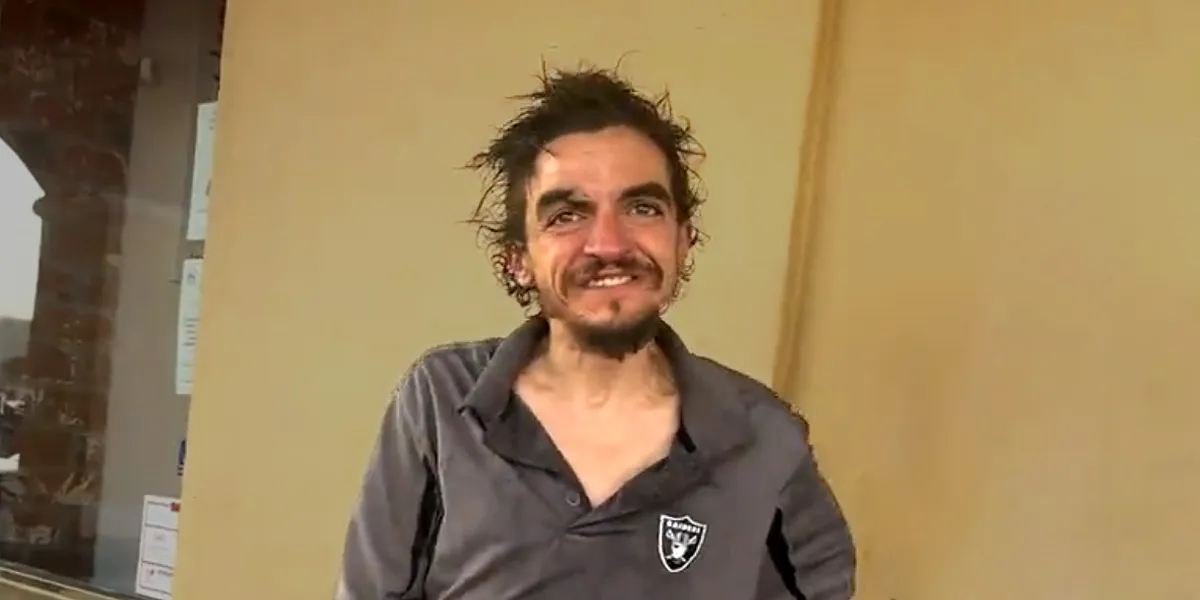
Viral video shows ‘Ned’s Declassified’ star Tylor Chase living on the streets of LA, spotted homeless
There’s a particular heartbreak in seeing someone you grew up watching on television reduced to a viral moment of visible suffering.
Someone who once brought joy and humor into living rooms now struggling in plain sight on a city street. For many fans of the early‑2000s Nickelodeon sitcom Ned’s Declassified School Survival Guide.
That moment came this year, when former child actor Tylor Chase was filmed looking distressed and disheveled on the streets of Riverside, California, triggering widespread concern, debate, and deep emotional reactions online and in the entertainment community.
Though Chase’s name might not be immediately familiar to everyone, his face certainly is to those who grew up watching him portray Martin Qwerly on the beloved kids’ show — the brainy, overly prepared hall monitor who seemed to have everything figured out at middle school in the fictional James K. Polk Middle School.
His character was beloved for his quirky enthusiasm, sharp mind, and earnest desire to help classmates survive the daily chaos of school life.
Nearly two decades later, this familiar face resurfaced not in a scripted scene, but through the unforgiving lens of strangers’ camera phones — a stark reminder not just of how fast fame can fade but how deeply complicated real life can become outside the spotlight.
A Viral Video that Brought Old Nostalgia and New Pain
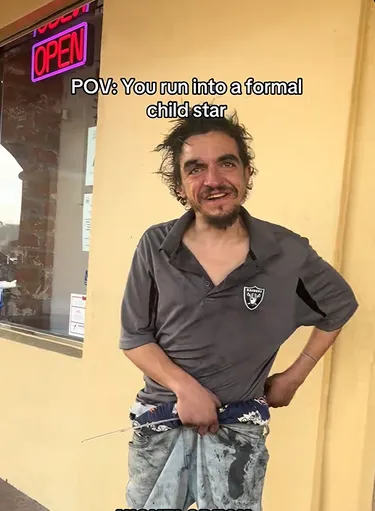
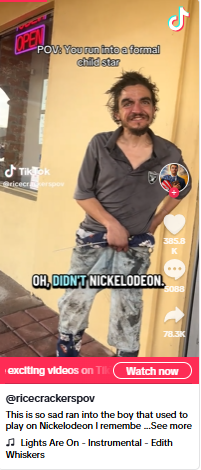
In one of the clips that spread widely on TikTok and social media platforms, Chase — visibly worn and struggling — is seen standing on a sidewalk wearing a faded Los Angeles Raiders polo shirt and battered jeans.
The person filming him asks if he was on Disney Channel, to which Chase replies politely yet with a foggy clarity: “Nickelodeon.
Ned’s Declassified School Survival Guide.” The interaction, simple in its words, cut deeply in its implication: a recognizable young actor reduced to a public spectacle, struggling to stand upright and make sense of the moment.
Reactions from longtime fans poured in immediately. Comments ranged from heartfelt sadness (“This just broke my heart”) to angry disappointment at the entertainment industry (“This is what Hollywood does to children”) to sober recognition of the complexities of adult life beyond childhood television.
Another clip showed Chase talking to a passerby who offers him money.
In an instinctive, telling gesture, he tries to hand over his watch in exchange — not because he wanted to part with it, but because he seemed to instinctively want to give something back.
The passerby gives him $20 anyway. This moment, however small on its own, underscored the human dignity and confusion tangled together in Chase’s circumstances.
From Child Star to Streets: The Path of a Former Rising Talent
Born on September 6, 1989, in Arizona, Tylor Chase’s early life led him into acting at a young age. Alongside his breakout role on Ned’s Declassified School Survival Guide (2004–2007), he appeared on shows like Everybody Hates Chris and in the film Good Time Max.
His baby‑faced charm and mellow sincerity made him a fan favorite during the peak of his youthful career.
But acting success as a child doesn’t always translate into adult stability. In the years after the show ended, Chase struggled with his transition into life beyond television.
Though he pursued creative outlets — such as posting poetry online and self‑publishing two fantasy novels — underlying issues with mental health and substance use began to surface more clearly.
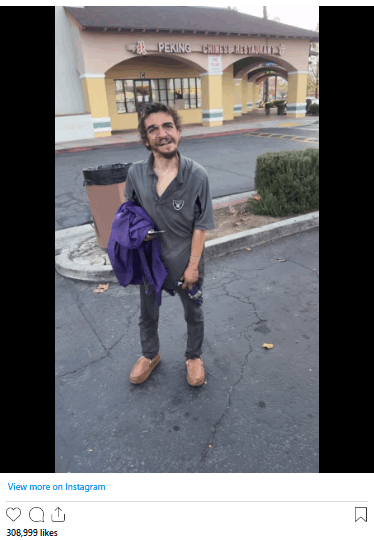
Over the past several years, local news reports indicate that Chase has been living much of his time on the streets of Riverside, a city in Southern California where his mother lives and where he has local connections and support networks, even as he struggles with instability.
Crisis and Contemporary Life on the Streets
The situation has grown increasingly visible over the past year as multiple videos and encounters were filmed by passersby, often without Chase’s full understanding of what was happening. According to police and reporting:
The Riverside Police Department confirmed that officers see Chase regularly — approximately weekly — and have offered him help dozens of times.
These offers include temporary housing, mental health services, substance abuse treatment, and medical care. He has declined them at every turn, citing personal choice.
Police emphasize that he is not currently wanted for any crimes and that in all interactions he has been polite and cooperative.
Officers in a specialized outreach division encounter him frequently, offering services, water, shelter options, and referrals to care providers, but Chase continues to refuse or walk away.
Police have not been able to determine exactly how long he has been living in this state, in part because Chase maintains he is not homeless, insisting that he has local friends and family support and remains in the area by choice.
Local court records also show that Chase has been involved in a number of minor legal cases since mid‑2023, including shoplifting and being under the influence of a controlled substance, though police stress he’s not currently wanted and has complied with officers when approached.
The Public’s Role: Concern or Cruelty?
The reaction online has been complex. Many fans express genuine sorrow — remembering Chase’s character with fond nostalgia and feeling a strange sense of personal connection to someone they watched grow up on television.
Others worry that viral videos and monetized content are turning someone’s very real suffering into fodder for social media views and ad revenue rather than support.
There is an uncomfortable truth here: filming moments of human anguish for entertainment or clicks can cross a line from bearing witness to exploiting pain.
Even when well‑meaning creators intend to raise awareness, there is a risk that the person at the center becomes a subject rather than a human being in crisis — someone whose dignity deserves protection, not performance.
A short‑lived GoFundMe campaign raised more than $1,200 for Chase after the video surfaced, but his mother, Paula Moisio, asked that it be taken down, emphasizing that cash was not what he needed.
“Tylor needs medical attention, not money,” she wrote. “I appreciate your effort, but money would not be a benefit to him.
I have gotten him several phones, but he loses them within a day or two. He can’t manage money for his meds by himself.”
Her comments underscore a painful reality that is often overlooked in viral moments: simply giving money does not address the deeper needs of someone battling mental health and addiction issues, especially when they are unable — or unwilling — to manage those resources themselves.
Voices from His Past: Former Co‑Stars Speak Out
Chase’s situation struck a nerve with more than just online fans — it moved his former Ned’s Declassified co‑stars as well.

Devon Werkheiser, who played Ned Bigby, described Chase as a “sensitive, sweet, and kind kid.” He expressed heartbreak at seeing someone who was once full of promise struggle so visibly.
Werkheiser also voiced frustration at social media users who filmed Chase during vulnerable moments, saying that addiction and mental health struggles are incredibly challenging when someone does not want help.
Another co‑star, Daniel Curtis Lee (who played Simon “Cookie” Nelson‑Cook), has taken a more active role in trying to help.
Lee shared a video of himself reuniting with Chase and offered him food, shelter, and the possibility of long‑term assistance.
Lee helped get Chase into a hotel room for safety during inclement weather and is exploring options to secure stable housing and rehabilitation if Chase chooses to accept it.
Perhaps most notably, Shaun Weiss, known for his role in The Mighty Ducks films and who has publicly navigated his own struggles with addiction and homelessness in the past, publicly offered help to Chase.
Weiss announced on social media that he had secured a detox bed and treatment facility space, urging people to try to locate Chase so he could connect him with care.
Weiss’s involvement highlights how shared experience and empathy can sometimes open doors that others cannot.
Mental Health, Choice, and Complexity
At the heart of Chase’s situation is a stark reality facing many people with severe mental health challenges: help is available, but acceptance is voluntary.
From police outreach teams to co‑stars offering housing, doctors, and structured rehab, every form of support offered to Chase has required his consent. So far, he has refused long‑term treatment and shelter.
This refusal is not uncommon among individuals grappling with serious psychiatric conditions — including bipolar disorder, substance use disorders, and trauma — where distrust of institutions or fear of losing autonomy can make people retreat further into isolation rather than toward help.
Chase himself, in recent interviews and clips shared with reporters, spoke about medication and substances he uses, mentioning both prescribed medications and recreational substances, even denying formal diagnoses despite evidence of ongoing struggles.
These conversations reflect the complicated interplay between self‑perception and clinical reality that many people with untreated or undertreated mental health conditions experience.
What This Story Asks of Us
There’s no tidy conclusion to the story of Tylor Chase — no “shocking twist” or single lesson that neatly wraps it up. Instead, it asks something much harder: What do we do when someone we feel we “know” suffers in ways beyond our control?
His past as a beloved child actor should not define him, nor should it be the sole lens through which people view his decline.
At the same time, recognizing him reminds us of just how fragile life can be once the glow of fame fades — and how little safety nets exist for those who fall through cracks in the systems of healthcare, housing, and social support.
Most of all, Chase’s situation highlights the difference between sympathy and substantive support. Viral videos may raise awareness, and fan outpourings may generate momentary emotion, but real help — long‑term, trauma‑informed, intersectional — requires patience, professional intervention, and the individual’s willingness to engage.
That willingness is often the hardest part to secure.
Tylor Chase doesn’t need pity clicks or pocket change.
He needs sustained, trauma‑informed support, access to long‑term treatment options, and a societal shift away from treating people in crisis as content and toward seeing them as human beings with dignity.
There’s a particular heartbreak in seeing someone you grew up watching on television reduced to a viral moment of visible suffering.
Someone who once brought joy and humor into living rooms now struggling in plain sight on a city street. For many fans of the early‑2000s Nickelodeon sitcom Ned’s Declassified School Survival Guide.
That moment came this year, when former child actor Tylor Chase was filmed looking distressed and disheveled on the streets of Riverside, California, triggering widespread concern, debate, and deep emotional reactions online and in the entertainment community.
Though Chase’s name might not be immediately familiar to everyone, his face certainly is to those who grew up watching him portray Martin Qwerly on the beloved kids’ show — the brainy, overly prepared hall monitor who seemed to have everything figured out at middle school in the fictional James K. Polk Middle School.
His character was beloved for his quirky enthusiasm, sharp mind, and earnest desire to help classmates survive the daily chaos of school life.
Nearly two decades later, this familiar face resurfaced not in a scripted scene, but through the unforgiving lens of strangers’ camera phones — a stark reminder not just of how fast fame can fade but how deeply complicated real life can become outside the spotlight.
A Viral Video that Brought Old Nostalgia and New Pain
In one of the clips that spread widely on TikTok and social media platforms, Chase — visibly worn and struggling — is seen standing on a sidewalk wearing a faded Los Angeles Raiders polo shirt and battered jeans.
The person filming him asks if he was on Disney Channel, to which Chase replies politely yet with a foggy clarity: “Nickelodeon.
Ned’s Declassified School Survival Guide.” The interaction, simple in its words, cut deeply in its implication: a recognizable young actor reduced to a public spectacle, struggling to stand upright and make sense of the moment.
Reactions from longtime fans poured in immediately. Comments ranged from heartfelt sadness (“This just broke my heart”) to angry disappointment at the entertainment industry (“This is what Hollywood does to children”) to sober recognition of the complexities of adult life beyond childhood television.
Another clip showed Chase talking to a passerby who offers him money.
In an instinctive, telling gesture, he tries to hand over his watch in exchange — not because he wanted to part with it, but because he seemed to instinctively want to give something back.
The passerby gives him $20 anyway. This moment, however small on its own, underscored the human dignity and confusion tangled together in Chase’s circumstances.
From Child Star to Streets: The Path of a Former Rising Talent
Born on September 6, 1989, in Arizona, Tylor Chase’s early life led him into acting at a young age. Alongside his breakout role on Ned’s Declassified School Survival Guide (2004–2007), he appeared on shows like Everybody Hates Chris and in the film Good Time Max.
His baby‑faced charm and mellow sincerity made him a fan favorite during the peak of his youthful career.
But acting success as a child doesn’t always translate into adult stability. In the years after the show ended, Chase struggled with his transition into life beyond television.
Though he pursued creative outlets — such as posting poetry online and self‑publishing two fantasy novels — underlying issues with mental health and substance use began to surface more clearly.
Over the past several years, local news reports indicate that Chase has been living much of his time on the streets of Riverside, a city in Southern California where his mother lives and where he has local connections and support networks, even as he struggles with instability.
Crisis and Contemporary Life on the Streets
The situation has grown increasingly visible over the past year as multiple videos and encounters were filmed by passersby, often without Chase’s full understanding of what was happening. According to police and reporting:
The Riverside Police Department confirmed that officers see Chase regularly — approximately weekly — and have offered him help dozens of times.
These offers include temporary housing, mental health services, substance abuse treatment, and medical care. He has declined them at every turn, citing personal choice.
Police emphasize that he is not currently wanted for any crimes and that in all interactions he has been polite and cooperative.
Officers in a specialized outreach division encounter him frequently, offering services, water, shelter options, and referrals to care providers, but Chase continues to refuse or walk away.
Police have not been able to determine exactly how long he has been living in this state, in part because Chase maintains he is not homeless, insisting that he has local friends and family support and remains in the area by choice.
Local court records also show that Chase has been involved in a number of minor legal cases since mid‑2023, including shoplifting and being under the influence of a controlled substance, though police stress he’s not currently wanted and has complied with officers when approached.
The Public’s Role: Concern or Cruelty?
The reaction online has been complex. Many fans express genuine sorrow — remembering Chase’s character with fond nostalgia and feeling a strange sense of personal connection to someone they watched grow up on television.
Others worry that viral videos and monetized content are turning someone’s very real suffering into fodder for social media views and ad revenue rather than support.
There is an uncomfortable truth here: filming moments of human anguish for entertainment or clicks can cross a line from bearing witness to exploiting pain.
Even when well‑meaning creators intend to raise awareness, there is a risk that the person at the center becomes a subject rather than a human being in crisis — someone whose dignity deserves protection, not performance.
A short‑lived GoFundMe campaign raised more than $1,200 for Chase after the video surfaced, but his mother, Paula Moisio, asked that it be taken down, emphasizing that cash was not what he needed.
“Tylor needs medical attention, not money,” she wrote. “I appreciate your effort, but money would not be a benefit to him.
I have gotten him several phones, but he loses them within a day or two. He can’t manage money for his meds by himself.”
Her comments underscore a painful reality that is often overlooked in viral moments: simply giving money does not address the deeper needs of someone battling mental health and addiction issues, especially when they are unable — or unwilling — to manage those resources themselves.
Voices from His Past: Former Co‑Stars Speak Out
Chase’s situation struck a nerve with more than just online fans — it moved his former Ned’s Declassified co‑stars as well.
Devon Werkheiser, who played Ned Bigby, described Chase as a “sensitive, sweet, and kind kid.” He expressed heartbreak at seeing someone who was once full of promise struggle so visibly.
Werkheiser also voiced frustration at social media users who filmed Chase during vulnerable moments, saying that addiction and mental health struggles are incredibly challenging when someone does not want help.
Another co‑star, Daniel Curtis Lee (who played Simon “Cookie” Nelson‑Cook), has taken a more active role in trying to help.
Lee shared a video of himself reuniting with Chase and offered him food, shelter, and the possibility of long‑term assistance.
Lee helped get Chase into a hotel room for safety during inclement weather and is exploring options to secure stable housing and rehabilitation if Chase chooses to accept it.
Perhaps most notably, Shaun Weiss, known for his role in The Mighty Ducks films and who has publicly navigated his own struggles with addiction and homelessness in the past, publicly offered help to Chase.
Weiss announced on social media that he had secured a detox bed and treatment facility space, urging people to try to locate Chase so he could connect him with care.
Weiss’s involvement highlights how shared experience and empathy can sometimes open doors that others cannot.
Mental Health, Choice, and Complexity
At the heart of Chase’s situation is a stark reality facing many people with severe mental health challenges: help is available, but acceptance is voluntary.
From police outreach teams to co‑stars offering housing, doctors, and structured rehab, every form of support offered to Chase has required his consent. So far, he has refused long‑term treatment and shelter.
This refusal is not uncommon among individuals grappling with serious psychiatric conditions — including bipolar disorder, substance use disorders, and trauma — where distrust of institutions or fear of losing autonomy can make people retreat further into isolation rather than toward help.
Chase himself, in recent interviews and clips shared with reporters, spoke about medication and substances he uses, mentioning both prescribed medications and recreational substances, even denying formal diagnoses despite evidence of ongoing struggles.
These conversations reflect the complicated interplay between self‑perception and clinical reality that many people with untreated or undertreated mental health conditions experience.
What This Story Asks of Us
There’s no tidy conclusion to the story of Tylor Chase — no “shocking twist” or single lesson that neatly wraps it up. Instead, it asks something much harder: What do we do when someone we feel we “know” suffers in ways beyond our control?
His past as a beloved child actor should not define him, nor should it be the sole lens through which people view his decline.
At the same time, recognizing him reminds us of just how fragile life can be once the glow of fame fades — and how little safety nets exist for those who fall through cracks in the systems of healthcare, housing, and social support.
Most of all, Chase’s situation highlights the difference between sympathy and substantive support. Viral videos may raise awareness, and fan outpourings may generate momentary emotion, but real help — long‑term, trauma‑informed, intersectional — requires patience, professional intervention, and the individual’s willingness to engage.
That willingness is often the hardest part to secure.
Tylor Chase doesn’t need pity clicks or pocket change.
He needs sustained, trauma‑informed support, access to long‑term treatment options, and a societal shift away from treating people in crisis as content and toward seeing them as human beings with dignity.


