
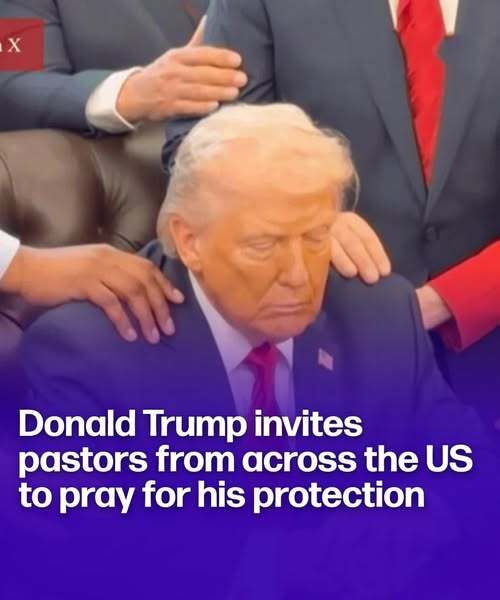
A video circulating widely online shows a group of Christian pastors gathered around former U.S. President Donald J. Trump inside the Oval Office at the White House.
In the footage, several religious leaders appear solemnly praying for the president during a period of heightened international tension and geopolitical conflict in the Middle East.
The video was shared publicly by Dan Scavino, who serves as White House Deputy Chief of Staff, on the social platform X, where it quickly drew attention and discussion.
Scavino explained that the pastors had been invited to the White House to pray for both the president and the United States amid the ongoing military situation involving Iran.
In the clip, the pastors stand around Trump as one leader prays aloud for wisdom, guidance, and protection for the president as he faces complex decisions and international pressures.
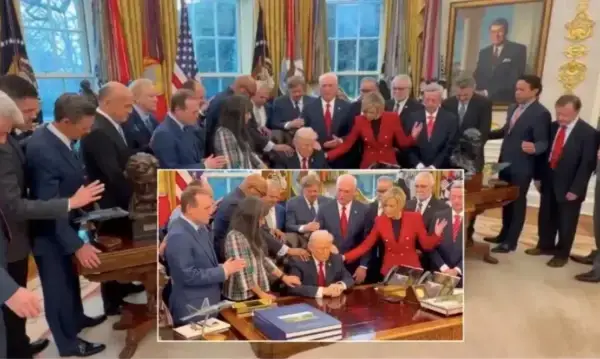
The intercession also asks for safety for members of the U.S. military and allied service personnel deployed in areas affected by the conflict, reflecting concern for those serving overseas.
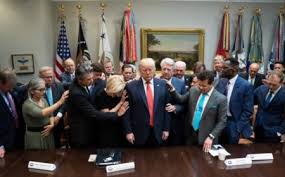
Those present place hands gently on Trump’s shoulders and back in what many recognize as the traditional Christian practice of “laying on of hands” during prayer gatherings.
This kind of spiritual support has occurred multiple times throughout Trump’s term, with faith leaders often calling for divine guidance during challenging national moments.
According to associated reporting, several well‑known evangelical leaders attended the prayer circle, including pastors and faith representatives from across the United States.
One participant identified in news accounts was Rev. Samuel Rodriguez, president of the National Hispanic Christian Leadership Conference, who emphasized the importance of spiritual unity in leadership.
Rodriguez described the event as a moment of “powerful spiritual unity and intercession,” aiming to fortify Trump with wisdom beyond worldly understanding.
News coverage noted that the prayer came during a period in which the United States and Israel had engaged in military actions against Iranian forces and facilities.
These military engagements were described by officials as efforts to counter what they characterize as Iranian threats related to regional security and nuclear ambitions.
In turn, Iranian authorities responded with missile launches directed toward locations where U.S. and allied forces are stationed, raising global concerns about escalation.
Observers reporting on the broader situation described an exchange of strikes and counter‑strikes that contributed to fears of a larger regional conflict unfolding.
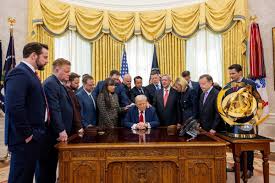
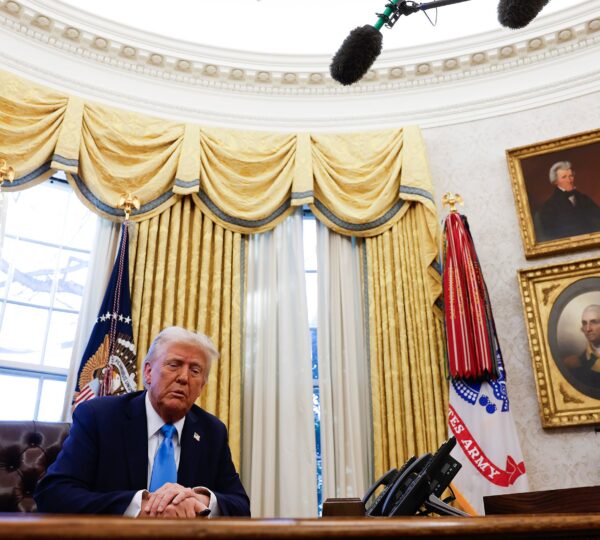
The clip shows Trump seated at the Resolute Desk, eyes closed, while pastors surround him, offering prayers and vocal blessings in a moment captured on video and widely shared online.
This gathering reflects a long‑standing tradition of faith leaders offering spiritual support for U.S. presidents, particularly during times of national challenge or uncertainty.
Supporters of the video highlighted the role of faith and prayer in leadership, noting that many Americans turn to religion for comfort during uncertain times.
Others engaged in online discussion about the event, debating whether faith should play a visible role in political and military contexts, especially at the highest levels of government.
Some commentators focused on the intensity of the geopolitical situation itself, emphasizing that most attention should be on diplomatic efforts to prevent further escalation.
International leaders and diplomatic representatives have repeatedly called for caution, restraint, and dialogue to minimize the risks of widespread conflict in the region.
Critics of the prayer event argued that blending religious practice and political office raises complex questions about the separation of church and state.
Supporters responded that the prayer moment was voluntary and symbolic, meant to offer comfort and unity during difficult global circumstances without imposing belief on others.
Even outside the United States, the video sparked reactions, with some audiences sharing humorous or satirical reinterpretations of the footage on social media platforms.
Despite differing opinions, the primary message expressed in the prayer was consistent: a plea for wisdom, protection, and guidance for the president and for peace for the country.
The event underscores how moments of international tension often intersect with expressions of personal and collective faith among various communities.
Observers noted that similar prayer gatherings have occurred throughout recent presidential administrations, though the frequency and public attention may vary with context.
The video remains widely shared online, emblematic of how modern media captures and circulates moments that blend politics, religion, and public interest.
While the prayer itself was brief, the reactions it drew illustrate how symbolic gestures can resonate differently across political and cultural communities.
Analysts pointed out that prayer initiatives rarely influence policy directly but can serve as emotional or spiritual support for leaders and followers alike.
In the context of ongoing Middle East developments, some religious leaders have emphasized the need for continued prayers for peace, diplomacy, and the safety of civilians.
The moment highlights broader themes about the role of religion in public life and how citizens engage with leaders during crises of national and international consequence.
As tensions remain ongoing, both U.S. officials and international partners emphasize the importance of avoiding further escalation and pursuing diplomatic solutions.
The video of the pastors praying for Trump thus stands as both a spiritual moment and a snapshot of a contentious period in global affairs.
For many observers, the scene symbolizes the complexity of modern leadership, where faith, politics, and public sentiment often converge in unexpected ways.
