
Life has a way of testing every one of us. No matter how strong, successful, or prepared we believe we are, there will come a moment when we are confronted with pain, loss, uncertainty, or emotional exhaustion.
Some struggles are visible to the world. Others remain hidden behind polite smiles and routine conversations. In recent years, as headlines have often focused on conflict, division, and hardship.
It can sometimes feel as though compassion is fading — as if people are becoming more distant, more preoccupied, less willing to pause for one another.
And yet, every so often, a story emerges that challenges that narrative. A story that reminds us that empathy is still alive, that strangers are still capable of extraordinary kindness, and that in moments of crisis, ordinary individuals can rise to meet extraordinary circumstances.
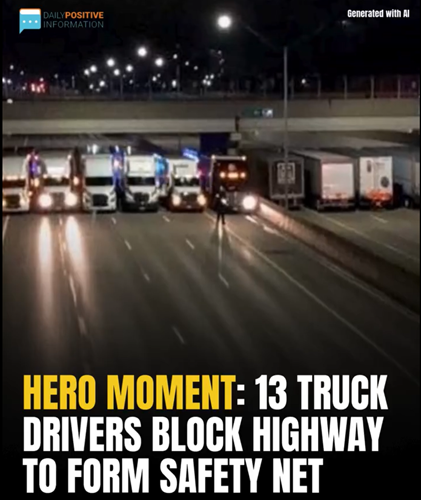
One such moment unfolded on Interstate 696 in Huntington Woods, Michigan, beneath a highway overpass — and it became a powerful example of what can happen when a community chooses to act together to save a life.
It began as an ordinary day. Commuters filled the lanes of I-696, heading to work, school, appointments, and home.
The steady rhythm of traffic — engines humming, turn signals blinking, horns occasionally sounding — created the familiar soundtrack of daily life in a busy metropolitan area. For most drivers, it was just another routine commute.
Then, without warning, everything changed.
Traffic began to slow. Brake lights illuminated in a ripple effect stretching down the highway. Within minutes, vehicles came to a complete stop. Engines were turned off.
Drivers looked at one another in confusion. Some checked navigation apps. Others called family members to explain the delay. Frustration started to build, as it often does when people are stuck without explanation.
What the motorists did not yet know was that just above them, on the overpass, a deeply human crisis was unfolding.
A man was standing at the edge of the bridge, contemplating suicide.
Law enforcement had received reports of the situation and responded quickly. Among those on the scene was Michigan State Police Trooper Michael Shaw.
Situations like this require immediate coordination, calm judgment, and a clear understanding that every second matters. The drop from the overpass to the highway below was significant. A fall from that height would likely have been fatal.
Mental health crises can occur quietly and unexpectedly. They are often invisible until they reach a critical point.
Across the country, first responders routinely face these heartbreaking situations, balancing urgency with compassion. In this case, the priority was clear: protect the man’s life at all costs.
Negotiators were called in to communicate with him. Traffic control measures were put into place. Officers began working to secure the perimeter and reduce additional risks.
But even with trained professionals on scene, the uncertainty remained. The man was in distress, and the danger was real.
It was during these tense moments that Trooper Michael Shaw proposed an idea that would soon capture national attention.
If negotiators needed more time to talk with the man — if the situation could not be resolved immediately — perhaps there was a way to reduce the potential consequences of a fall.
His idea was practical, direct, and rooted in one goal: create a safety barrier beneath the overpass.
Trooper Shaw reached out to a traffic officer to help coordinate a detour, preventing additional vehicles from piling into the already stopped lanes.
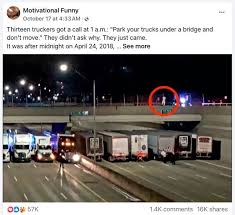
Then he contacted truck drivers in the area with an urgent request. He asked if they would be willing to position their large semi-trucks side by side beneath the bridge, directly under the spot where the man was standing.
The goal was simple. By aligning the trailers closely together, they could significantly reduce the distance of a potential fall and possibly prevent a fatal outcome.
What happened next was a powerful demonstration of collective action.
Thirteen truck drivers answered the call.
Some were hauling freight across state lines. Others were making local deliveries. Many of them had never met before that day. Yet when asked if they would help, they did not hesitate.
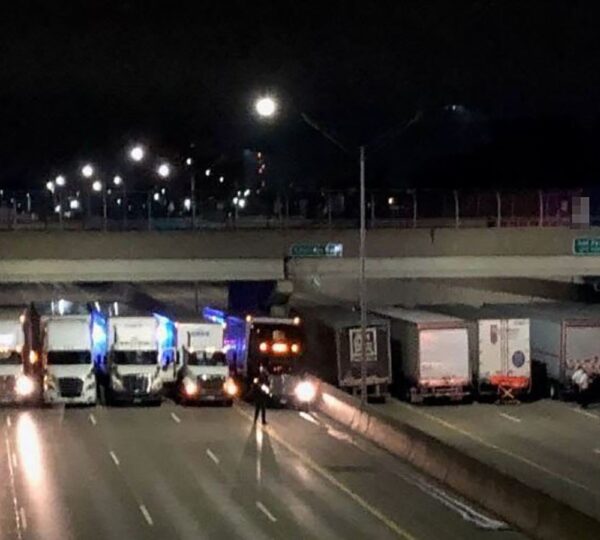
One by one, they maneuvered their massive vehicles into position, carefully aligning them in a tight row beneath the overpass.
Coordinating large commercial trucks on an active interstate is no small task. It required precision, patience, and trust. The drivers worked together under the direction of law enforcement, forming what became an improvised safety platform.
They turned off their engines. Emergency lights flashed. And then they waited.
Above them, negotiators continued speaking calmly with the man on the bridge. Crisis negotiation is a delicate process built on active listening, empathy, and patience.
There are no guarantees. There is no script. The goal is to establish connection, reduce emotional intensity, and create space for the person in crisis to step back from irreversible decisions.
Time stretched on.
Minutes felt like hours. For the drivers parked below, the weight of the moment was tangible. They did not know the man’s name. They did not know his story.
They did not know what pain or circumstances had brought him to that ledge. But they understood one thing clearly: his life had value.
Four hours passed.
Throughout that time, the truck drivers remained in place. Deliveries were delayed. Schedules were disrupted. Personal plans were put on hold. Yet none of that seemed to matter in comparison to the possibility of preventing a tragedy.
Meanwhile, officers and mental health professionals continued their steady work above. They spoke in measured tones. They reassured. They listened. They allowed silence when needed. Every word was chosen carefully.
Finally, after hours of tension, something shifted.
The man stepped back from the edge.
He allowed responders to approach him safely. He was escorted away from the bridge and taken to receive medical and psychological assistance. He was alive.
That outcome was the result of coordinated effort — the quick thinking of Trooper Michael Shaw, the skill of trained negotiators, the organization of traffic officers, and the willingness of thirteen truck drivers to act without hesitation.
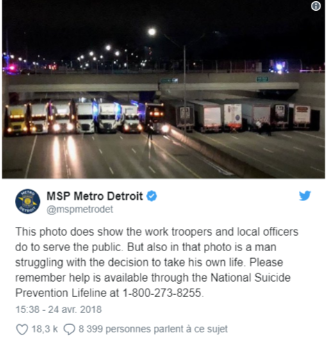
In the days that followed, images of the trucks lined up beneath the overpass circulated widely. From above, the row of trailers formed a striking visual: a literal barrier between life and death.
News outlets across the country reported on the coordinated response. For many observers, the story stood out not only because a life had been saved, but because of how it had been saved.
The drivers did not receive payment for their time. They were not seeking recognition. They responded because they were asked — and because helping felt like the right thing to do.
Stories like this resonate because they counter a common narrative of isolation and indifference. In an era where social media often amplifies conflict and negativity, it can be easy to overlook the quiet acts of cooperation happening every day. Yet beneath the surface, communities continue to function through shared responsibility and mutual support.
The events on Interstate 696 also highlight the importance of mental health awareness. Crises rarely appear out of nowhere.
They are often the culmination of prolonged stress, depression, trauma, or other underlying challenges. Access to support services, open conversations about mental health, and early intervention can make a significant difference.
Equally important is the reminder that prevention is a collective effort. While trained professionals play a critical role, everyday citizens can also contribute simply by being willing to help when asked.
In this case, the truck drivers used the tools available to them — their vehicles — to create a protective barrier. They did not need specialized training. They needed willingness.
Trooper Michael Shaw later received recognition for his leadership and innovative thinking during the crisis. Yet he consistently emphasized that the successful outcome was a team effort.
Without the cooperation of the truck drivers and the dedication of the negotiation team, the story might have ended differently.
The image of those thirteen trucks remains powerful because it represents more than a traffic delay. It represents a pause — a collective decision to prioritize human life over convenience. For hours, a busy interstate became something else entirely: a coordinated act of compassion.
For the man whose life was spared, that day marked the beginning of another chapter. While the details of his personal journey remain private, the fact that he was given a second chance is significant.
Moments of acute crisis do not define a person’s entire life. With appropriate care and support, recovery and healing are possible.
For the drivers who participated, the experience likely became a lasting memory. Few people expect that an ordinary workday will transform into a moment of life-saving collaboration. Yet that is precisely what happened.
For the broader public, the story serves as a reminder that goodness does not always announce itself loudly. Sometimes it appears in the form of large trucks parked side by side.
Sometimes it appears in the steady voice of a negotiator. Sometimes it appears in the willingness of strangers to stand together for hours simply because someone else needs time.
It is natural to feel discouraged by the challenges we see in the world. But stories like the one on Interstate 696 offer balance. They show that compassion remains present — not just as an abstract idea, but as action.
To Trooper Michael Shaw, whose quick thinking transformed a dangerous situation into a coordinated rescue, gratitude is well deserved.
To the crisis negotiators and responding officers, appreciation is owed for their professionalism and calm under pressure.
And to the thirteen truck drivers who parked their rigs beneath that overpass, thank you for demonstrating that everyday individuals can make an extraordinary difference.
You did not simply block a highway. You created a safety net. You turned heavy machinery into a symbol of hope.
And you reminded millions of people that even in moments of deep darkness, humanity still has the capacity to respond with light.
