
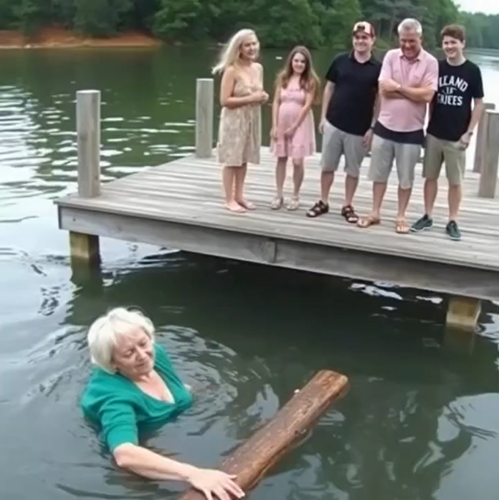
The woman, soaked and visibly trembling, slowly pushed herself up from the cold ground beside the pier. Her breath was uneven, yet her posture began to straighten with surprising calmness.
For a moment, no one spoke. The only sound was the faint movement of water against the wooden structure beneath them. Her family stood nearby, frozen between shock, embarrassment, and confusion at what had just happened.
Her clothes clung heavily to her body, dripping onto the worn wooden planks. Despite her condition, she did not rush or panic. Instead, she seemed to gather herself in silence.
Her eyes, once filled with fear and helplessness, now reflected something different. There was pain, yes, but also a growing sense of awareness and determination forming beneath it.
She slowly raised her hands to her headscarf, which was wet and heavy. With deliberate movements, she untied it, squeezing out the water as her family watched in uneasy silence.
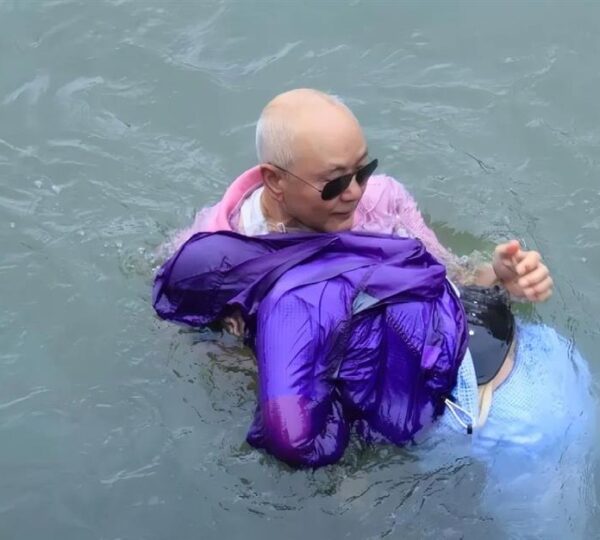
The son shifted uncomfortably, his expression changing from earlier amusement to something closer to guilt. The grandson avoided eye contact, staring instead at the ground beneath his feet.
The daughter-in-law stood slightly behind the others, her hands clasped tightly together, unsure whether to speak or remain silent in the tense atmosphere that had suddenly formed.
The woman finally exhaled deeply, as if releasing years of suppressed emotion. Her voice, when it came, was calm but carried a quiet strength that demanded attention.
“Are you alright?” her son asked again, more carefully this time, his earlier confidence completely gone, replaced by uncertainty and concern.
She paused before answering, brushing wet strands of hair away from her face. Her movements were slow, intentional, as if she was reclaiming control over herself.
“I’ve spent much of my life afraid,” she began softly, her gaze moving from one family member to another without anger or shouting.
“Afraid of water, afraid of judgment, afraid of disappointing others. And maybe I allowed that fear to define me more than I realized,” she continued steadily.
Her words hung in the air, heavy and unavoidable. No one interrupted her. Even the sounds around them seemed quieter, as if the environment itself was listening.

The grandson finally looked up, his expression no longer playful. He seemed to be processing the seriousness of what had happened moments earlier.
The woman took a small step forward, her feet carefully finding balance on the wet surface. Despite everything, she stood firmly, refusing to appear weakened.
“You may think this was just a joke,” she said, her tone firm but controlled, “but fear is not something to be used for entertainment.”
Her son opened his mouth slightly, as if to respond, but stopped when he saw the seriousness in her expression. He realized she was not finished speaking.
“I am not angry,” she continued, surprising them all with her calmness. “Anger would only continue the cycle of harm. But I am deeply aware now.”
She looked directly at the grandson for a brief moment, not with hatred, but with a clear message of disappointment and reflection that made him look away again.
“What happened today will not define me,” she added. “Instead, it will remind me that I still have control over what I choose to face in life.”
Her voice softened slightly, though her strength did not fade. “And I choose to no longer live in fear of something that has limited me for too long.”

The son lowered his head, his earlier confidence completely replaced by regret. He seemed to be searching for words that would not come easily in that moment.
The woman gently picked up her scarf again, wringing out the last of the water. Each movement now felt intentional, almost symbolic, rather than purely physical.
“I will learn to swim,” she said finally, her voice steady and certain. “Not because I was forced into this moment, but because I choose to grow beyond it.”
Her words carried no hesitation. They were not a reaction to humiliation, but a decision rooted in self-awareness and quiet determination.
The family remained silent, absorbing what she had said. The realization slowly settled in that their actions had consequences they had not fully considered.
Without waiting for a response, she turned away from them. Her steps were slow but steady, each one echoing a sense of dignity that had not been present earlier.
As she walked away from the pier, the tension behind her did not disappear immediately, but it began to shift into reflection and discomfort.
Her son finally spoke her name softly, but she did not turn back. Not out of anger, but because she needed distance to gather herself.
The wind moved gently across the water, carrying the quiet aftermath of the moment. The family stood still, each lost in their own thoughts.
In the days that followed, the memory of that incident remained with them, becoming something they could not easily dismiss or laugh about again.
The woman, true to her words, sought out swimming lessons. At first, even stepping near the water brought hesitation and discomfort.
However, she did not allow herself to retreat. Each session became a process of slowly rebuilding confidence and confronting long-held fear.
The instructor noticed her determination, even when progress was slow. She never gave up, even on the most difficult days when fear returned strongly.
Over time, her movements in the water became less tense. What once felt overwhelming gradually turned into something manageable and even freeing.
Outside the pool, her family began to change as well. Their conversations became more thoughtful, and their behavior toward her grew more respectful.
The grandson, in particular, appeared more reflective, often avoiding jokes that involved others’ discomfort or vulnerability.
The son eventually tried to speak with her privately, offering a quiet apology that was not dramatic, but sincere and deeply felt.
She accepted it without bitterness, acknowledging that understanding had begun to replace pride within their family dynamic.
Months later, she could swim short distances on her own, a milestone that symbolized far more than just physical ability.
It represented reclaiming control over fear, rebuilding self-respect, and transforming a painful experience into personal growth.
Her journey became a reminder within the family that strength is not always visible at first glance, but often revealed through resilience.
What began as a moment of humiliation slowly transformed into a long process of reflection, learning, and emotional maturity for everyone involved.
