
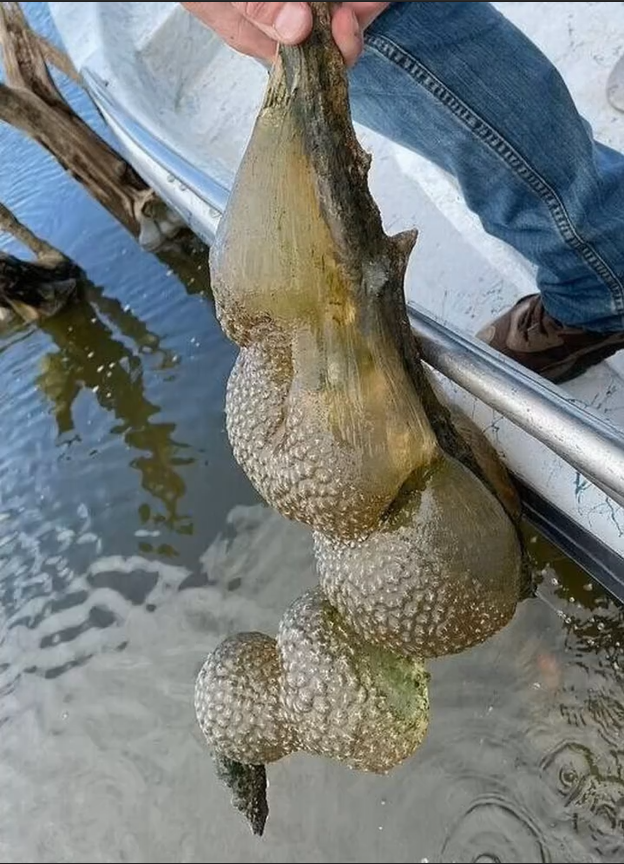
In March 2024, boaters exploring the calm waters of McGee Creek Reservoir in Atoka County, Oklahoma, noticed something unusual hanging from submerged tree branches. Strange jelly-like masses clung beneath the water’s surface, sparking curiosity and confusion among visitors.
At first glance, these mysterious blobs appeared almost alien. Their gelatinous texture and irregular shapes resembled something from a science fiction film rather than a natural formation quietly growing in a peaceful freshwater lake.
The unusual discovery quickly attracted attention from people visiting the reservoir. Photos circulated online as many wondered whether the formations were eggs, an invasive species, or some unknown aquatic organism living beneath the lake’s surface.
Despite their strange appearance, scientists soon clarified that the blobs were not dangerous or unusual at all. In reality, they were colonies of bryozoans, small aquatic animals that naturally occur in freshwater ecosystems across North America.
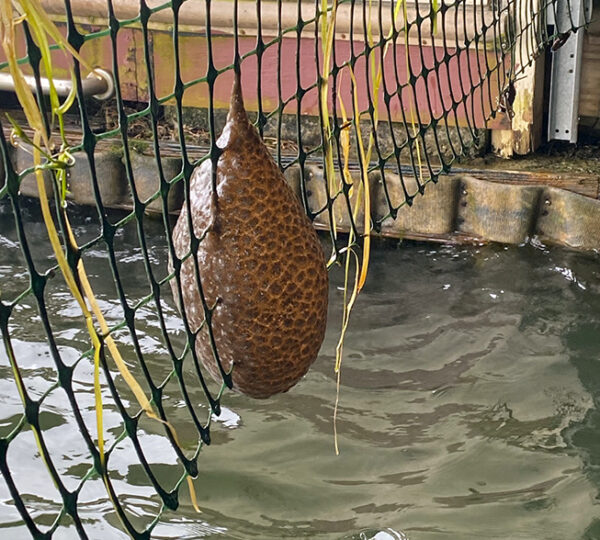
The Oklahoma Department of Wildlife Conservation provided information to the public to help explain what people were seeing. According to the agency, bryozoans are common organisms that form jelly-like colonies attached to submerged surfaces such as branches and rocks.
Bryozoans are tiny invertebrate animals that live together in groups known as colonies. Each colony contains hundreds or even thousands of individual organisms called zooids, which cooperate together to survive and grow.
Although a colony may appear as one large blob, it is actually composed of many zooids living side by side. Each zooid functions as a small animal with its own feeding structure and specialized biological roles.
These microscopic zooids are filter feeders, meaning they capture small particles from the surrounding water. Using tiny hair-like structures called cilia, they move water across their feeding organs and collect nutrients.
The feeding structure used by each zooid is called a lophophore. This circular arrangement of tentacles allows bryozoans to efficiently filter bacteria, algae, and organic particles from the water around them.
By filtering these particles, bryozoans play an important role in maintaining water quality. Their feeding activity helps remove excess organic material and microscopic organisms that naturally accumulate in freshwater environments.
The jelly-like appearance of bryozoan colonies comes from a protective outer layer that surrounds the entire colony. This coating has a gelatinous texture that protects the delicate zooids living inside.
The outer material often feels soft and slippery when underwater. However, when exposed to air and allowed to dry, the surface becomes brittle and can easily break apart.
Most freshwater bryozoan colonies appear translucent or slightly brownish in color. Their shapes vary widely depending on environmental conditions, available surfaces, and the age of the colony.
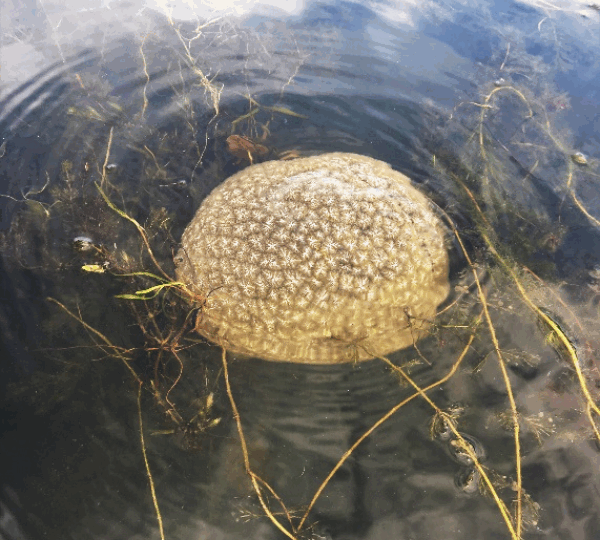
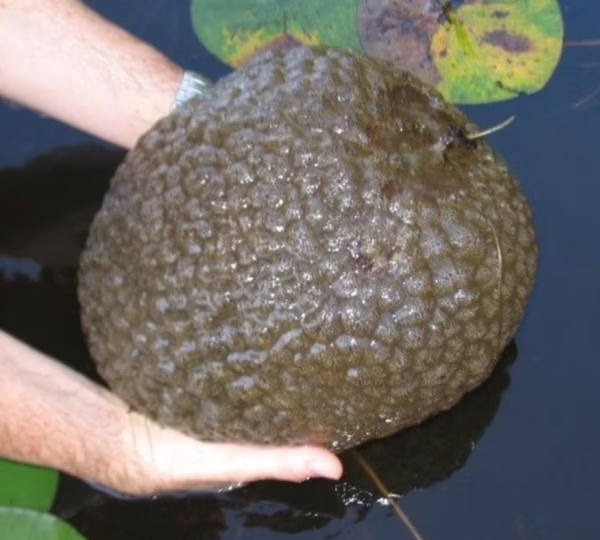
Some colonies resemble rounded blobs, while others develop irregular branching structures. In many cases, they grow in clusters that cover submerged wood, rocks, or aquatic vegetation.
Bryozoans tend to attach themselves to stable surfaces where water gently flows past them. This movement allows a constant supply of microscopic food particles to reach the colony.
Lakes, ponds, and slow-moving rivers provide ideal environments for bryozoans to grow. Calm water with sufficient nutrients helps colonies expand steadily throughout the warm months.
In the case of McGee Creek Reservoir, submerged tree limbs offered perfect attachment points. The branches created sheltered areas where bryozoans could grow undisturbed beneath the water’s surface.
When water conditions are favorable, bryozoan colonies can grow rapidly. Colonies may reach the size of a grapefruit, a basketball, or occasionally even larger.
Although these colonies may appear strange, they are completely harmless to humans. They do not sting, bite, or release toxins into the water.
Scientists emphasize that bryozoans pose no threat to swimmers, anglers, or boaters. Their presence is simply a sign of natural biological activity within the lake.
In fact, the appearance of bryozoan colonies often indicates that the water environment is relatively healthy. These organisms typically thrive in freshwater systems with stable conditions and sufficient oxygen.
One of the most beneficial roles bryozoans play involves water filtration. By feeding continuously, they remove suspended particles and microorganisms from the water column.
This natural filtration can contribute to improved water clarity. While bryozoans alone do not control water quality, their activity supports the overall balance of aquatic ecosystems.
Bryozoans also play a role in the aquatic food web. Several animals feed on them or interact with their colonies in different ways.
Fish, snails, and certain aquatic invertebrates may consume bryozoan tissue. These interactions help transfer energy through the ecosystem from microscopic particles to larger animals.
In addition, bryozoan colonies can create microhabitats for other organisms. Small insects and aquatic invertebrates sometimes hide among the folds and surfaces of the colony.
These tiny habitats contribute to biodiversity within freshwater ecosystems. The presence of different organisms living together strengthens ecological stability in lakes and reservoirs.
Bryozoans reproduce in several interesting ways that help them survive seasonal changes. One of their most remarkable reproductive strategies involves producing structures called statoblasts.
Statoblasts are durable reproductive capsules that allow bryozoans to survive harsh conditions such as winter freezing or drought. They contain genetic material capable of forming new colonies later.
When environmental conditions become unfavorable, colonies release statoblasts into the water. These small structures sink to the bottom or attach to surfaces.
Once temperatures rise and conditions improve, the statoblasts can develop into new colonies. This process allows bryozoans to repopulate lakes and ponds year after year.
Statoblasts are extremely resilient and can survive long periods in sediment. Some may remain dormant until the right environmental signals trigger their development.
This reproductive strategy helps bryozoans spread widely throughout freshwater systems. Water currents, animals, and even birds can transport statoblasts between different bodies of water.
Because of this dispersal ability, bryozoans can be found across many regions of the world. They inhabit lakes, reservoirs, ponds, and slow-moving rivers on multiple continents.
Although they are widespread today, bryozoans have an even more impressive history on Earth. Fossil records show that their ancestors existed hundreds of millions of years ago.
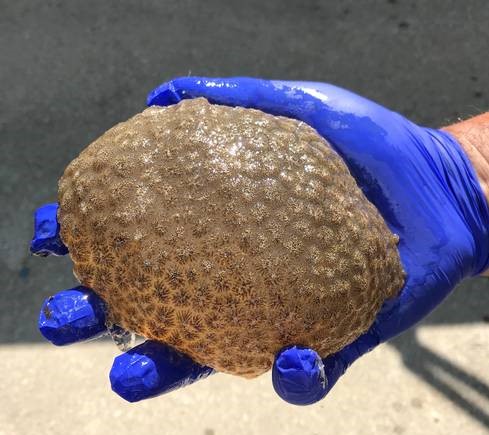
Scientists estimate that bryozoans first appeared during the Ordovician period roughly 470 million years ago. Since then, they have evolved into thousands of different species.
These ancient origins make bryozoans one of the oldest groups of colonial animals still living today. Their survival through many geological eras demonstrates remarkable adaptability.
Over millions of years, bryozoans have adapted to both marine and freshwater environments. Many species live in oceans, while others have specialized for life in lakes and rivers.
Freshwater bryozoans like those found in Oklahoma represent only a small portion of the group’s diversity. However, they play an important ecological role wherever they appear.
Despite their long history, bryozoans remain unfamiliar to many people. Because they live underwater and are often small, they rarely attract attention unless colonies grow large.
When colonies become visible near the water’s surface or attached to docks and branches, people may notice them for the first time and wonder what they are.
In many cases, their gelatinous texture leads observers to assume they are eggs or some type of unusual algae. However, careful study quickly reveals their true biological nature.
Scientists study bryozoans to learn more about aquatic ecosystems and environmental health. Their presence can provide clues about water conditions, nutrient levels, and ecological stability.
Because bryozoans filter water continuously, they respond to changes in the environment. Pollution or poor water quality may reduce their ability to survive and grow.
Therefore, the appearance of healthy bryozoan colonies can indicate that a freshwater habitat remains relatively balanced. This is one reason scientists view them as positive ecological indicators.
At McGee Creek Reservoir, the discovery of bryozoan colonies suggested that the lake continues to support a functioning aquatic ecosystem. Clean water and suitable habitats allow many organisms to thrive there.
Reservoirs like McGee Creek provide valuable resources for both wildlife and people. They support fish populations, recreational activities, and natural biodiversity.
The presence of organisms such as bryozoans demonstrates that complex ecological processes are constantly taking place beneath the water’s surface.
Although humans often notice only fish or large animals in lakes, microscopic organisms and colonial invertebrates play equally important roles in maintaining ecological balance.
Every organism in the aquatic environment contributes to the broader system. From bacteria to fish, each species participates in nutrient cycling and energy transfer.
Bryozoans represent one small but fascinating component of this intricate natural network. Their colonies quietly filter water and support other organisms without drawing much attention.
For boaters and visitors, encountering bryozoan colonies can be a surprising experience. However, understanding what they are helps transform confusion into appreciation for freshwater biodiversity.
Instead of viewing these blobs as strange or frightening, they can be recognized as natural signs of life thriving beneath the water.
Education about organisms like bryozoans helps people better understand the ecosystems they enjoy during outdoor recreation.
Lakes and reservoirs contain countless species that interact in complex ways. Learning about these interactions encourages responsible environmental stewardship.
Protecting freshwater habitats ensures that organisms such as bryozoans continue to survive and perform their ecological functions.
Clean water policies, habitat conservation, and responsible recreation all contribute to maintaining healthy aquatic ecosystems.
When people respect natural environments, they help preserve the delicate balance that allows biodiversity to flourish.
The mysterious blobs discovered in Oklahoma ultimately served as a reminder of how much hidden life exists within lakes and reservoirs.
What first appeared unusual or even unsettling turned out to be an example of nature quietly operating as it has for millions of years.
Bryozoans continue to thrive in freshwater environments around the world, filtering water and supporting aquatic ecosystems.
Their long evolutionary history and unique colonial lifestyle make them one of the most intriguing groups of small aquatic animals.
The next time someone notices a jelly-like mass attached to an underwater branch, it may simply be another colony of bryozoans doing its important work.
Rather than being mysterious invaders, these organisms are part of a natural system that has existed for hundreds of millions of years.
Their presence reminds us that even the smallest creatures can play significant roles in maintaining the health of our planet’s ecosystems.
Understanding these organisms helps people appreciate the complex and interconnected world hidden beneath the surface of freshwater lakes.
Bryozoans may look unusual at first, but they represent a remarkable example of cooperation, adaptation, and ecological balance in the natural world.
