
Six Girls, Five Pairs of Legs: The Optical Illusion That’s Leaving People Baffled
Optical illusions are among the most fascinating ways our brains can be tricked.
They reveal just how complex and imperfect our perception of reality can be.
No matter how confident you are in your eyesight, illusions like these can make even the sharpest observers pause, scratch their heads, and double-check what they see.
Recently, one optical illusion has captivated social media users across the world: a photograph of six girls sitting on a couch, yet there appear to be only five pairs of legs.
The image is simple, yet it has left thousands asking the same question: how can one person appear to have no legs at all?
Why Optical Illusions Trick Our Brains
To understand why illusions like this work, it helps to know how our brains process visual information.

According to the Queensland Brain Institute, an optical illusion occurs “when our brain and eyes try to communicate with each other, but the interpretation becomes a little mixed-up.”
In other words, our brain constantly interprets visual cues, makes assumptions, and fills in missing information.
Most of the time, this process happens so seamlessly that we barely notice it.
However, clever optical illusions exploit these shortcuts, causing our brain to “see” something that isn’t there or to misinterpret what is visible.
The institute elaborates: “For example, your brain might think something is moving when it isn’t.
Our brains and eyes evolved to be highly sensitive to movement because spotting slight motion in prehistoric times could save your life.
A rustle in the bushes could indicate a predator, signaling it was time to escape.”
This heightened sensitivity to visual cues — an evolutionary advantage in survival — explains why our brain can be easily fooled in controlled situations like photos or drawings.
Optical illusions can also exploit patterns, symmetry, shadows, and perspective.
By deliberately creating ambiguity, artists and photographers can trick the brain into seeing shapes, objects, or movements that don’t exist, creating a fascinating conflict between perception and reality.
The Viral Image That Confused Everyone
The particular photo making waves on Reddit, Twitter, and other platforms shows six girls sitting on a couch.
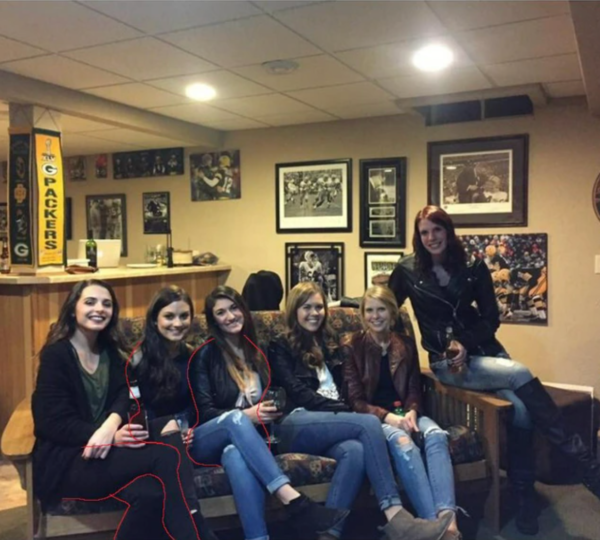
At first glance, however, only five pairs of legs are visible. For those scrolling quickly through their feeds, it can feel impossible — almost as if the photographer accidentally erased a person’s legs.
Social media forums lit up with discussion as users attempted to explain the phenomenon.
Many initially thought it was a Photoshop error or a deliberate joke. Others tried to trace the positions of the girls and their clothing, attempting to reconstruct the puzzle manually.
The image’s popularity grew because it’s immediately relatable — most people have tried and failed to solve a visual trick, making this a perfect collective brain teaser.
How the Illusion Works
According to explanations on Reddit and The Tab, the illusion is primarily caused by clever positioning, overlapping, and perspective.
One user noted: “The second girl’s legs are behind the first girl’s legs. You can’t see them at first because they blend with the others, but they are there.”
The arrangement causes your brain to incorrectly assign visible legs to the wrong person, creating the impression that one girl is missing her legs entirely.
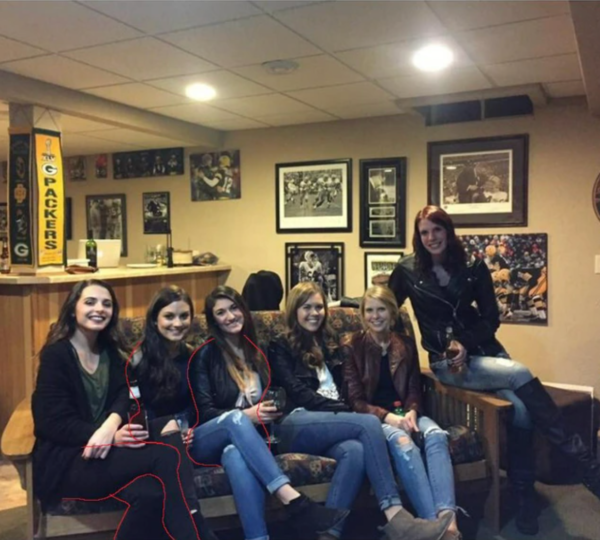
Reddit user ElMangosto went a step further, providing a detailed breakdown with a labeled diagram. His explanation reads:
“Left to right, girls are numbered #1, #2, #3, and so on. Girl #1 has her legs crossed with no visible tear in her knee.
Girl #2 has one leg visible, and there’s a tear in her knee. The legs of #2 and #3 are positioned behind and over each other, creating confusion.
Following the tear on #2’s knee, you can see a sock on the right but not the left — that’s the clue. Girl #3 is leaning forward, using her hand on the seat behind #4 to support herself, adding to the illusion.”
Put simply, the “missing” legs are actually hidden in plain sight.
The clever overlap of limbs, combined with the girls’ poses and the way the photo was framed, fools our brains into misassigning which legs belong to which person.

Shadows, socks, and knee tears serve as subtle visual cues that reveal the truth once observed carefully.
Why the Illusion Went Viral
Several factors contributed to this image’s viral success:
Relatability: Many people enjoy visual puzzles and take pride in spotting subtle differences or “hidden” elements. A challenge like this naturally encourages sharing and engagement.
Complexity without Obvious Answers: The illusion is intricate enough to be baffling but not so complex that it feels impossible. This keeps viewers intrigued and motivated to solve it.
Social Media Discussion: Platforms like Reddit and Twitter allow people to debate and share solutions, creating an interactive experience. Every comment and theory drives further engagement.
Beyond entertainment, images like this highlight how our brains process visual information and how perception can sometimes be unreliable.
They show that even in a world filled with information, our own senses can mislead us — a humbling reminder of the limits of human perception.
How to Solve the Illusion Yourself
If you’re still puzzled, here’s how to approach it:
Look for overlapping limbs: Notice where knees, socks, and shoes might give away hidden legs.
Observe perspective carefully: The girl leaning forward may obscure another’s legs, creating confusion.
Focus on subtle details: Torn knees, crossed legs, or different sock patterns can help separate one person’s legs from another’s.
Once you start paying attention to these small cues, the image finally “clicks,” revealing that no girl is missing legs — it’s simply a perfectly executed illusion.
What We Can Learn from Optical Illusions
Illusions like the viral six-girls image are more than just fun; they remind us of the incredible complexity of the human brain.
They demonstrate how quickly our minds form assumptions, how perception can be manipulated, and how a small shift in perspective can completely alter our understanding of reality.
They also offer a playful way to challenge our brains. Sharing illusions with friends or family can spark curiosity, conversation, and even a bit of friendly competition.
And as frustrating as they may be at first, the satisfaction of finally seeing the “truth” behind an illusion is surprisingly rewarding.
Final Thoughts
The six-girls-on-a-couch optical illusion is a perfect example of how our brains can be tricked by simple visual cues.
While it may initially leave us scratching our heads, it also highlights the brilliance of perspective, framing, and human perception.
Next time you see a puzzling image, take a closer look — your brain may be deceiving you, but with careful observation, the mystery can always be solved.
Whether you’re a fan of brain teasers, optical illusions, or just enjoy sharing viral content, this image is a playful reminder of how extraordinary — and occasionally unreliable — our visual perception can be.
Optical illusions are among the most fascinating ways our brains can be tricked.
They reveal just how complex and imperfect our perception of reality can be.
No matter how confident you are in your eyesight, illusions like these can make even the sharpest observers pause, scratch their heads, and double-check what they see.
Recently, one optical illusion has captivated social media users across the world: a photograph of six girls sitting on a couch, yet there appear to be only five pairs of legs.
The image is simple, yet it has left thousands asking the same question: how can one person appear to have no legs at all?
Why Optical Illusions Trick Our Brains
To understand why illusions like this work, it helps to know how our brains process visual information.
According to the Queensland Brain Institute, an optical illusion occurs “when our brain and eyes try to communicate with each other, but the interpretation becomes a little mixed-up.”
In other words, our brain constantly interprets visual cues, makes assumptions, and fills in missing information.
Most of the time, this process happens so seamlessly that we barely notice it.
However, clever optical illusions exploit these shortcuts, causing our brain to “see” something that isn’t there or to misinterpret what is visible.
The institute elaborates: “For example, your brain might think something is moving when it isn’t.
Our brains and eyes evolved to be highly sensitive to movement because spotting slight motion in prehistoric times could save your life.
A rustle in the bushes could indicate a predator, signaling it was time to escape.”
This heightened sensitivity to visual cues — an evolutionary advantage in survival — explains why our brain can be easily fooled in controlled situations like photos or drawings.
Optical illusions can also exploit patterns, symmetry, shadows, and perspective.
By deliberately creating ambiguity, artists and photographers can trick the brain into seeing shapes, objects, or movements that don’t exist, creating a fascinating conflict between perception and reality.
The Viral Image That Confused Everyone
The particular photo making waves on Reddit, Twitter, and other platforms shows six girls sitting on a couch.
At first glance, however, only five pairs of legs are visible. For those scrolling quickly through their feeds, it can feel impossible — almost as if the photographer accidentally erased a person’s legs.
Social media forums lit up with discussion as users attempted to explain the phenomenon.
Many initially thought it was a Photoshop error or a deliberate joke. Others tried to trace the positions of the girls and their clothing, attempting to reconstruct the puzzle manually.
The image’s popularity grew because it’s immediately relatable — most people have tried and failed to solve a visual trick, making this a perfect collective brain teaser.
How the Illusion Works
According to explanations on Reddit and The Tab, the illusion is primarily caused by clever positioning, overlapping, and perspective.
One user noted: “The second girl’s legs are behind the first girl’s legs. You can’t see them at first because they blend with the others, but they are there.”
The arrangement causes your brain to incorrectly assign visible legs to the wrong person, creating the impression that one girl is missing her legs entirely.
Reddit user ElMangosto went a step further, providing a detailed breakdown with a labeled diagram. His explanation reads:
“Left to right, girls are numbered #1, #2, #3, and so on. Girl #1 has her legs crossed with no visible tear in her knee.
Girl #2 has one leg visible, and there’s a tear in her knee. The legs of #2 and #3 are positioned behind and over each other, creating confusion.
Following the tear on #2’s knee, you can see a sock on the right but not the left — that’s the clue. Girl #3 is leaning forward, using her hand on the seat behind #4 to support herself, adding to the illusion.”
Put simply, the “missing” legs are actually hidden in plain sight.
The clever overlap of limbs, combined with the girls’ poses and the way the photo was framed, fools our brains into misassigning which legs belong to which person.
Shadows, socks, and knee tears serve as subtle visual cues that reveal the truth once observed carefully.
Why the Illusion Went Viral
Several factors contributed to this image’s viral success:
Relatability: Many people enjoy visual puzzles and take pride in spotting subtle differences or “hidden” elements. A challenge like this naturally encourages sharing and engagement.
Complexity without Obvious Answers: The illusion is intricate enough to be baffling but not so complex that it feels impossible. This keeps viewers intrigued and motivated to solve it.
Social Media Discussion: Platforms like Reddit and Twitter allow people to debate and share solutions, creating an interactive experience. Every comment and theory drives further engagement.
Beyond entertainment, images like this highlight how our brains process visual information and how perception can sometimes be unreliable.
They show that even in a world filled with information, our own senses can mislead us — a humbling reminder of the limits of human perception.
How to Solve the Illusion Yourself
If you’re still puzzled, here’s how to approach it:
Look for overlapping limbs: Notice where knees, socks, and shoes might give away hidden legs.
Observe perspective carefully: The girl leaning forward may obscure another’s legs, creating confusion.
Focus on subtle details: Torn knees, crossed legs, or different sock patterns can help separate one person’s legs from another’s.
Once you start paying attention to these small cues, the image finally “clicks,” revealing that no girl is missing legs — it’s simply a perfectly executed illusion.
What We Can Learn from Optical Illusions
Illusions like the viral six-girls image are more than just fun; they remind us of the incredible complexity of the human brain.
They demonstrate how quickly our minds form assumptions, how perception can be manipulated, and how a small shift in perspective can completely alter our understanding of reality.
They also offer a playful way to challenge our brains. Sharing illusions with friends or family can spark curiosity, conversation, and even a bit of friendly competition.
And as frustrating as they may be at first, the satisfaction of finally seeing the “truth” behind an illusion is surprisingly rewarding.
Final Thoughts
The six-girls-on-a-couch optical illusion is a perfect example of how our brains can be tricked by simple visual cues.
While it may initially leave us scratching our heads, it also highlights the brilliance of perspective, framing, and human perception.
Next time you see a puzzling image, take a closer look — your brain may be deceiving you, but with careful observation, the mystery can always be solved.
Whether you’re a fan of brain teasers, optical illusions, or just enjoy sharing viral content, this image is a playful reminder of how extraordinary — and occasionally unreliable — our visual perception can be.


