
The young woman sat quietly in the barbershop chair, her hands clasped together in her lap, knuckles whitening under the pressure.
The rhythmic hum of the clippers in the background seemed to echo the racing of her own heart, a constant mechanical drone that never faltered, never gave pause.
She tried to steady herself, brushing her hands gently over her knees, inhaling and exhaling as if the motion could calm the storm inside her chest. Yet, no matter how deliberately she moved, how controlled her breathing, the unease remained, a gnawing awareness that the world she had known — the world where she felt safe in her own body — was shifting, slipping from her.
Every now and then, her fingers moved involuntarily to her hair, running over the strands that had once framed her face. They slipped through her grip, brushing against her palms before drifting to the floor.
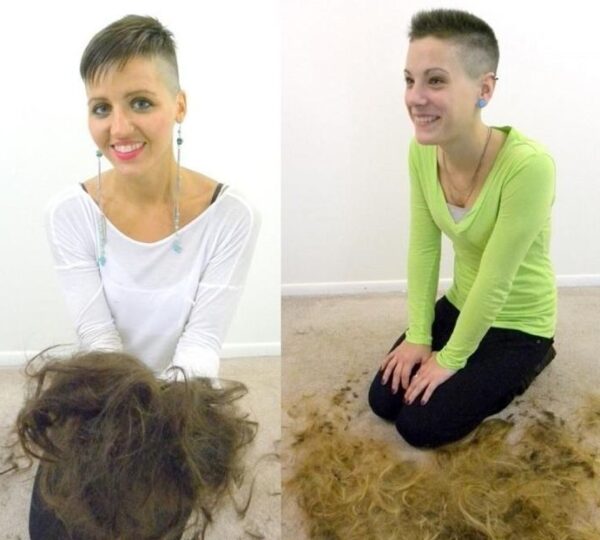
Each hair that fell was a quiet reminder of the months of struggle she had endured in silence. At home, she had spent countless hours standing in front of the bathroom mirror, peering at the pillow in the morning, at the drain in the shower, watching in disbelief as more and more hair collected there.
She had felt panic rise in her throat, the kind of helpless panic that comes when the body seems to betray the mind, and no one else — not her friends, not her coworkers, not even the occasional casual acquaintance — seemed to notice, to understand, to truly see.
Tears stung her eyes as she lifted her gaze, trying to focus on the reflection in the mirror in front of her. She watched her own face framed by thinning locks, her expression a mixture of fear, resignation, and quiet sorrow.
She didn’t bother to wipe the tears that began to trail down her cheeks; this was a moment that demanded acknowledgment, a private grief that refused to be ignored.
Her chest tightened with every strand that dropped, each one feeling like a fragment of her identity, her confidence, slipping from her hands.
The lump in her throat was impossible to swallow down completely, leaving her voiceless and trembling in the quiet hum of the barbershop.
The world carried on around her. Other customers chatted in low tones, their conversations punctuated by occasional laughter or the snip of scissors in the distance.
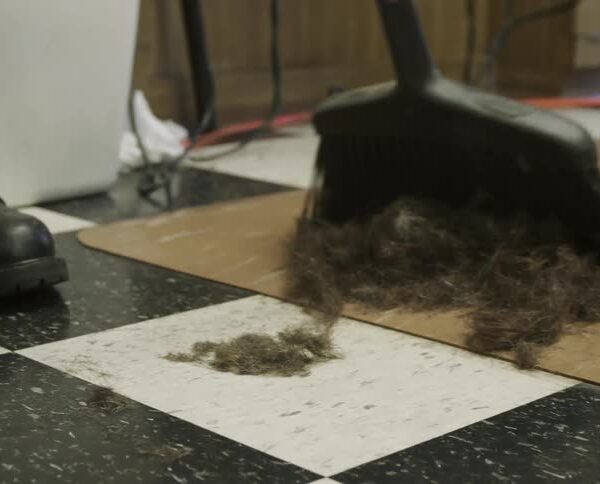
Yet for her, time seemed to stretch and narrow simultaneously, condensing into the confined space of her chair, the mirrored walls reflecting only the truth she could not hide: her vulnerability.
Every buzz of the clippers resonated within her chest, a constant reminder that she could not simply will this experience away. Then, the unexpected happened.
A hand rested gently on her shoulder, warm and grounding, interrupting the private rhythm of her despair. She flinched, startled by the contact, by the sudden human presence that seemed to enter her space without asking permission.
When she looked up, she saw Jake standing there — broad-shouldered, quiet, and steady, a face weathered in a way that suggested both resilience and deep empathy.
His eyes met hers, and in them she read not pity, not judgment, but understanding, an unspoken recognition of the fight she had been waging alone.
Without a word, Jake removed his cap, revealing thick, dark hair that fell in soft waves. Then, slowly, deliberately, he reached for a pair of clippers, the metal gleaming under the bright barbershop lights.
With a deep, steady breath, he switched them on, the buzzing filling the space between them. And then he began to shave his own head.
Her breath caught in her throat. She could not speak. She could only watch as clumps of his hair fell, swirling gently to the floor. The room seemed to pause, the usual sounds of the barbershop fading behind the hum of the clippers and the quiet tension that had taken hold.

The other barbers, initially frozen, began to watch. Some furrowed their brows in confusion, others hesitated, uncertain of the purpose of this act.
Yet there was something in Jake’s deliberate calm, in the unspoken courage of his gesture, that shifted the energy in the room.
Slowly, almost imperceptibly at first, one by one, the barbers followed. Clippers buzzed to life, and heads began to be shaved, revealing skin that had never been touched by their tools before.
The room filled with the hum of solidarity, a chorus of buzzing metal and falling hair, a sound that was no longer mechanical but symbolic.
It was no longer about fashion, about trend, about bravado. It was about something deeper — about acknowledgment, about empathy, about being present in someone else’s struggle.
The young woman sat frozen, her eyes wide, tears continuing to streak her cheeks as she took in the scene. Hair fell around her and theirs alike, collecting on the floor in a growing testament to shared vulnerability.
Every buzz, every strand landing softly on the tiles seemed to whisper to her: you are not alone. We see you. We understand. Your struggle does not go unnoticed.
Her chest tightened as a surge of emotion overtook her. It was a mixture she could barely name — sorrow, relief, fear, courage, and hope all woven together in the quiet rhythm of the clippers.
She had entered the barbershop expecting isolation, expecting shame, expecting the loneliness that often accompanies such profound personal struggle.
Yet what she felt now was the opposite: connection, profound and grounding, an invisible thread tying her to these men who had, in their own quiet way, stepped into her world to show she did not face it alone.
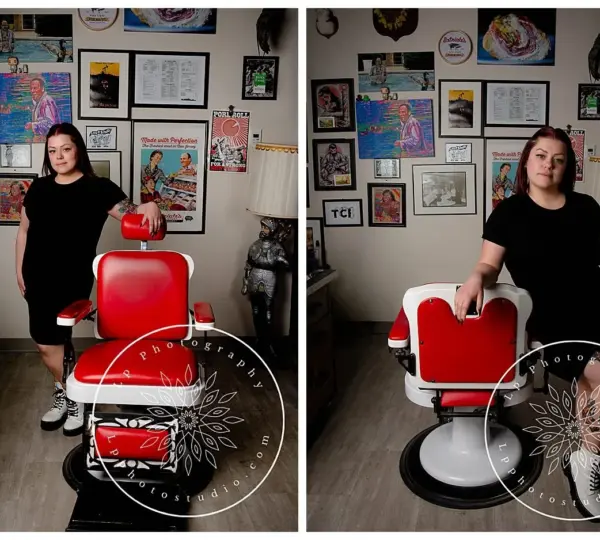
Tears, this time, were different. They streamed freely down her face, unrestrained and unafraid. These were not tears of defeat or despair; they were tears of gratitude, recognition, and release.
Her shoulders, so long held rigid against the weight of private suffering, began to relax. A warmth spread from her chest down to her hands, grounding her in the knowledge that she was seen and accepted, that her pain was acknowledged not through words but through action and solidarity.
Jake, noticing her gaze, offered a small, understanding smile. “We’re all in this together, kid,” he said softly. The words were simple, but they carried a weight far beyond their brevity.
She responded with a shaky laugh, the sound fragile but cathartic, releasing months of tension she hadn’t known could be let go in this small, sacred space.
As she looked around, the transformation of the room struck her. Everyone — every barber, herself included — was bald now, their hair pooled in clumps on the floor.
The mirrors reflected not just faces, but courage, vulnerability, and an unspoken bond formed through shared action.
The barbers, often assumed to be rough, stoic, or unfeeling, had opened themselves fully, showing that true strength often lies in the willingness to be vulnerable alongside someone else.
Tentatively, she reached up to touch her own scalp. The smoothness beneath her fingers was a physical reminder of what she had endured, but she did not recoil.
Instead, there was an unexpected sense of liberation, a tactile confirmation of courage — a reminder that loss, even in its most personal and visible form, could be met with resilience and compassion.
Jake leaned closer, as if sensing her hesitation, and whispered again, “It doesn’t hurt to be brave, and it doesn’t mean you’re alone.”
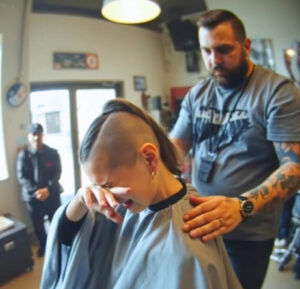
The words sank into her heart, embedding themselves as an affirmation she would carry long after the hum of clippers faded and the barbershop returned to its everyday rhythm.
Outside, the cool wind brushed across her bare scalp, a sensation she expected to sting, to remind her of vulnerability and loss. Instead, it felt refreshing, cleansing, renewing.
Each breath of air carried with it the memory of the kindness, courage, and connection she had just experienced — a memory she knew would remain a guide and a source of strength in the days ahead.
The young woman walked with a new lightness, her steps measured but confident. For the first time in months, she felt seen, understood, and connected. Her struggle was no longer private, her grief no longer hers alone.
In that small barbershop, through the simple yet profound act of shared vulnerability, she had discovered a universal truth: she was never truly alone.
The experience became a turning point, a moment that reshaped how she approached her own body, her own identity, and her relationship to vulnerability.
She realized that while loss could strip away physical things — strands of hair, outward appearances, aspects of control — it could never diminish the human capacity for empathy, connection, and resilience.
And so she walked forward, carrying with her not just the physical evidence of what she had endured, but the invisible, indelible marks of solidarity, understanding, and hope.
The barbershop, once a place of mundane routine, had become a sanctuary, a sacred space where pain was met with compassion, and where courage was as contagious as the simple act of clippers buzzing to life.
For her, that day would remain unforgettable. She had entered with anxiety, fear, and quiet despair — and left with a renewed sense of strength, belonging, and dignity.
Each step in the cool wind outside was a testament to the power of empathy, the transformative effect of human kindness, and the deep, unspoken bond formed when people stand together in the face of vulnerability.
She knew now, unequivocally, that no hardship, no loss, no fear, and no hair could define her alone. She had been seen, she had been understood, and she had discovered a community of courage that would remain with her always.
And in that discovery, she found a profound and lasting truth: the most powerful strength lies not in what is hidden, but in what is shared.
