
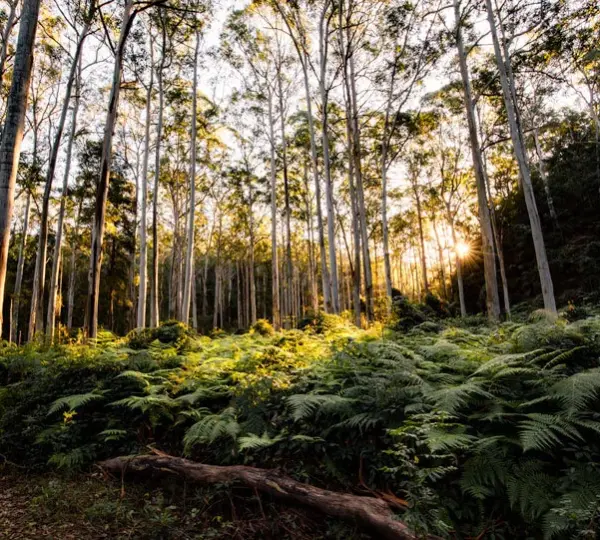
There’s something profoundly calming about spending time in nature. The mental tranquility it brings is almost unmatched—whether it’s a leisurely walk along a quiet country lane.
A gentle Sunday stroll through a meadow filled with wildflowers, or an invigorating hike beneath the sheltering canopy of a dense forest.
For many people, escaping the noise and constant motion of city life is not just a luxury but a vital ritual. Immersing oneself in the natural world provides a sense of grounding, an opportunity to reset mentally, and a chance to reconnect with the fundamental rhythms of life.
The sounds of birdsong, rustling leaves, and babbling streams offer a form of meditation that even the most sophisticated urban wellness practices struggle to replicate.
For some, time spent outdoors becomes a regular habit, a dedicated portion of their week that offers clarity, perspective, and balance.
The human mind, overstimulated by screens, social media, and the relentless pace of modern life, craves this connection with nature.
Studies have shown that even brief exposure to natural environments can reduce stress, improve mood, and sharpen cognitive function.
Being surrounded by trees, open skies, and wildlife provides a chance to slow down, observe, and appreciate the subtleties of life that often go unnoticed in urban settings.
Yet, one of the most delightful aspects of exploring the outdoors is its unpredictability. Nature is full of surprises, some profound, some whimsical, and some downright misleading.
Occasionally, what you think you see is not exactly what it appears to be. This was precisely the case for Australian nature enthusiast and amateur photographer Kym Beechey, whose experience walking through the bushland produced a story both amusing and enlightening.
Kym Beechey: A Life Among Nature
Kym Beechey has long been passionate about the outdoors. She enjoys walks in areas abundant with native flora and fauna, often seeking solace and inspiration in the quiet rhythms of the bush.
Kym’s approach to nature combines both observation and mindfulness; she doesn’t just pass through the environment—she immerses herself in it.
Her keen interest in wildlife, coupled with a growing hobby in photography, has made her highly attuned to the small wonders of the natural world, from rare plants to elusive birds.
Photography, for Kym, is more than just a pastime. It is a way of documenting the fleeting moments of beauty and peculiarities in the wild.
She carries her camera or smartphone on walks with the intent to capture something extraordinary, understanding that in nature, patience and attention to detail are rewarded.
Animals, however, are not posed subjects. Unlike studio photography, wild creatures are unpredictable, shy, and often move faster than one’s lens can follow.
Success in wildlife photography requires observation, timing, and respect for the subjects’ space—a balance Kym has carefully cultivated over the years.
The Curious Encounter
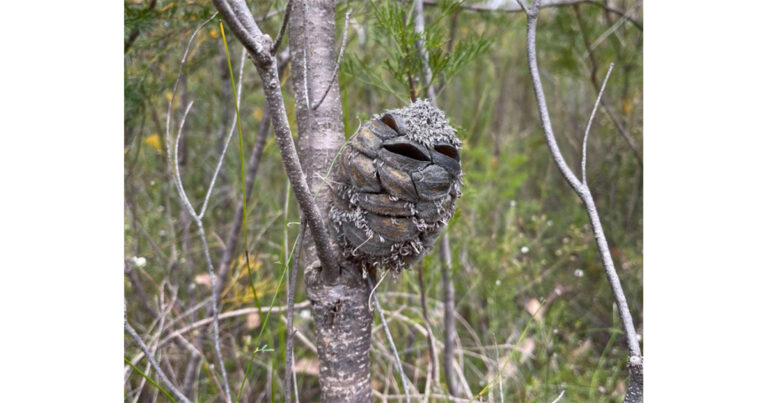
On a recent walk, Kym experienced a moment that perfectly exemplified the unpredictability of nature. As she wandered through a wooded area rich with native Australian flora, she noticed something perched low on a branch.
At first glance, the creature appeared to be a newborn tawny frogmouth—a small, nocturnal bird native to Australia that bears a striking resemblance to an owl.
The bird seemed to be resting, its eyes partially closed, giving it a peaceful, content expression.
Kym even thought it looked like it was smiling, a feature that immediately captured her attention and sparked her excitement. The possibility of photographing such a rare, young bird up close was thrilling.
Excited but cautious, Kym carefully raised her phone, zoomed in, and snapped several photos. She was mindful not to startle the animal, holding her breath and maintaining a respectful distance.
The scene felt almost magical: a tiny, fluffy creature, perfectly still, with the soft filtered light of the forest highlighting its subtle textures. It seemed to embody the tranquility of the morning, an emblem of nature’s gentle surprises.
A Hilarious Revelation
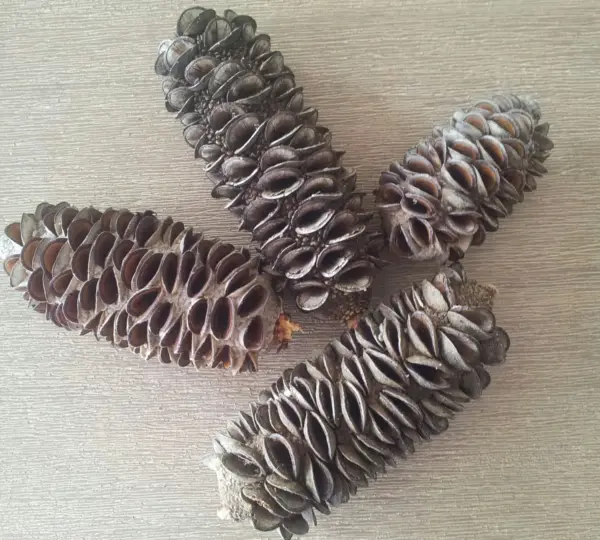
However, when Kym reviewed her photos more closely, the truth became apparent. The “bird” she had so carefully observed and photographed was not a bird at all. It was a banksia pod—a seed pod from the native Australian banksia tree.
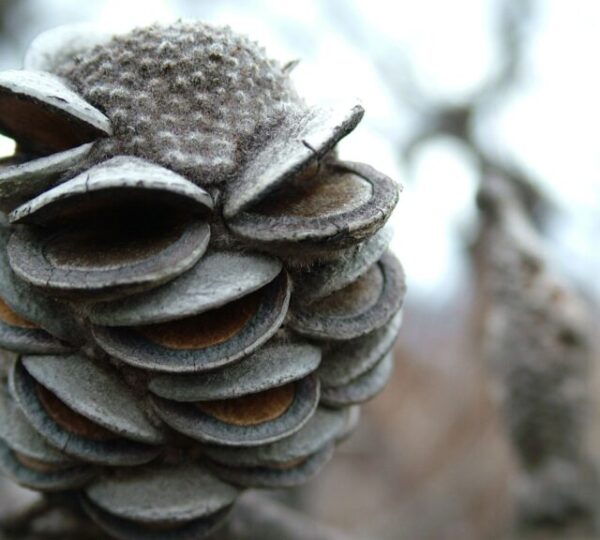
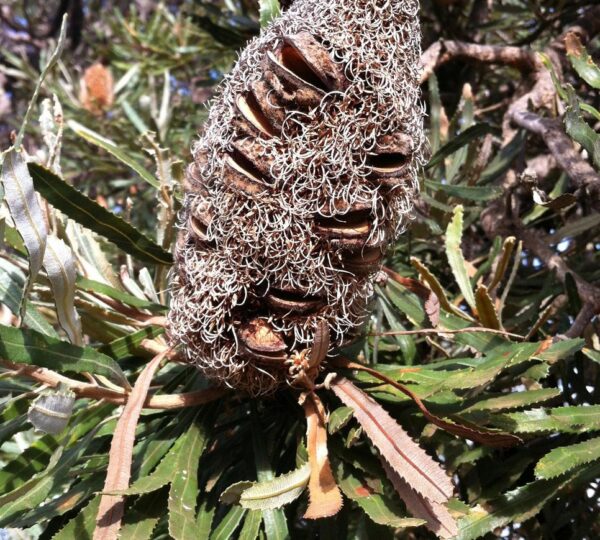
Banksia pods are fascinating botanical structures that, from certain angles, can closely mimic the shapes and textures of small animals. Some pods even have markings or protrusions that resemble eyes, beaks, or facial expressions.
Kym’s initial misidentification is entirely understandable—nature is full of such visual illusions, and the brain often fills in familiar patterns when confronted with ambiguous shapes.
The banksia pod she photographed had an appearance so convincingly “bird-like” that it took a detailed look at her photos to realize the truth. She could not help but laugh at the mix-up.
The creature she had thought was alive, capable of flight and song, was, in reality, an inanimate part of a tree. While it may not have been eligible to blink or move, it had certainly captured her imagination and curiosity.
The Banksia Tree and Its Unique Seed Pods
Banksia trees are native to Australia, primarily found in the southwestern regions, though they also grow in parts of New Zealand and Papua New Guinea.
Often mistaken for conifers due to the appearance of their woody seed pods, banksias are not true pines. The seed pods are one of the tree’s most distinctive features, displaying a rugged texture and unusual shapes that can sometimes appear anthropomorphic, as in Kym’s encounter.
These seed pods play a critical role in the life cycle of the banksia. Many species have pods that only open under extreme conditions, particularly after bushfires.
The intense heat from fires causes the pods to release their seeds, which then fall onto nutrient-rich soil cleared of competing vegetation.
This adaptation ensures the propagation of the species, making banksia trees emblematic of resilience and regeneration in the Australian bush.
The pods themselves often carry the marks of their fiery exposure, giving them twisted, sculpted forms that can easily resemble living creatures at first glance.
Kym’s “baby bird” may very well have gone through such a natural process, explaining its uncanny resemblance to a tawny frogmouth and the peculiar textures that fooled her initial perception.
Mistaken Identity as a Learning Moment
Although Kym did not capture a rare bird, the experience was memorable in other ways. Her photo serves as a humorous reminder of the ways our minds interpret visual cues, especially in environments rich with textures, shapes, and shadows.
It is a testament to the surprise and unpredictability inherent in exploring natural spaces.
Mistaken identity in nature is a common phenomenon. Animals often camouflage themselves against foliage, while plants and fungi can mimic forms familiar to humans.
These illusions are not only amusing—they illustrate the remarkable complexity and creativity of ecosystems, where evolution shapes both flora and fauna to survive and thrive.
For Kym, the encounter reinforced several valuable lessons: patience is essential, observation requires care, and sometimes the most intriguing moments in nature are the ones that challenge your assumptions.
Her “discovery” became a story worth telling, even if the subject was botanical rather than avian.
Embracing the Unexpected
The broader takeaway from Kym’s experience is the joy of unpredictability in the natural world. Nature doesn’t operate on a human schedule; it doesn’t conform to expectations.
Whether it’s a misidentified bird, a hidden animal, or a rare plant in bloom, these moments offer a gentle reminder to slow down and notice the subtle details that make each encounter unique.
Kym’s photo has become part of her personal collection, not as an image of a rare species but as a testament to the wonder, humor, and charm that nature can provide.
She now looks at the photo and laughs, appreciating the story behind it as much as the image itself. In many ways, this is the essence of nature photography: capturing not only what is visible but the experiences, emotions, and surprises that arise along the way.
The Psychological and Educational Value
Kym’s experience also touches on broader concepts in psychology and perception. Human brains are wired to recognize patterns, often filling in missing information with familiar shapes or expectations.
This ability, known as pareidolia, is why we sometimes see faces in clouds, animals in tree bark, or expressions in inanimate objects.
While it can lead to amusing misinterpretations, it also reflects the brain’s remarkable capacity for recognition and creative problem-solving.
Engaging with nature in this way—through observation, photography, and reflection—enhances cognitive function, promotes mindfulness, and deepens our connection to the world around us.
Kym’s encounter with the banksia pod is a small but vivid example of how closely observing our environment can enrich our understanding of both nature and ourselves.
Nature’s Lessons in Patience and Humor
In addition to cognitive and psychological benefits, Kym’s story highlights another important lesson: the value of patience and humor.
Nature teaches us to expect the unexpected, to embrace uncertainty, and to find delight in small, surprising details.
The laugh she experienced upon realizing her “bird” was a seed pod embodies a playful humility that often accompanies moments of discovery in the wild.
Such experiences remind us that exploration is as much about curiosity and enjoyment as it is about achieving a specific goal.
Sometimes, the most memorable moments occur not because we found what we expected, but because we stumbled upon something entirely different, prompting wonder, reflection, and joy.
A Lasting Memory
Although Kym’s photo may not grace the pages of a wildlife magazine as a newborn tawny frogmouth, it captures a story that resonates on multiple levels: a tale of misperception, the beauty of flora, and the endless surprises that await in nature.
Each time she revisits the image, it serves as a reminder of her walk through the Australian bush, the quiet magic of discovery, and the unexpected lessons that nature provides.
Her story encourages all who explore the outdoors to look closely, observe carefully, and appreciate both the familiar and the unfamiliar.
It is a gentle nudge to slow down, notice the small details, and find joy in the quirks and peculiarities that make each natural environment unique.
Conclusion: Celebrating Nature’s Unpredictability
Kym Beechey’s encounter with the banksia pod is more than a humorous anecdote—it is a celebration of the wonder, unpredictability, and beauty inherent in the natural world.
While she initially thought she had discovered a rare bird, what she actually found was a striking example of nature’s creativity and resilience.
Banksia pods, with their unique forms and adaptations to fire-prone ecosystems, provide a fascinating glimpse into the complex strategies plants employ to survive.
Through her careful observation, patience, and sense of humor, Kym transformed a simple walk into a story worth sharing.
It reminds us all that nature is full of surprises and that sometimes the unexpected moments—the ones that challenge our assumptions—are the most rewarding.
Her photograph, a banksia pod masquerading as a baby bird, is a whimsical testament to the joys of exploration, the importance of mindfulness, and the endless fascination of the natural world.
In the end, whether it’s a bird, a pod, or another extraordinary feature of the environment, nature continues to offer lessons, stories, and moments of delight—if only we take the time to look closely enough.
