

In the tumultuous world of American politics, almost nothing is immune from public scrutiny — not even what officials choose to wear. In recent weeks, White House Press Secretary Karoline Leavitt has found herself at the center of a debate that goes beyond policy and press briefings.
Spilling over into questions about personal branding, public messaging, fashion choices, and perceived inconsistencies between rhetoric and lifestyle.
The controversy didn’t begin with a handbag, but with a sharp rebuke of an ally nation — and the optics of that criticism collided with the optics of luxury fashion to create a viral moment that drew reactions from social media users, political observers, and fashion commentators alike.
The Spark: A Diplomatic Jab Over the Statue of Liberty
The sequence of events that ignited this broader discussion began in March 2025, when a French politician suggested that the United States should return the Statue of Liberty — a gesture that was interpreted by many observers on both sides of the Atlantic as symbolic, rhetorical, or possibly even humorous.
The Statue of Liberty, gifted by France to the United States in the late 19th century, stands in New York Harbor as a symbol of friendship and shared democratic ideals between the two nations.
As part of that long history, the suggestion that the statue could be “returned” was framed by the French speaker as a commentary on American politics rather than a literal diplomatic demand.
Karoline Leavitt, serving as Press Secretary in the Trump White House, took the rebuke a step further during a March 17 briefing.
When asked whether the Trump administration would consider such a return — a scenario that was widely dismissed as unrealistic and legally implausible because UNESCO and international heritage conventions list the statue as U.S. property — Leavitt responded forcefully.
Her exact words included a pointed historical reference:
“Absolutely not,” she said, “and my advice to that unnamed, low‑level French politician would be to remind them that it’s only because of the United States of America that the French are not speaking German right now, so they should be very grateful to our great country.”
The remark was intended as a reminder of the U.S. role in World War II — particularly American military involvement in liberating Europe.
But critics noted that it oversimplified history and ignored France’s own significant contributions in both world conflicts as well as in the American Revolution itself.
Leavitt’s words became widely shared and widely commented on, sparking debate both domestically and internationally.
Some commentators viewed the response as spirited U.S. patriotism, while others saw it as unnecessarily combative toward a longtime ally.

Enter the Handbag: Luxury and Irony in the Spotlight
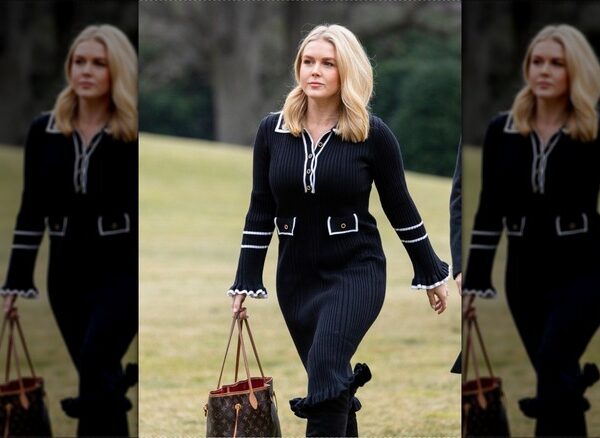
Just days after Leavitt’s widely reported response to the French politician, she posted photos on her Instagram account showing her carrying a Louis Vuitton Neverfull MM tote — a luxury handbag retailed at $2,030 and manufactured by one of France’s most iconic fashion houses.
Louis Vuitton, founded in 1854 in France and internationally renowned as a pinnacle of luxury fashion, carries not just a price tag but broad cultural recognition as a French brand.
The Neverfull — one of the brand’s most popular styles — is a frequent sight among fashion enthusiasts around the world.
That juxtaposition — strident public criticism of a French figure coupled with visible ownership and promotion of a French luxury product — was enough to catch the attention of social media users, commentators, and casual observers alike.
One of the most commonly shared reactions was a seemingly simple question, offered with a tinge of incredulity: “Why have a Louis Vuitton bag if everything from France is so bad?”
This comment didn’t necessarily engage with the substance of international politics or diplomatic relations, but it hit directly at the optics: the contrast between rhetorical positions on national value and personal choices regarding expensive fashion goods.
From a public relations standpoint, the episode illustrates how even celebrity‑style accessories — what many might assume are apolitical — can become entangled in broader debates about messaging and authenticity.
Different Sides of the Reaction: Critics vs. Supporters
As is typical in political discourse today, responses to the handbag incident fell broadly into two opposing camps.
Critics and Satire
Critics of Leavitt’s remarks and her fashion choices were quick to spotlight what they saw as a contradiction — or at the very least an ironic juxtaposition.

On social media platforms like X (formerly Twitter), Reddit, and Instagram, some commentators used humor or pointed criticism to highlight what they saw as inconsistency.
While much of this commentary was opinion and not grounded in official analysis, the volume of responses made clear that the optics struck a chord.
Some users invoked historical memory, noting that in the American Revolution, French support — including military aid and crucial funding — played a key role in the colonies’ success against Britain, and that America’s own history remains intertwined with French involvement.
Others took aim at Leavitt personally, questioning her understanding of history or her approach to international relations.
It’s worth noting that online reactions are not necessarily representative of broader public opinion — they can be amplified by bots, heated partisans, or niche communities — but they do reflect a wide range of perspectives on the interplay between personal expression and public messaging.
Supporters and Defenders
On the other side, many of Leavitt’s supporters defended her and dismissed the handbag discussion as a superficial distraction from more substantive policy debates.
In comments on social media, some applauded her as a professional, admired her handling of the press briefing, and praised her appearance and confidence.
Typical supportive remarks included praise for her “professionalism” and “representation” of U.S. interests, and reminders that personal fashion choices do not necessarily negate or undermine one’s political positions.
One common theme among supporters was the idea that personal style — including wearing designer accessories — should be seen independently of policy statements, and that criticism over clothing choices is trivial compared to deeper geopolitical questions.
Leavitt’s Focus on Family and Personal Life
Instead of escalating the controversy, Karoline Leavitt largely sidestepped the handbag debate, choosing to focus on family and personal moments that humanized her beyond political headlines.

In the wake of social media discourse, she shared images of herself at home with her young son — including a heartwarming snapshot of the toddler helping bake muffins and another of her child being pushed in a stroller by a great‑grandparent — moments captioned with simple, everyday warmth.
These posts offered voters and observers a reminder that beyond the press podium, she is a working mother with familial commitments — a dynamic that resonates with many who balance professional obligations with family life.
Leavitt has, in interviews outside of the handbag controversy, discussed the challenges and rewards of parenting while serving in the White House, emphasizing how she strives to be present at home while fulfilling demanding official duties.
This framing aligns with a broader effort to emphasize relatability and common human experience in public figures’ private lives.
A Young Press Secretary in a High‑Profile Role
Karoline Leavitt’s position itself adds a layer of complexity to the conversation. At 27 years old, she is the youngest Press Secretary in U.S. history — a distinction that draws both admiration and scrutiny.
Her rapid ascent into one of the most visible roles in American government — speaking daily on behalf of the President and administration — means her words and actions are constantly under a microscope.
Every press briefing, social media post, and public appearance is evaluated not just for message content, but for tone, substance, and implication.
This heightens the likelihood that seemingly small personal choices — like handbag brand or wardrobe details — become fuel for public debate.
Context: Rhetoric and International Relations
To fully understand why Leavitt’s remarks about France drew both applause and criticism, it helps to recognize the broader political context in which they occurred.
The Trump administration’s second term has been marked by a combative approach to foreign policy and communications.
Press secretaries and spokespeople like Leavitt are often tasked with defending policy decisions vigorously, sometimes using historical references or sharp retorts to counter criticism from foreign figures or media narratives.
Leavitt’s statement about the Statue of Liberty — invoking American military intervention in Europe during World War II — was intended as a patriotic assertion of American contributions to global security.
Yet some historians and commentators noted that the remark oversimplified history and overlooked France’s significant role in earlier conflicts, including the American Revolution, when French assistance was crucial to the birth of the United States.
This blend of historical interpretation and political rhetoric made the situation especially ripe for online debate — and the handbag, whether consciously or not, became a juxtaposition point in that broader narrative.
Fashion, Politics, and Perception
Beyond the immediate political context, the episode raises larger questions about how public figures are perceived and how personal choices intersect with public messaging.
In modern media culture, clothing, accessories, and personal branding often carry symbolic meaning.
When a press secretary sharply criticizes an ally nation, and soon after is photographed with a luxury item that originated from that same country’s fashion industry, the public may interpret those two phenomena together — regardless of intent.
Fashion analysts often observe that accessories like luxury handbags are not just style choices, but statements — consciously or unconsciously signaling status, identity, and cultural associations.
In this case, the juxtaposition of a political stance and a high‑end French brand became a flashpoint precisely because both elements were publicly visible within a short time frame.
Broader Cultural Debates Over Luxury Goods
Leavitt is not the first public figure to face scrutiny over luxury fashion in a political context. Across the political spectrum, individuals from politicians to celebrities are often called out — or mocked — for carrying expensive brands, regardless of any connection to policy or ideology.
These debates are part of a larger cultural conversation about authenticity, privilege, and perception. Critics argue that public officials should be mindful of how visible consumer choices might undercut their narratives, while defenders insist that personal fashion choices should remain distinct from political positions.
The Louis Vuitton brand itself, while French in origin, has a complex relationship with global fashion markets: some of its products are manufactured outside France at facilities in places like Texas, yet the brand remains quintessentially associated with French luxury heritage.
What This Means Going Forward
At its core, the handbag controversy encapsulates the modern dynamic of politics and public life: where personal expression, public statement, online discourse, and media narratives all intersect — often in unpredictable ways.
For Karoline Leavitt, the episode became another headline in a string of highly visible moments since assuming her role. Her critics see it as symptomatic of a broader pattern of contradictions or controversial rhetoric, while her supporters dismiss it as superficial noise around a serious job.
What’s clear is that in the digital age, nothing happens in isolation. A remark about diplomatic history can rapidly be reframed through the lens of fashion optics, social media commentary, and broader cultural debates — all influencing how public figures are perceived and how political narratives evolve.
Whether one views the handbag conversation as irony, hypocrisy, or simply an unrelated personal choice, it highlights how every detail of a political figure’s public life can become fodder for discussion in contemporary media cycles.
Conclusion: Style, Substance, and the Public Square
Karoline Leavitt’s recent experience — from sharp diplomatic remarks about France to the subsequent focus on a Dior tote — shows how tightly interwoven politics and personal presentation have become.
In an era of viral commentary and rapid online reactions, even fashion accessories can take on outsized symbolic meaning.
Regardless of where one stands politically, this episode offers a revealing glimpse into how modern public life operates: where messaging, optics, fashion, and history can collide in ways that shape public perception and fuel debate far beyond the original topic.
The conversation around Leavitt — and her choice to share glimpses of family life in response to the criticism — also underscores another aspect of contemporary leadership: the balancing act between professional authority and personal identity.
In the end, what began with a rhetorical exchange over a historic monument became a wider discussion about consistency, personal choice, and the complex ways in which public figures are scrutinized in the digital age.
As political and cultural debates continue, episodes like this illustrate that even a handbag can become a talking point in the larger story of public trust, perception, and leadership.
