
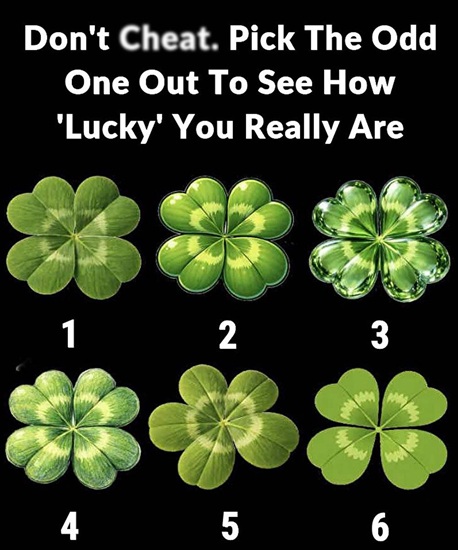
At first glance, the image appears simple—a small collection of six clovers, each slightly different, and one task: identify the one that doesn’t belong. The exercise seems playful but subtly challenges how you perceive patterns.
The visual simplicity masks a deeper psychological test. Observers begin noticing minute differences in shape, color, texture, or symmetry, and these subconscious priorities reveal more about individual thought patterns than any singular “correct” choice.
Cultural associations with clovers also play a role. The four-leaf clover, long regarded as a symbol of luck, heightens the illusion of rarity. Yet here, each clover appears unique, making the idea of a “special one” more subjective than factual.
Human perception naturally searches for patterns, but people focus on different cues. Some immediately notice the color variations, while others gravitate toward symmetry or size. The brain evaluates these cues in milliseconds, forming interpretations that are both instinctive and learned.
Those who select the first clover often exhibit grounded thinking and a preference for simplicity. This choice may indicate an inclination to trust natural instincts rather than overanalyze every detail before arriving at a conclusion.
Choosing the second clover can suggest an analytical mind. Such individuals often consider balance, proportion, and subtle irregularities, weighing each visual factor carefully before making a decision, which reflects a methodical approach to problem-solving.
The third clover typically appeals to observers who value boldness or uniqueness. Picking this option may reveal a mindset that embraces creativity and originality, even when the choice defies conventional or expected norms of pattern recognition.
Selecting the fourth clover usually resonates with those attentive to subtle layers, texture, and depth. It often suggests a creative or nuanced perspective, highlighting a person’s ability to see beyond superficial details into more complex patterns.
If the fifth clover is chosen intuitively, it may reveal reliance on gut feeling over analytical reasoning. These individuals often trust internal judgment and instinctual responses, allowing their subconscious assessment to guide decisions without overthinking external cues.
The sixth option frequently draws the attention of people who value clarity, efficiency, and decisiveness. They may prioritize straightforward evaluation over ambiguity, reflecting a pragmatic approach to both visual tasks and broader problem-solving situations.
This exercise does not measure luck in any literal sense. Instead, it highlights how humans process information, make decisions, and interpret visual stimuli, revealing cognitive tendencies that influence daily choices far beyond the puzzle itself.
Perception, in this context, is deeply subjective. Two observers may select different clovers for equally valid reasons, demonstrating that decision-making is shaped by individual priorities, past experiences, and personal cognitive frameworks.
Interestingly, the task mirrors real-life scenarios where there is no single “correct” answer. People navigate ambiguity, assess incomplete information, and act based on perception, awareness, and judgment—factors often misattributed to chance or luck.
The symbolism of the clovers extends to human psychology. What is often labeled as fortune is frequently a reflection of attentiveness, interpretation, and the ability to act on subtle cues rather than mere randomness or coincidence.
Beyond perception, the exercise touches on decision-making speed. Some people react almost immediately, relying on instinct, while others pause to analyze, illustrating the interaction between intuitive and deliberate cognitive processing.
Patterns, anomalies, and visual differences provide insight into problem-solving approaches. Observers who focus on irregularities may demonstrate creative thinking, while those prioritizing harmony may prefer structured, orderly solutions.
Cognitive science suggests that even minor visual tests like this activate multiple brain regions, including those involved in spatial reasoning, pattern recognition, and executive function, illustrating the deep complexity behind seemingly simple choices.
The task also encourages reflection on self-awareness. How individuals choose reflects not only perception but also personality traits, tolerance for ambiguity, and comfort with uncertainty, all of which shape real-world decisions and interpersonal interactions.
By emphasizing subjective interpretation, the puzzle underscores that meaning often arises from perspective. Just as no clover is inherently “wrong,” experiences in life are rarely absolute; understanding emerges from context and cognitive framing.
Furthermore, the exercise offers subtle lessons about bias. People may unconsciously favor certain attributes—brightness, symmetry, or size—revealing hidden preferences that influence judgment without conscious recognition.
The clover selection can also illuminate creativity and divergent thinking. Choosing a clover that seems “out of place” might reflect a willingness to embrace novelty, challenge expectations, and approach problems in unconventional ways.
Conversely, choices driven by conventional norms reveal risk-averse tendencies or a preference for established structures. Both approaches provide valid insight into cognitive diversity and individual decision-making styles.
The act of deciding which clover “doesn’t belong” becomes a mirror reflecting not external truth but inner perception, showing that judgment is a function of personal priorities, not absolute correctness.
Ultimately, the exercise transforms a simple visual puzzle into a study of cognitive processes, highlighting how perception shapes reasoning, how instinct and analysis interact, and how subjective judgment governs human behavior.
Rather than evaluating luck or accuracy, the test celebrates individuality. Every choice is valid because every observer processes information differently, demonstrating that human cognition is complex, diverse, and deeply personal.
This subtle insight explains why such puzzles resonate widely: they reveal aspects of ourselves that words alone often cannot, connecting visual cognition to personality, intuition, and broader mental strategies.
In the context of everyday life, the lesson is profound. What appears straightforward often contains multiple valid interpretations, reminding us to approach ambiguity with patience, reflection, and curiosity rather than judgment.
The clovers thus serve as a metaphor for life. Just as there is no single “correct” clover, there is rarely a single correct way to navigate uncertainty, perceive situations, or solve problems in the real world.
In essence, the exercise illustrates that perception and interpretation create meaning. Choices emerge not from luck but from awareness, judgment, and the willingness to act on what the mind observes and values most.
Finally, the puzzle encourages mindfulness. By examining why one selects a particular clover, individuals gain insight into thought patterns, priorities, and decision-making tendencies, offering a playful yet meaningful lens into human cognition.
