
For centuries, humans have been fascinated by visual puzzles and optical illusions, images that challenge perception and force the brain to work in unexpected ways.
From ancient carvings to modern interactive online games, these illusions have long served as both entertainment and subtle mental exercise.
If you’re someone who delights in teasing your brain, testing your observational skills, and seeing the world from multiple perspectives, optical illusions provide an endlessly satisfying playground.
I, however, have a confession: I am hopeless at them. As a child, I remember receiving a “train your brain” book from my grandmother when I was six years old.
It promised hours of amusement and mental stimulation, full of puzzles, mazes, hidden objects, and riddles designed to strengthen cognitive skills. I barely managed to glance at it before it sat, mostly untouched, on my bookshelf for a decade.
When I finally opened it at the age of sixteen, the intricate visual puzzles still baffled me. Somehow, the images seemed to dance in ways my brain couldn’t quite follow, and I rarely managed to spot the solutions without frustration.
Despite my personal struggles, I can see why brain teasers and visual illusions are so popular worldwide. The rise of the internet has created a digital space where people constantly challenge themselves—and each other—through puzzles that test perception, memory, and pattern recognition.
Images designed to hide multiple objects or faces in plain sight have gone viral countless times, often sparking debates over how many elements can actually be found.
These challenges are more than a novelty—they engage the brain’s visual cortex, memory networks, and problem-solving skills all at once.
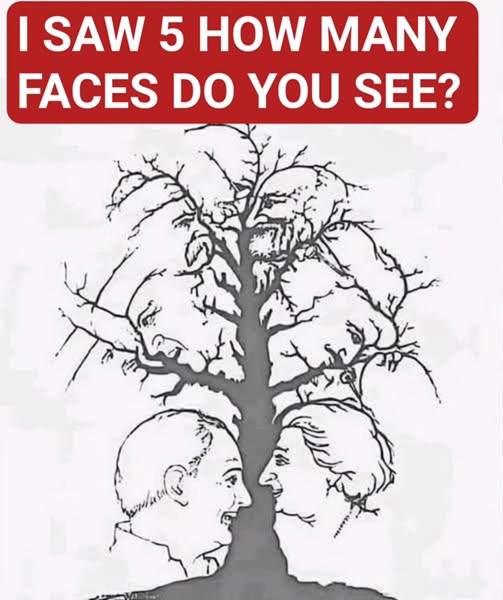
Recently, I stumbled across an online optical illusion that has captured the attention of thousands: the “National Leaders Tree.”
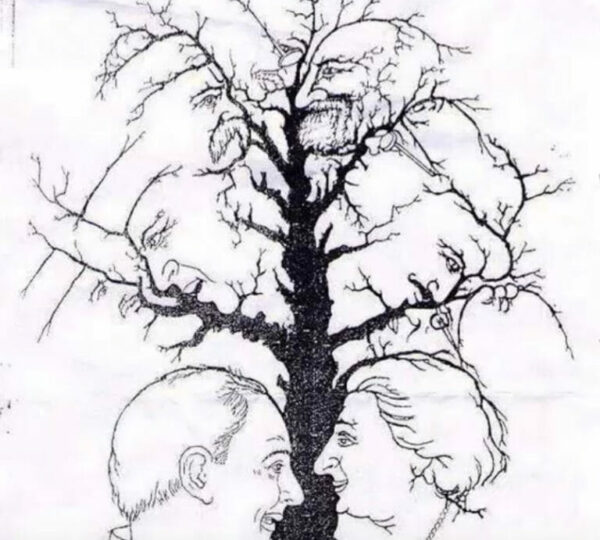
The image is deceptively simple at first glance: a large tree, intricately drawn, with branches, leaves, and shadows creating a dense, textured pattern.
But as you focus, you notice hints of something unusual: faces embedded within the tree itself, some obvious, some cleverly camouflaged.
This is a classic example of a type of illusion known as a hidden object or hidden figure puzzle, where the mind must detect patterns that are partially obscured or blended into the surrounding visual information.
The challenge of the “National Leaders Tree” lies in both observation and cognitive interpretation. The human brain is wired to recognize faces almost instinctively—a phenomenon known as pareidolia. Pareidolia is the tendency to perceive familiar shapes, particularly faces, in random or ambiguous visual patterns.
It is the same reason people claim to see faces in clouds, in the moon’s craters, or in the bark of trees. Optical illusions like this one exploit that natural ability, prompting viewers to search for hidden patterns while simultaneously testing patience, attention to detail, and memory recall.
How the “National Leaders Tree” Works
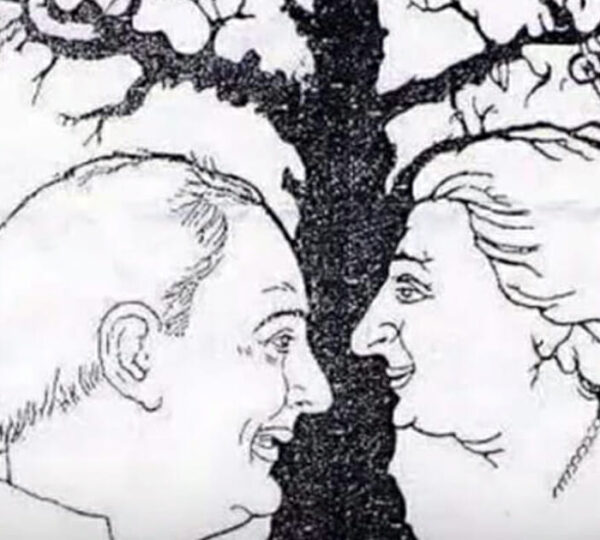
At first glance, everyone can spot the two most obvious faces at the base of the tree. These are designed to anchor the viewer, providing a starting point and demonstrating that there is indeed more to discover.
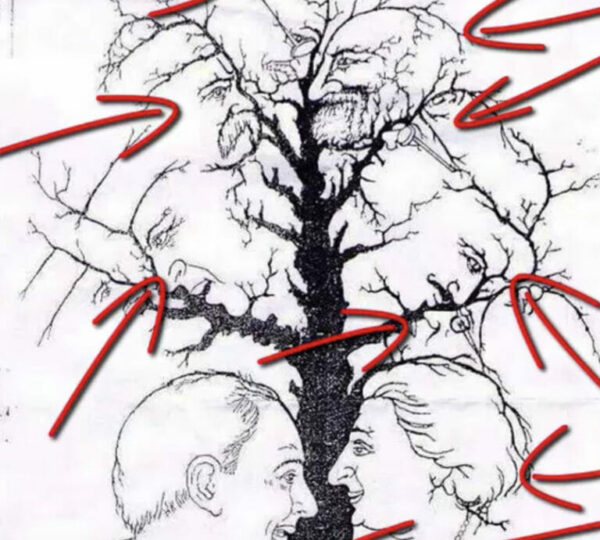
But the true challenge is to locate the additional faces, which are often integrated into branches, foliage, or the texture of the trunk.
Some may be partial, showing only eyes or a mouth, while others may be rotated or stylized in such a way that they merge almost seamlessly with the surrounding bark and leaves.
Interestingly, online communities have attempted to assign meaning to the number of faces a person can find. While this is largely playful and should not replace professional assessments, it is based on observations related to attention, memory, and facial recognition ability. The categories are generally framed as follows:
2 to 4 faces: Spotting only the most obvious faces may indicate difficulty in visual pattern recognition or minor lapses in short-term memory. Some sources suggest it could hint at reduced attentional focus, though this should not be overinterpreted without proper cognitive testing.
5 to 6 faces: Finding slightly more than the baseline but missing the majority could suggest that while your memory and perception are functional, there may be room for improvement in concentration and attention to detail. It is also noted,
in lighthearted contexts, as a potential indicator of vulnerability to memory-related conditions like early-stage dementia, though this is meant as a fun observation rather than a clinical diagnosis.
7 to 8 faces: Successfully identifying most of the hidden faces demonstrates above-average visual acuity and memory retention. It suggests an ability to notice subtle patterns and maintain mental focus over time.
More than 9 faces: Locating nine or more faces indicates excellent visual perception, pattern recognition, and memory skills. Individuals in this category are often praised for their observational precision and attention to detail.
The Psychology Behind Hidden Figures
The cognitive mechanisms at play in puzzles like the “National Leaders Tree” are rooted in visual processing, memory, and pattern recognition. When viewers scan the image, the brain must filter out irrelevant information while simultaneously seeking structured patterns.
This involves the prefrontal cortex, responsible for problem-solving and decision-making, as well as the occipital lobe, which processes visual stimuli. People who are naturally attentive or who frequently practice cognitive challenges may find it easier to detect subtle cues within the artwork.
Additionally, the act of searching for faces taps into working memory, the brain’s system for temporarily holding and manipulating information. Each time you identify a face, you must remember its location to avoid repetition and to mentally map the remaining portions of the image. This type of mental exercise has been shown to enhance neural plasticity, reinforcing the brain’s ability to learn and adapt over time.
From a social perspective, sharing such puzzles online creates a sense of community and competition. Users often post screenshots with annotations highlighting the faces they’ve found, compare totals, and challenge others to beat their score. This adds a layer of engagement, blending cognitive exercise with social interaction—an especially powerful combination for mental stimulation.
Tips for Successfully Spotting Hidden Faces
While some people seem naturally adept at visual puzzles, anyone can improve their performance by following a few strategies:
Start with the obvious: Begin by locating the faces that are easy to see. This establishes a reference point and helps your brain attune to the stylistic cues the artist uses.
Scan systematically: Move your eyes slowly across the image in a grid-like pattern. Divide the picture mentally into quadrants to ensure no area is overlooked.
Look for subtle cues: Focus on recurring shapes, shadows, and contrasts. Eyes and mouths are often the first parts of a hidden face to appear.
Step back: Sometimes, viewing the image from a slightly greater distance allows the brain to detect patterns that are missed at close range.
Take breaks: Visual fatigue can reduce your ability to spot hidden objects. Briefly closing your eyes or shifting focus can refresh your perspective.
Practice regularly: Like any skill, your ability to spot hidden faces improves with consistent practice. Engaging with multiple types of optical illusions strengthens both memory and visual processing.
Why People Love These Puzzles
Optical illusions are more than entertainment—they tap into a deep human fascination with perception, surprise, and problem-solving.
They allow viewers to experience the thrill of discovery and challenge the brain to interpret ambiguous stimuli. When successfully completed, these puzzles provide a sense of accomplishment and a small dopamine boost, rewarding the brain for recognizing patterns and solving problems.
The “National Leaders Tree” is particularly appealing because it combines artistry with cognitive challenge. Unlike simple puzzles, it demands patience, attention, and a willingness to consider multiple possibilities simultaneously.
This mirrors real-life situations where the brain must analyze complex information, spot anomalies, and make decisions based on incomplete data.
Historical Context: The Evolution of Visual Brain Teasers
The concept of hidden objects in art dates back centuries. Renaissance artists, for example, occasionally embedded subtle symbols or hidden figures within their paintings, challenging viewers to look closer and rewarding careful observation.
In Eastern traditions, intricate designs in mandalas and temple carvings sometimes incorporated hidden motifs with spiritual significance, emphasizing mindfulness and focus.
In the 20th century, psychologists and educators began formalizing these puzzles as tools for cognitive development. Books like the one I received from my grandmother often contained hidden picture exercises, mazes, and pattern-recognition puzzles, designed to enhance attention, memory, and problem-solving abilities in children and adults alike.
The digital age has since transformed these exercises into interactive online challenges, making them accessible to a global audience and adding social and competitive elements.
The Broader Connection to Memory and Cognitive Health
While playful interpretations of hidden-face puzzles exist, they also underscore the connection between visual processing and memory. Research has shown that activities requiring attention to detail, pattern recognition, and working memory can help maintain cognitive function and delay age-related decline.
Regular engagement with such puzzles stimulates neural pathways, improves concentration, and strengthens the brain’s ability to manage multiple pieces of information simultaneously.
In this sense, completing the “National Leaders Tree” challenge is more than a test of perception—it’s a small exercise in mental fitness, reinforcing the very cognitive abilities that help with day-to-day tasks and learning.
Sharing, Social Interaction, and Online Trends
The online popularity of the “National Leaders Tree” illustrates another key aspect of optical illusions: they foster connection.
People compare results, debate interpretations, and celebrate successes or laugh over missed faces. Social media amplifies the effect, creating viral discussions, memes, and tutorials that guide viewers in spotting the hidden elements.
Some users even categorize themselves based on how many faces they find, jokingly creating “tiers” of perceptual skill—from novice observers to elite pattern recognizers. This sense of playful identity mirrors the social and psychological appeal that has kept brain teasers popular for generations.
Concluding Thoughts: More Than Just a Game
The “National Leaders Tree” is emblematic of why optical illusions endure as a source of fascination. It combines artistry, observation, memory, and social engagement in a single challenge. While some may find it maddening, others experience joy and satisfaction in discovery.
Even if, like me, you struggle to find all the faces, there is value in the process of searching, thinking, and observing. It reminds us that perception is subjective, that our brains interpret patterns differently, and that intelligence and memory are multifaceted skills—not simply the ability to score perfectly on a puzzle.
So, whether you spot two faces or more than nine, the exercise engages your brain, challenges your attention, and connects you to a centuries-old tradition of visual problem-solving.
Next time you encounter the “National Leaders Tree” or a similar hidden-object puzzle, remember: the fun is in the journey of discovery, the satisfaction of noticing what others may miss, and the joy of teasing your brain in ways that are both playful and cognitively enriching.
