
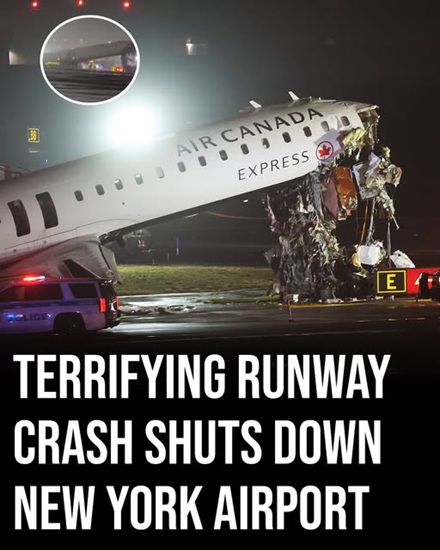
A serious aviation incident reportedly took place late Sunday night at New York’s LaGuardia Airport, raising significant safety concerns and temporarily disrupting operations at one of the nation’s busiest travel hubs.
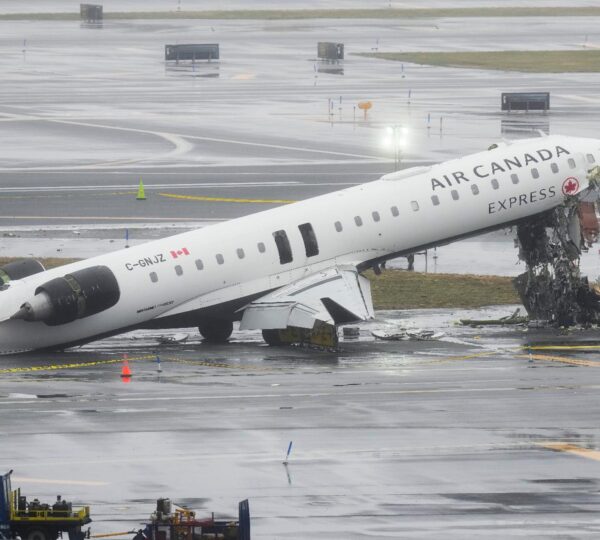
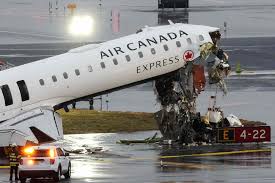
Preliminary reports indicate that a regional passenger aircraft operated by Air Canada was involved in a ground collision with an airport emergency vehicle while moving along the runway after landing.
The aircraft, identified as a CRJ-900 regional jet, had just completed a scheduled flight from Montreal and was in the process of taxiing toward its assigned gate when the incident occurred.
According to early data, the plane was carrying between 80 and 100 passengers, along with crew members, all of whom experienced a sudden and alarming moment upon impact with the vehicle.
Flight tracking sources suggest the aircraft was moving at a relatively low speed, approximately 24 miles per hour, which is typical for taxiing operations following a safe landing.
The collision is believed to have taken place shortly before 11:40 p.m. on Runway 4, a commonly used section of the airport that handles both arrivals and departures under controlled conditions.
Emergency response teams were immediately dispatched to the scene, as airport authorities worked quickly to assess the situation and ensure the safety of everyone involved in the incident.
Initial reports from U.S. media indicated that multiple individuals sustained injuries, including personnel associated with airport operations and emergency services present on the runway at the time.
Among those reportedly injured were two Port Authority personnel assigned to fire response duties, both of whom were transported to nearby hospitals for medical evaluation and treatment.
While early information suggested the possibility of critical injuries, officials have not confirmed the full extent or severity of all injuries, and updates have remained limited as investigations continue.
Some early media reports mentioned fatalities involving flight crew members; however, such claims have not been officially confirmed and should be treated with caution pending verified statements from authorities.
Air traffic control communications have become a key part of the ongoing investigation, with audio recordings suggesting that instructions were given to the emergency vehicle shortly before the collision occurred.
According to these recordings, controllers reportedly instructed the vehicle to stop multiple times, indicating a possible breakdown in coordination or timing between ground operations and aircraft movement.
One early line of inquiry focuses on whether the fire truck had received proper clearance to enter or cross the runway, which is a strictly regulated process requiring precise communication.
Aviation experts emphasize that runway incursions, although rare, are taken extremely seriously due to the potential risks they pose to both aircraft and ground personnel in active operational zones.
Weather conditions at the time of the incident may also have played a contributing role, as reports suggest that visibility and overall conditions were less than ideal late Sunday evening.
Reduced visibility can complicate both pilot awareness and ground vehicle navigation, especially in busy airport environments where multiple moving elements must be carefully coordinated at all times.
Following the collision, the Federal Aviation Administration implemented an immediate ground stop, temporarily halting all incoming and outgoing flights at LaGuardia Airport to prioritize safety and emergency response.
As a result of the shutdown, numerous flights were delayed or redirected to nearby airports, including John F. Kennedy International Airport and Newark Liberty International Airport.
At least 18 flights were reportedly diverted during the disruption, creating a ripple effect across regional travel schedules and causing inconvenience for passengers and airline operations alike.
Passengers aboard the affected aircraft were safely evacuated after the collision, according to preliminary reports, and were later assisted by airport staff as part of standard emergency procedures.
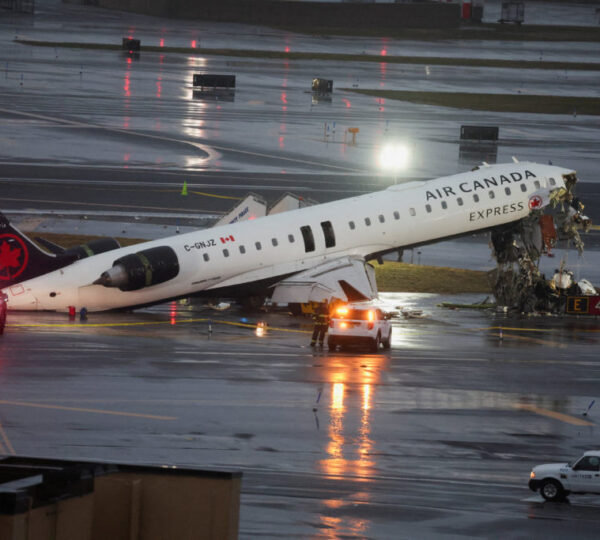
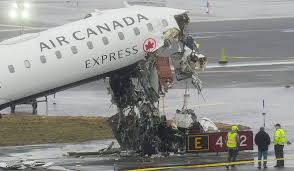
Images and footage from the scene showed the aircraft stationary on the runway, with visible signs of impact that underscored the seriousness of the incident despite the relatively low taxiing speed.
Emergency crews conducted a thorough inspection of both the aircraft and the damaged vehicle, ensuring there were no additional hazards such as fuel leaks or fire risks following the collision.
Airport officials worked overnight to manage the situation, clear the runway, and begin the process of restoring normal operations once it was deemed safe to do so.
The investigation into the cause of the collision is being led by federal aviation authorities, in coordination with local airport officials and other relevant agencies involved in air safety oversight.
Key aspects under review include communication protocols, runway access procedures, vehicle movement permissions, and any potential human or technical errors that may have contributed to the event.
Aviation safety systems are designed with multiple layers of protection, but incidents like this highlight how critical timing, communication, and coordination are in preventing runway-related accidents.
Experts note that while such incidents are uncommon, they provide valuable lessons that can lead to improved procedures, enhanced training, and stronger safety measures across the aviation industry.
Airlines and airport authorities are expected to fully cooperate with investigators, providing data, recordings, and operational details necessary to reconstruct the sequence of events leading up to the collision.
Passengers affected by the disruption were offered assistance, including rebooking options and support services, as airlines worked to minimize the impact of the unexpected incident.
In the hours following the event, airport operations gradually resumed, although delays continued as schedules were adjusted and aircraft movements were carefully managed.
Public statements from officials have remained cautious, emphasizing that the investigation is ongoing and that conclusions will only be drawn once all available evidence has been thoroughly examined.
Authorities have also urged the public and media to avoid spreading unverified information, particularly regarding injuries or fatalities, until official confirmations are released through reliable channels.
This approach is essential in maintaining accurate reporting and ensuring that affected individuals and their families are not subjected to unnecessary distress caused by misinformation.
Runway safety remains a top priority for aviation regulators worldwide, with continuous efforts focused on improving technology, communication systems, and operational protocols to prevent similar incidents.
Modern airports rely on a combination of human coordination and advanced systems to manage traffic on the ground, making it essential that all elements function seamlessly during both routine and unexpected situations.
The LaGuardia incident serves as a reminder of the complexities involved in airport operations and the importance of vigilance at every stage of aircraft movement, from landing to gate arrival.
As more details become available, authorities are expected to provide clearer insights into what went wrong and what measures may be implemented to reduce the risk of similar occurrences in the future.
For now, the focus remains on supporting those affected, completing a thorough investigation, and ensuring that all safety standards continue to be upheld across airport operations.
