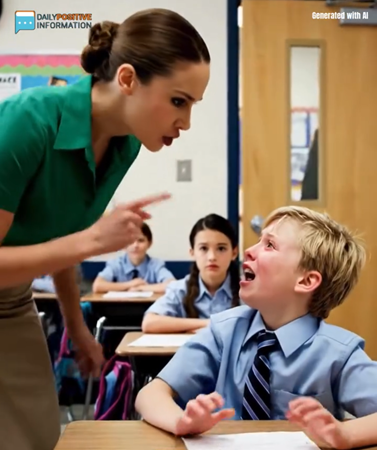
My teacher accused me of lying when I said my dad was a hero—until he suddenly walked into the classroom in full uniform.
The assignment seemed simple enough on paper. “Write about your hero,” Mrs. Vance had written in her perfect, looping cursive on the chalkboard.
Her handwriting was so elegant that it looked like it belonged on a wedding invitation, not a dusty blackboard in a middle school classroom in Ohio.
For the twenty-nine other students in my seventh-grade English class, the assignment was straightforward. Jenny, sitting at the front with her color-coded binders, was probably writing about her mother, the veterinarian.
Kyle, the kid who made it his mission to trip me every time I walked down the aisle, was undoubtedly writing about his older brother, the high school quarterback.
But for me—Leo—this wasn’t just a school assignment. It was a trap.
I stared at the blank, college-ruled paper in front of me, the blue lines blurring together as my thoughts tumbled chaotically.

My pencil was chewed down to the wood at the top, the eraser long gone. I tapped it against the desk repeatedly, a nervous habit I couldn’t control.
“Leo, stop that racket,” Mrs. Vance snapped without even looking up from her grading.
The class giggled, a low, simmering sound that made my stomach twist. They were always waiting for me to mess up. I could feel their eyes on me, judging every movement.
I was the kid whose clothes smelled faintly of damp drywall because our trailer had a leak we couldn’t afford to fix.
I was the kid who wore the same hoodie for days in a row. To Mrs. Vance, I was just another stain on her otherwise perfect classroom record.
She looked at me like I was nothing more than gum stuck to the bottom of a shoe—annoying, bothersome, and completely disposable.
“Five minutes left,” she announced sharply. My heart pounded against my ribs.
I had the words inside me; I had rehearsed them over and over each night, praying that somehow, when the time came, I would have the courage to write them down. But actually putting them on paper required a bravery I wasn’t sure I had.
I missed him so much it felt like a physical ache, right behind my sternum. I gripped the pencil tighter, my knuckles turning white.
Just write it, Leo. Just tell the truth.
I began to write. I didn’t worry about spelling, punctuation, or grammar. I poured everything out onto the page.
I wrote about the smell of boot polish and the crisp scent of his uniform.

I wrote about the scratch of his beard when he hugged me goodbye, the letters that had stopped coming six months ago, the way I felt proud and scared all at once.
I wrote about Captain James Miller—my father—the man who was currently deployed somewhere I couldn’t pronounce, doing a job I didn’t fully understand, yet he was the reason I kept going every day.
“Pencils down,” Mrs. Vance commanded.
I scribbled the last period with trembling hands. She stood up, smoothing her skirt as if preparing for some grand performance.
She was tall, severe, and her hair was sprayed so stiff it probably wouldn’t move even in a hurricane.
“Today, we are going to share. Public speaking is a vital skill,” she announced, scanning the room.
I shrank into my seat, wishing I could disappear into the particleboard desk in front of me. Please don’t pick me, I begged silently.
“Let’s start with… Leo.”
Of course.
The class groaned collectively, a sound heavy with mockery. Kyle snickered, and I could feel my face growing hot. I tried to make myself invisible, but it was hopeless.
“Come to the front, Leo. Tuck in your shirt. You look like you rolled out of a dumpster,” Mrs. Vance said with that same sharp, cutting tone.
I walked forward slowly, legs shaking like jelly. Every pair of eyes felt like a weight, pressing down on me. They weren’t curious or kind; they were waiting to watch me fail.
“Who is your hero, Leo?” Mrs. Vance asked.
I took a deep breath, clutching my paper so tightly it crinkled.
“My hero… is my dad,” I whispered.
“Speak up, Leo. Use your diaphragm,” she barked.
I steadied my voice. “My hero is my dad. Captain James Miller.”

The room fell silent for a moment. Then Kyle laughed. “Your dad? The guy who ran off on your mom because you’re poor?”
The class erupted in laughter. I could feel my stomach twisting and my cheeks burning.
Mrs. Vance allowed the laughter to roll for a few seconds before finally raising a hand. “Kyle, that’s enough.” But her tone lacked real authority, and she quickly turned back to me.
“Go on, Leo. Read what you wrote.”
I read my words, voice quivering at first but growing steadier. I wrote about his bravery, his leadership, the Bronze Star he had shown me before leaving.
I spoke of the pride I felt, the strength he gave me even from thousands of miles away.
When I finished, I expected silence. Maybe even respect. Instead, I saw Mrs. Vance smiling—not a kind smile, but a predator’s smile, sharp and unsettling.
“That’s a very creative story, Leo,” she said, her voice dripping with false sweetness.
“It’s not a story,” I stammered. “It’s true.”
Her smile faltered. She walked toward me, heels clicking ominously on the floor. “Leo, we value honesty.
I know your mother works double shifts to keep the lights on. You’re on free lunch. There is no shame in poverty—but there is shame in lying to impress your classmates.
Pretending your father is a decorated officer when we know he’s not… is serious.”
“He is!” I yelled, desperation clawing at my throat. “He is a Captain! He’s coming back! He promised!”
“Sit down, Leo,” she snapped. “You’ve had your fun.”
The classroom felt suffocating. I could barely breathe. I felt cornered, powerless.
I looked at the desk beneath me, scratched and covered in old graffiti, and slowly climbed on top. My sneakers squeaked against the surface.
Standing there, everything seemed distorted; my classmates’ faces looked monstrous.
Mrs. Vance’s voice was sharp. “Say: ‘I am sorry for lying to the class about my father.’”
I tried, but my voice cracked. “I… I can’t,” I whispered.
She slammed her hand on the desk. “You can, and you will! You are a pathological liar, Leo. Now apologize!”
Just as tears were about to fall uncontrollably, the door creaked.
Heads turned. A polished boot stepped through the doorway. Another followed. A man walked in—tall, broad-shouldered, dressed in immaculate Army Dress Blues.
Medals gleamed on his chest, a scar traced his jawline, but his eyes—blue, piercing—searched for me.
He stopped, looking at Mrs. Vance first. “Ma’am,” he said, low and commanding. “I suggest you tell my son to get down before I lose my military bearing.”
Mrs. Vance paled. She stammered. “I… I…”

I froze. “Dad?”
Captain Miller’s face softened. “Hey, buddy. I heard you were writing an essay about me. Thought I’d come help you with the research.”
In that moment, I felt seen, protected, and proud. My hero was standing right there, real, alive, and finally home.
I didn’t even use the chair to get down. I jumped.
My sneakers hit the floor with a heavy thud, reverberating through the silent classroom, and before I could even regain my balance, I was moving on instinct alone.
I didn’t care about the class. I didn’t care about Mrs. Vance or her rigid rules about walking in the classroom or standing still.
I launched myself at him, and the world seemed to collapse into a single point of gravity and relief.
He caught me mid-air. His arms were like steel bands, wrapping around me with a strength I had only imagined before.
The impact knocked the wind out of me, but it was the best feeling I had ever known. For the first time in months, maybe years, I felt completely safe.
He smelled like rain and airport coffee, mixed with that precise, sharp scent of starch that the Army uses on his uniforms. It was familiar, comforting, and somehow real.
“I got you,” he whispered into my hair, his voice rough with emotion, low and steady at the same time. “I got you, Leo. I’m home.”
I buried my face in the wool of his uniform, sobbing without shame. These were not the shameful, defeated tears from before.
These were tears of relief, tears that come only when you’ve been holding your breath for months and finally exhale, letting go of everything you’ve been carrying inside.
He held me like he could absorb my pain through his shoulders and arms, and I wanted to stay like that forever.
When he finally set me down, he kept a heavy hand on my shoulder, like a shield against the world. “Stand tall, Leo. Wipe your face,” he said softly.
His presence alone was enough to make the fear and humiliation from earlier shrink to nothing.
I scrubbed my cheeks with the sleeve of my hoodie, sniffing loudly, and when I looked up at him, he was enormous, commanding, real.
Captain James Miller, my dad, the man I had been writing about every night in my journal, was right in front of me, alive and intact, and nothing else mattered in that moment.
Then his eyes swept across the room. The soft, fatherly look vanished, replaced by the cold, calculating gaze of a man who had led soldiers into combat.
He scanned the room like a predator hunting for prey. Kyle was staring at the floor, white as chalk, while Jenny and a few others stared at me with wide eyes, caught between awe and fear.
Then Dad looked at Mrs. Vance.
She was still standing behind her desk, clutching a red pen as if it were a weapon, looking small and frail, completely out of her element. “I…” she started, her voice trembling. “I… Sir… I had no idea…”
“Captain,” Dad corrected her, his voice firm. “You may address me as Captain Miller.”
“Captain Miller,” she whispered, disbelief written across her face.
Dad took a step closer, his polished boots clicking against the linoleum. “I stood outside that door for five minutes, Ma’am,” he said slowly, letting every word land.
“I heard you tell my son that he was a pathological liar. I heard you tell him his father abandoned him.
I heard you order him to stand on a desk like some circus act. That, Ma’am, is not discipline. That is abuse.”
Mrs. Vance flushed a deep, blotchy red, her carefully cultivated authority crumbling in real time.
“I was maintaining order! Leo has a history of storytelling! He disrupts class! I was trying to teach him a lesson about honesty!”
Dad laughed, a sound devoid of humor, sharp and cold as steel. “Honesty?” he repeated, walking over to my crumpled essay on the floor and smoothing it out with care.
“My son wrote these words, words that are true. ‘My hero is my dad, Captain James Miller.’ Where is the lie?”
Mrs. Vance faltered. “We… we didn’t have any record on file of your service. Leo comes to school in… well, look at him, you know…”
“You assumed,” Dad cut her off sharply. “You assumed that because my son wears second-hand clothes, his father couldn’t possibly be an officer.
You assumed that because my wife works two jobs to keep our family afloat while I serve my country, we are somehow ‘less than.’ You are wrong, Ma’am, and I will not allow you to humiliate him for your ignorance.”
He towered over her now, his presence overwhelming. “The Army does not pay in riches. It pays in honor, integrity, and respect. Something you clearly know nothing about.”
Mrs. Vance tried to regain control. “You can’t speak to me like that! I am a teacher! I am in charge of this classroom!”

“Not anymore,” Dad said simply. “You forfeited that right when you bullied a thirteen-year-old boy and accused him of lying about his own father.”
He turned to the class. “Is this how she treats you?”
No one answered at first. Silence stretched heavy across the room. Then, one by one, small voices began to speak up. Sarah, the quietest girl in class, whispered, “She called me stupid last week because I dropped my book.”
“She told me I’d end up pumping gas if I failed my quiz,” another student added.
The room erupted into a chorus of complaints, the truth coming out like a flood, and Mrs. Vance’s power evaporated under the weight of the students’ voices and my father’s commanding presence.
Dad turned back to me and whispered, “Leo, grab your backpack. We’re leaving.”
I scrambled to collect my things, barely able to believe what was happening. Outside the classroom, I could hear the faint sounds of applause from my classmates.
Jenny, Mike, even Kyle—hesitant at first—were clapping. Mrs. Vance stood alone, her control shattered.
Dad guided me down the hall. “You want a burger?” he asked, winking.
“With bacon,” I replied, grinning like the world had suddenly flipped upside down.
We walked out, but I knew the story wasn’t over. Mrs. Vance was just a symptom of a larger problem in the school, and Dad? He was just beginning to make it right.
The assignment seemed simple enough on paper. “Write about your hero,” Mrs. Vance had written in her perfect, looping cursive on the chalkboard.
Her handwriting was so elegant that it looked like it belonged on a wedding invitation, not a dusty blackboard in a middle school classroom in Ohio.
For the twenty-nine other students in my seventh-grade English class, the assignment was straightforward. Jenny, sitting at the front with her color-coded binders, was probably writing about her mother, the veterinarian.
Kyle, the kid who made it his mission to trip me every time I walked down the aisle, was undoubtedly writing about his older brother, the high school quarterback.
But for me—Leo—this wasn’t just a school assignment. It was a trap.
I stared at the blank, college-ruled paper in front of me, the blue lines blurring together as my thoughts tumbled chaotically.
My pencil was chewed down to the wood at the top, the eraser long gone. I tapped it against the desk repeatedly, a nervous habit I couldn’t control.
“Leo, stop that racket,” Mrs. Vance snapped without even looking up from her grading.
The class giggled, a low, simmering sound that made my stomach twist. They were always waiting for me to mess up. I could feel their eyes on me, judging every movement.
I was the kid whose clothes smelled faintly of damp drywall because our trailer had a leak we couldn’t afford to fix.
I was the kid who wore the same hoodie for days in a row. To Mrs. Vance, I was just another stain on her otherwise perfect classroom record.
She looked at me like I was nothing more than gum stuck to the bottom of a shoe—annoying, bothersome, and completely disposable.
“Five minutes left,” she announced sharply. My heart pounded against my ribs.
I had the words inside me; I had rehearsed them over and over each night, praying that somehow, when the time came, I would have the courage to write them down. But actually putting them on paper required a bravery I wasn’t sure I had.
I missed him so much it felt like a physical ache, right behind my sternum. I gripped the pencil tighter, my knuckles turning white.
Just write it, Leo. Just tell the truth.
I began to write. I didn’t worry about spelling, punctuation, or grammar. I poured everything out onto the page.
I wrote about the smell of boot polish and the crisp scent of his uniform.
I wrote about the scratch of his beard when he hugged me goodbye, the letters that had stopped coming six months ago, the way I felt proud and scared all at once.
I wrote about Captain James Miller—my father—the man who was currently deployed somewhere I couldn’t pronounce, doing a job I didn’t fully understand, yet he was the reason I kept going every day.
“Pencils down,” Mrs. Vance commanded.
I scribbled the last period with trembling hands. She stood up, smoothing her skirt as if preparing for some grand performance.
She was tall, severe, and her hair was sprayed so stiff it probably wouldn’t move even in a hurricane.
“Today, we are going to share. Public speaking is a vital skill,” she announced, scanning the room.
I shrank into my seat, wishing I could disappear into the particleboard desk in front of me. Please don’t pick me, I begged silently.
“Let’s start with… Leo.”
Of course.
The class groaned collectively, a sound heavy with mockery. Kyle snickered, and I could feel my face growing hot. I tried to make myself invisible, but it was hopeless.
“Come to the front, Leo. Tuck in your shirt. You look like you rolled out of a dumpster,” Mrs. Vance said with that same sharp, cutting tone.
I walked forward slowly, legs shaking like jelly. Every pair of eyes felt like a weight, pressing down on me. They weren’t curious or kind; they were waiting to watch me fail.
“Who is your hero, Leo?” Mrs. Vance asked.
I took a deep breath, clutching my paper so tightly it crinkled.
“My hero… is my dad,” I whispered.
“Speak up, Leo. Use your diaphragm,” she barked.
I steadied my voice. “My hero is my dad. Captain James Miller.”
The room fell silent for a moment. Then Kyle laughed. “Your dad? The guy who ran off on your mom because you’re poor?”
The class erupted in laughter. I could feel my stomach twisting and my cheeks burning.
Mrs. Vance allowed the laughter to roll for a few seconds before finally raising a hand. “Kyle, that’s enough.” But her tone lacked real authority, and she quickly turned back to me.
“Go on, Leo. Read what you wrote.”
I read my words, voice quivering at first but growing steadier. I wrote about his bravery, his leadership, the Bronze Star he had shown me before leaving.
I spoke of the pride I felt, the strength he gave me even from thousands of miles away.
When I finished, I expected silence. Maybe even respect. Instead, I saw Mrs. Vance smiling—not a kind smile, but a predator’s smile, sharp and unsettling.
“That’s a very creative story, Leo,” she said, her voice dripping with false sweetness.
“It’s not a story,” I stammered. “It’s true.”
Her smile faltered. She walked toward me, heels clicking ominously on the floor. “Leo, we value honesty.
I know your mother works double shifts to keep the lights on. You’re on free lunch. There is no shame in poverty—but there is shame in lying to impress your classmates.
Pretending your father is a decorated officer when we know he’s not… is serious.”
“He is!” I yelled, desperation clawing at my throat. “He is a Captain! He’s coming back! He promised!”
“Sit down, Leo,” she snapped. “You’ve had your fun.”
The classroom felt suffocating. I could barely breathe. I felt cornered, powerless.
I looked at the desk beneath me, scratched and covered in old graffiti, and slowly climbed on top. My sneakers squeaked against the surface.
Standing there, everything seemed distorted; my classmates’ faces looked monstrous.
Mrs. Vance’s voice was sharp. “Say: ‘I am sorry for lying to the class about my father.’”
I tried, but my voice cracked. “I… I can’t,” I whispered.
She slammed her hand on the desk. “You can, and you will! You are a pathological liar, Leo. Now apologize!”
Just as tears were about to fall uncontrollably, the door creaked.
Heads turned. A polished boot stepped through the doorway. Another followed. A man walked in—tall, broad-shouldered, dressed in immaculate Army Dress Blues.
Medals gleamed on his chest, a scar traced his jawline, but his eyes—blue, piercing—searched for me.
He stopped, looking at Mrs. Vance first. “Ma’am,” he said, low and commanding. “I suggest you tell my son to get down before I lose my military bearing.”
Mrs. Vance paled. She stammered. “I… I…”
I froze. “Dad?”
Captain Miller’s face softened. “Hey, buddy. I heard you were writing an essay about me. Thought I’d come help you with the research.”
In that moment, I felt seen, protected, and proud. My hero was standing right there, real, alive, and finally home.
I didn’t even use the chair to get down. I jumped.
My sneakers hit the floor with a heavy thud, reverberating through the silent classroom, and before I could even regain my balance, I was moving on instinct alone.
I didn’t care about the class. I didn’t care about Mrs. Vance or her rigid rules about walking in the classroom or standing still.
I launched myself at him, and the world seemed to collapse into a single point of gravity and relief.
He caught me mid-air. His arms were like steel bands, wrapping around me with a strength I had only imagined before.
The impact knocked the wind out of me, but it was the best feeling I had ever known. For the first time in months, maybe years, I felt completely safe.
He smelled like rain and airport coffee, mixed with that precise, sharp scent of starch that the Army uses on his uniforms. It was familiar, comforting, and somehow real.
“I got you,” he whispered into my hair, his voice rough with emotion, low and steady at the same time. “I got you, Leo. I’m home.”
I buried my face in the wool of his uniform, sobbing without shame. These were not the shameful, defeated tears from before.
These were tears of relief, tears that come only when you’ve been holding your breath for months and finally exhale, letting go of everything you’ve been carrying inside.
He held me like he could absorb my pain through his shoulders and arms, and I wanted to stay like that forever.
When he finally set me down, he kept a heavy hand on my shoulder, like a shield against the world. “Stand tall, Leo. Wipe your face,” he said softly.
His presence alone was enough to make the fear and humiliation from earlier shrink to nothing.
I scrubbed my cheeks with the sleeve of my hoodie, sniffing loudly, and when I looked up at him, he was enormous, commanding, real.
Captain James Miller, my dad, the man I had been writing about every night in my journal, was right in front of me, alive and intact, and nothing else mattered in that moment.
Then his eyes swept across the room. The soft, fatherly look vanished, replaced by the cold, calculating gaze of a man who had led soldiers into combat.
He scanned the room like a predator hunting for prey. Kyle was staring at the floor, white as chalk, while Jenny and a few others stared at me with wide eyes, caught between awe and fear.
Then Dad looked at Mrs. Vance.
She was still standing behind her desk, clutching a red pen as if it were a weapon, looking small and frail, completely out of her element. “I…” she started, her voice trembling. “I… Sir… I had no idea…”
“Captain,” Dad corrected her, his voice firm. “You may address me as Captain Miller.”
“Captain Miller,” she whispered, disbelief written across her face.
Dad took a step closer, his polished boots clicking against the linoleum. “I stood outside that door for five minutes, Ma’am,” he said slowly, letting every word land.
“I heard you tell my son that he was a pathological liar. I heard you tell him his father abandoned him.
I heard you order him to stand on a desk like some circus act. That, Ma’am, is not discipline. That is abuse.”
Mrs. Vance flushed a deep, blotchy red, her carefully cultivated authority crumbling in real time.
“I was maintaining order! Leo has a history of storytelling! He disrupts class! I was trying to teach him a lesson about honesty!”
Dad laughed, a sound devoid of humor, sharp and cold as steel. “Honesty?” he repeated, walking over to my crumpled essay on the floor and smoothing it out with care.
“My son wrote these words, words that are true. ‘My hero is my dad, Captain James Miller.’ Where is the lie?”
Mrs. Vance faltered. “We… we didn’t have any record on file of your service. Leo comes to school in… well, look at him, you know…”
“You assumed,” Dad cut her off sharply. “You assumed that because my son wears second-hand clothes, his father couldn’t possibly be an officer.
You assumed that because my wife works two jobs to keep our family afloat while I serve my country, we are somehow ‘less than.’ You are wrong, Ma’am, and I will not allow you to humiliate him for your ignorance.”
He towered over her now, his presence overwhelming. “The Army does not pay in riches. It pays in honor, integrity, and respect. Something you clearly know nothing about.”
Mrs. Vance tried to regain control. “You can’t speak to me like that! I am a teacher! I am in charge of this classroom!”
“Not anymore,” Dad said simply. “You forfeited that right when you bullied a thirteen-year-old boy and accused him of lying about his own father.”
He turned to the class. “Is this how she treats you?”
No one answered at first. Silence stretched heavy across the room. Then, one by one, small voices began to speak up. Sarah, the quietest girl in class, whispered, “She called me stupid last week because I dropped my book.”
“She told me I’d end up pumping gas if I failed my quiz,” another student added.
The room erupted into a chorus of complaints, the truth coming out like a flood, and Mrs. Vance’s power evaporated under the weight of the students’ voices and my father’s commanding presence.
Dad turned back to me and whispered, “Leo, grab your backpack. We’re leaving.”
I scrambled to collect my things, barely able to believe what was happening. Outside the classroom, I could hear the faint sounds of applause from my classmates.
Jenny, Mike, even Kyle—hesitant at first—were clapping. Mrs. Vance stood alone, her control shattered.
Dad guided me down the hall. “You want a burger?” he asked, winking.
“With bacon,” I replied, grinning like the world had suddenly flipped upside down.
We walked out, but I knew the story wasn’t over. Mrs. Vance was just a symptom of a larger problem in the school, and Dad? He was just beginning to make it right.


