
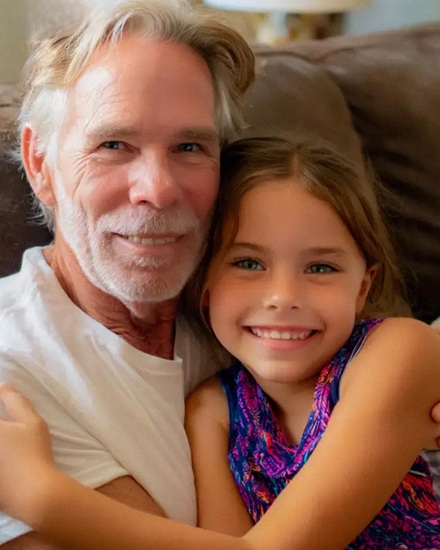
Lily used to burst through our front door like she was running toward Christmas morning. She never knocked properly. The door would swing open with a bang against the stopper, her small sneakers squeaking against the hardwood as she sprinted down the hallway.
“GRANDPA!” she would shout, her voice echoing through the house. Jim always pretended to brace himself for impact, widening his stance like a football player about to be tackled.
A second later she would launch into him, arms tight around his waist, her laughter bubbling up like she had been saving it all week. He would groan dramatically as if she had knocked the wind out of him, and then scoop her up anyway.
She adored him in a way only a child can adore someone—completely and without question. She wore his old baseball cap even though it slid down over her eyes. She begged him to teach her card tricks, even though she never quite understood how they worked.
When they played Go Fish, she cheated openly, hiding cards under her leg, and he always pretended not to notice. She called him her “favorite person,” and he would roll his eyes like it embarrassed him, though the pride in his face gave him away every time.

At first, everything felt normal.
The first morning she perched on a stool in the kitchen, swinging her legs while Jim made pancakes. She narrated his coffee routine as if she were hosting a cooking show.
“First you scoop,” she announced seriously. “Then you pour. Then you wait. Then you don’t drink it because it’s yucky.”
Jim winked at me over her head. “I’m raising a critic.”
The house felt warm and alive again. Toys scattered across the living room. Cartoon voices drifting from the television. Lily’s constant commentary filling every quiet space.
But by the fourth day, something shifted.
It wasn’t loud or dramatic. It was small. Subtle. The kind of change you might dismiss if you weren’t paying attention.
At dinner she pushed peas around her plate instead of talking nonstop about her day. When Jim asked if she wanted to play cards after dessert, she said, “Maybe later,” without looking up.
Later never came.
That night, as always, Jim waited by the couch for her hug before bed. It was a ritual they had never skipped.
“Go give Grandpa a hug before bed,” I said gently.
She stopped halfway down the hallway. She looked at him. Really looked at him.
Then she shook her head.
Jim kept smiling, but I saw it strain at the edges. “No hug tonight?”
“I’m sleepy,” she said quickly and disappeared into the guest room.
The silence that followed felt heavier than it should have.

Later, as I tucked her in, she stared at the ceiling like she was studying something invisible.
“Sweetheart,” I asked softly, brushing her hair off her forehead, “why didn’t you hug Grandpa?”
She hesitated. Then she turned toward me and whispered, “Grandma… he’s different.”
My heart tightened in a way I couldn’t immediately explain. “Different how?”
She swallowed. “He was crying.”
I blinked. “Grandpa was crying?”
She nodded. “Last night. I got up for water. I heard noises.”
“What kind of noises?”
“Like when someone tries not to be loud,” she said carefully. “I peeked in the kitchen.”
A cold prickle ran across my skin.
“He was at the table,” she continued. “His head was down. He was shaking. He had his hands on his face.” Her eyes filled with tears. “Grandpa never cries. He looked… small.”
I took her hand in mine. It felt warm and fragile.
“Thank you for telling me,” I said. “You did the right thing.”
“Is he mad at me?” she whispered.
“No,” I said immediately.
“Did I make him cry?”
“No. You didn’t.”
“But he’s different.”
“I know,” I said gently. “I’m going to talk to him.”
That night I found Jim in his recliner, a book open on his lap. The television was off. The room was quiet.
“You okay?” I asked.
“Fine,” he said too quickly.
“You’ve been on the same page for ten minutes.”
He glanced down at the book like it had betrayed him. “Guess it’s boring.”
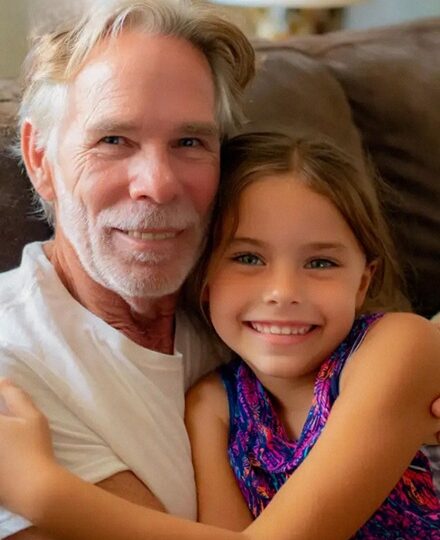
He forced a laugh that didn’t reach his eyes.
In the morning I watched him more closely.
He reached for the sugar while making coffee, then paused, staring at the counter as if he couldn’t quite remember what he was looking for.
“It’s right there,” I said softly.
He blinked. “Right. Of course.”
Later, Lily asked for a card trick. He shuffled the deck, stopped mid-motion, then reshuffled again with visible frustration. He performed the trick, but it lacked its usual flourish. Lily clapped politely, but her smile didn’t fully return.
That afternoon I passed the den and saw papers spread across his desk. Medical pamphlets. Printouts. A card with an appointment time circled in blue ink.
When he noticed me standing there, he gathered the papers too quickly and shoved them into a drawer.
“Bills,” he said.
“Since when do you hide bills?” I asked.
He didn’t answer.
That night, after Lily had fallen asleep, I sat across from him at the kitchen table.
“She saw you crying,” I said quietly.
His jaw tightened. “She shouldn’t have been up.”
“Jim.”
“I was tired.”
“A child doesn’t stop hugging someone over one moment,” I said carefully. “What’s going on?”
“Nothing.”
“Jim.”
“Drop it.”
He had never spoken to me like that in forty-two years of marriage.
After he went to bed, I opened the drawer.
Inside was an appointment card from a neurology clinic. A pamphlet about cognitive assessment. A printout detailing follow-up testing.
My hands trembled.
A floorboard creaked behind me.
“You went through my things,” Jim said quietly.
“I did,” I replied. “Because you wouldn’t tell me.”

He lowered himself into the chair across from me. For a moment he looked angry. Then he just looked tired.
“I didn’t want you to know,” he whispered.
“Why?”
“Because then it’s real.”
My throat tightened. “What did they say?”
He stared at the carpet.
“They said it’s early,” he muttered. “They love that word.”
“Early what?”
He swallowed.
“Early dementia,” he said. “Alzheimer’s is possible.”
The room seemed to tilt.
He kept talking, his voice uneven. “I’ve been forgetting things. Names. Why I walked into rooms. I read and it doesn’t stick. I feel it happening, and I can’t stop it.”
“And you cried alone,” I said.
“I didn’t want to be a burden.”
“You’re my husband,” I whispered. “Not a burden.”
“And Lily,” he added, his voice cracking. “She looks at me like I’m the safest place in the world. I didn’t want that to change.”
The weight of that broke something open in me. Not anger. Not fear. Just grief for something we hadn’t even fully lost yet.
The next morning we called our daughter Erin and her husband Daniel. We told them everything.
Erin’s face crumpled as Jim explained. Daniel went very quiet, asking careful, practical questions about next steps and specialists. It was clear he was trying to steady the room.
“No more secrets that land on a child,” I said firmly.
That evening I sat with Lily on her bed.
“Grandpa’s brain is going through something hard,” I explained gently. “Sometimes it gets mixed up. That made him sad.”
She stared at her hands. “Is he still Grandpa?”
“Yes,” I said without hesitation. “He’s still Grandpa.”
“Can I see him?”
We walked into the living room together.
Jim looked up like he’d been holding his breath all day.
“Hi, kiddo,” he said softly.
Lily stood in front of him. “Grandpa, you were crying.”
“I was,” he admitted. “I’m sorry you saw that.”
“Are you mad?”
“Never.”
“Are you scared?”
He nodded. “A little.”
She stepped forward and wrapped her arms around him. Tight. The kind of hug that doesn’t question.
When she pulled back, she said in her serious seven-year-old voice, “No more secrets.”

Jim looked at me.
“No more secrets,” he promised.
Over the next few days, we began adjusting in small, deliberate ways. We wrote things down more often. We created lists. We scheduled follow-up appointments.
We researched early-stage dementia and what it might mean for daily life. The doctors had explained that early intervention, cognitive exercises, and structured routines could help maintain quality of life. We focused on what we could control.
Lily noticed everything, but she didn’t pull away again.
When Erin came to pick her up at the end of the week, Lily hugged Jim without hesitation. He handed her his old baseball cap.
“For safe keeping,” he said.
She placed it on her head like it was something sacred.
“See you soon,” she told him.
“I’ll be here,” he replied.
After they left, the house felt too quiet.
The toys were gone. The hallway echoed differently. I drove to the cemetery that afternoon and sat on a bench beneath a maple tree, letting the fear rise and settle and rise again.
I thought about the years behind us. The wedding photo in the hallway. The nights we stayed up with sick babies. The vacations, the arguments, the reconciliations. The long, ordinary days that had quietly built a life.
Then I stood up, because there was no other choice.
When I came home, Jim was at the kitchen table again, his book open.
“You okay?” he asked.
I nodded, then shook my head. “No. But I will be.”
He gave me a tired smile. “Me too.”
I walked over and wrapped my arms around him.
He held me back, solid and warm.
For now, he was still here.
For now, he could still laugh at Lily’s jokes, still teach her card tricks, still wear that baseball cap when she insisted he match her. The future felt uncertain, but the present was real and steady in my hands.
We did not know exactly what the months ahead would bring. We knew there would be difficult conversations, medical appointments, and moments of frustration. We knew there would also be birthday parties, school recitals, and quiet Sunday mornings with coffee and pancakes.
Dementia may change many things, but it does not erase love. It does not erase the decades that built a family. It does not erase the comfort of a familiar embrace.
And so we began, not with fear, but with honesty.
No more secrets.
Just one day at a time.
