
That morning began like any other, the kind of day that slips past you without notice. The sky was a dull, oppressive gray, heavy with clouds that threatened rain.
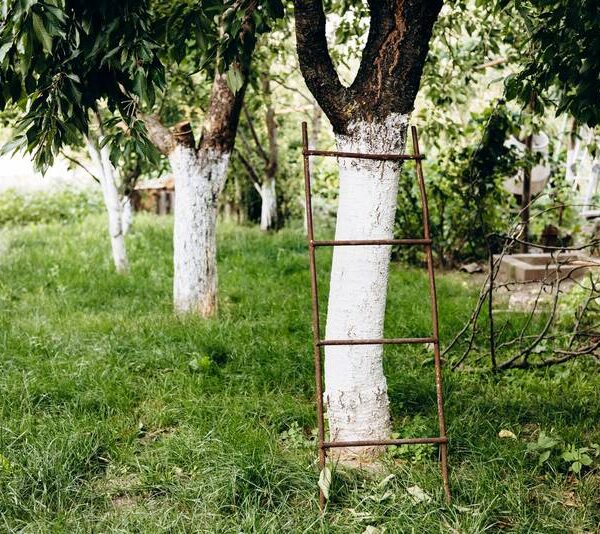
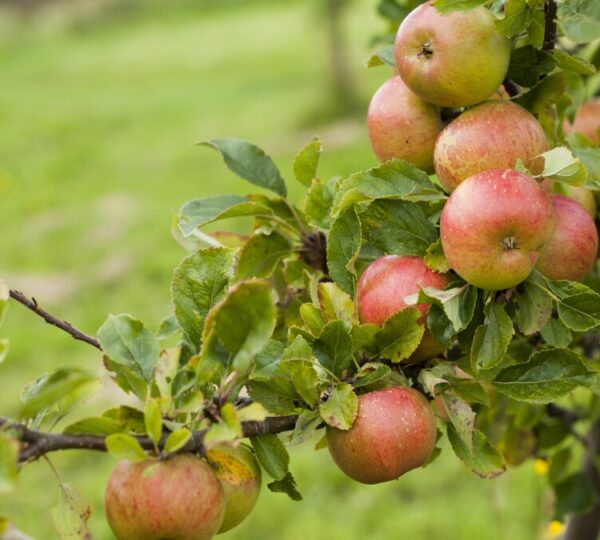
But I felt a quiet sense of purpose as I surveyed the yard. My old apple tree, a relic from decades past, had been leaning awkwardly for months, and the top branches were lifeless.
Stripped bare by seasons of neglect and storms. I had postponed this chore far too long, letting other responsibilities take precedence. But today, I resolved to tackle it.
I wanted to prune it back, reclaim a sense of order, and maybe salvage a few of the remaining healthy limbs. With the ladder set up and my pruning tools in hand, I felt the familiar satisfaction that comes from confronting something you’ve been avoiding.
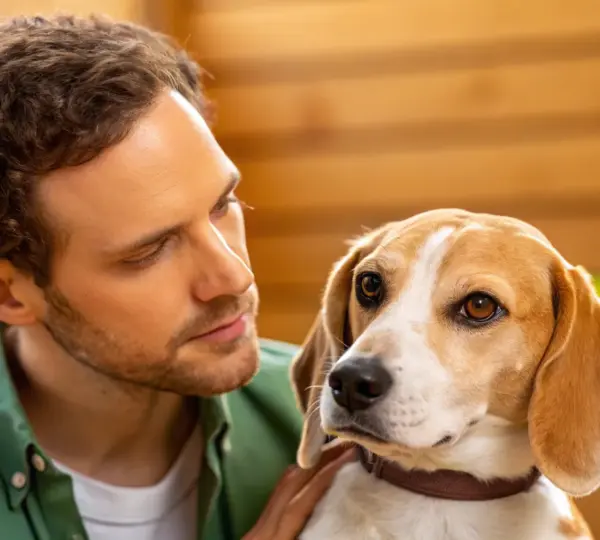
Max, my loyal dog, followed close behind, his ears flicking and tail stiff, circling me with an energy that felt slightly off.
It wasn’t his usual excited anticipation; there was a tension in his movements that unsettled me, though I tried to ignore it.
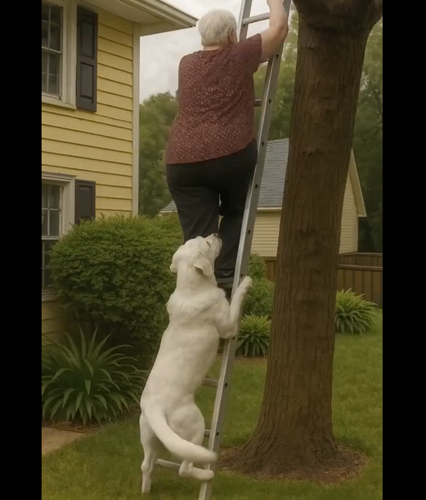
I leaned the ladder against the tree trunk and carefully tested its stability. Max stopped moving the instant my boot touched the first rung, his body rigid as if frozen by some unseen force.
His gaze met mine, wild and urgent, conveying a message I could not yet decipher. I chuckled lightly, brushing off my unease. “Relax, buddy. I’ll be down in a minute,” I said, attempting to soothe him and myself. I climbed another rung, feeling the ladder sway gently beneath me.
And then it happened—a sharp, insistent tug at the cuff of my trousers. Max had latched on with his teeth, gripping tightly enough that I nearly lost my balance.
My surprise quickly turned to concern. “Hey! What’s gotten into you?” I asked, trying not to hurt him as I attempted to disentangle his jaws from my pant leg.
But Max braced himself, digging his paws into the earth, his eyes reflecting something far more serious than mere playfulness or stubbornness.
Frustration mounted as I climbed down, my pulse quickening not just from the tug but from the realization that Max wasn’t acting like his usual self.
I led him toward the kennel, reasoning that perhaps the impending storm had stirred unease, or that he simply wanted attention. Inside the kennel, I secured the chain and tried to calm him with a gentle pat on the head.
A low, trembling whine emanated from him, a sound thick with unease and perhaps even fear. I whispered assurances, “I’ll be right back, buddy,” attempting to mask my own growing apprehension.
Returning to the ladder, I felt a creeping sense of doubt, but stubborn resolve pushed me forward. My foot had barely reached the second rung when the world changed in an instant.
A blinding flash of light tore through the thick clouds above, so intense that I squeezed my eyes shut reflexively. The thunder that followed wasn’t a distant rumble; it was a physical assault, reverberating through my chest and ribs with a violent, bone-jarring crack.
The next few moments exist in a blur of motion and instinct. Lightning struck the apple tree with terrifying precision, the trunk exploding outward as bark, splinters, and shards of wood erupted like shrapnel in every direction.
A wave of scorching heat washed over me, forcing me backward as the ladder clattered to the ground, narrowly missing my feet.
The acrid, electric scent of burning wood filled my nostrils, sharp and unforgettable. Smoke spiraled from the shattered tree, and the top half trembled in the aftermath of the strike.
I lay on the wet grass, stunned, my heart hammering as adrenaline coursed through me. Max barked frantically, straining against the chain as if he were trying to pull me into safety himself.
I realized, with a jolt of clarity, that if he hadn’t intervened moments earlier—if he hadn’t clamped onto my trousers—I might have been halfway up that ladder, directly beside the trunk, when it was struck.
I slowly got to my feet, my body trembling, and approached Max, who gazed at me with a mixture of pleading and relief, as if asking, Do you finally understand?
I knelt in the soaked grass and unclipped his chain. He rushed to me, pressing his warm head against my chest. I wrapped my arms around him, feeling his tremors mingle with my own.
It was a raw, visceral moment, one that transcended words. Max had sensed something I could not, a danger invisible to human perception but tangible in the air around us. His instincts had propelled him into action, a silent guardian compelling me to step away from a lethal path.
As the rain finally began to fall, first in hesitant drops and then in heavy sheets, we took refuge on the porch. I watched the apple tree smolder, steam rising from charred branches and shattered bark.
The storm’s fury had been swift and merciless, but Max had acted with foresight and loyalty that defied explanation. One moment I was irritated that my dog had interrupted my task; the next, I was overwhelmed by gratitude for the life I still had.
Max stayed close, pressing against my leg, periodically glancing up to ensure I remained unharmed. I scratched behind his ears, a gesture loaded with unspoken understanding and appreciation.
“Good boy,” I whispered. “You knew. And I didn’t. Thank you.” The storm gradually eased, leaving behind a quiet aftermath. Clouds drifted apart, revealing a pale, washed-out sky, and the yard smelled richly of wet earth and scorched wood.
The apple tree, a once-proud fixture of my garden, was reduced to a dangerous, smoldering stump, a reminder of how close I had come to tragedy.
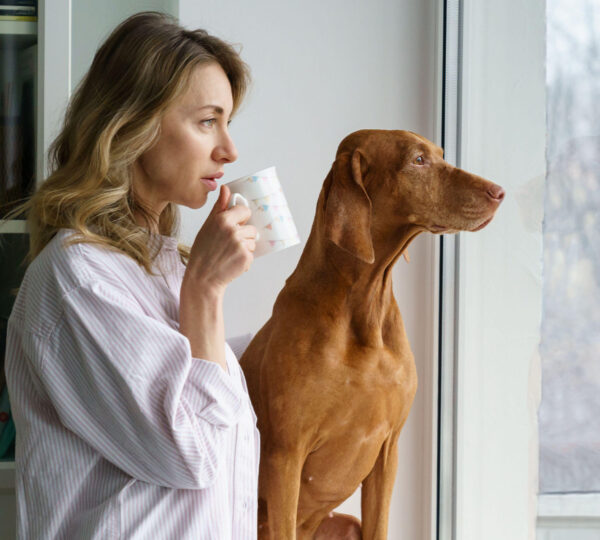
Later, after the rain subsided and the air was scented with renewal, I returned to the yard with Max trotting beside me.
The remains of the tree told a vivid story: blackened bark, a trunk split almost in half, scorch marks etched across the grass. I rested a hand on Max’s head, steadying both of us as we surveyed the destruction.
Every detail underscored the fine line between routine and catastrophe, the razor-thin margin that separated life from death.
Animals possess an awareness that transcends human perception. Dogs, in particular, are finely attuned to changes in air pressure, vibrations, and subtle cues in their environment that humans cannot consciously detect.
Max had perceived a threat in the seconds before it became apparent to me, and he acted decisively. He didn’t understand lightning or weather systems in scientific terms, but he recognized danger, and he intervened with the only tools he had: strength, instinct, and unwavering loyalty.
There is a quiet wisdom in observing such moments. Pets are not merely companions; they are extensions of perception, guardians whose understanding operates beyond our cognitive reasoning.
Max’s grip on my trousers was not misbehavior—it was a deliberate act of protection. And in that split second, I realized the depth of his awareness, the intelligence and instinct embedded in his being. He communicated a vital truth that could not be spoken: Step no further.
That day left an indelible impression on me. The apple tree could be replaced, the yard restored, but the lesson lingered far beyond the physical aftermath.
Life is fragile, and the guardians of life sometimes arrive in forms we take for granted. Max, in his quiet, nonverbal way, had saved me from a force of nature that was sudden, violent, and utterly indiscriminate.
He reminded me of the importance of presence, of observing signals we often dismiss, and of trusting those whose senses operate in ways we cannot fathom.
In the weeks that followed, I reflected on the experience constantly. Every time Max nudged me, followed me with watchful eyes, or reacted sharply to an unseen movement, I remembered that morning.
The apple tree remained a scarred sentinel in the yard for some time, a living monument to both the storm and my dog’s courage.
I treated him with renewed care, understanding that loyalty is measured not just in companionship but in instinctive action that can protect life itself.
There’s a universal lesson in this experience: sometimes, the bravest warnings come not in words, but in actions, in tugs at trousers, in the watchful eyes of a devoted animal.
Max had acted without hesitation, without complaint, and without understanding the full magnitude of the storm. Yet his decision to intervene was precise, correct, and life-saving.
Even as I recount this event, the images remain vivid: the blinding flash, the violent thunderclap, the splintering apple tree, and Max’s tense, unwavering gaze. It was a reminder of vulnerability, of the forces beyond human control, and of the silent, profound intelligence of animals who live beside us.
That morning could have ended differently, and the thought alone underscores the gift of vigilance, loyalty, and instinct.
Max remains by my side, a steady presence in my life. Each glance, each nudge, carries the memory of that morning and the knowledge that he sees what I cannot.
In the quiet moments, I marvel at the bond between human and animal, at the subtle ways in which nature communicates, and at the miraculous ways in which life is preserved, often against all odds.
The storm passed, the sky cleared, and the apple tree was eventually removed, its charred remains a cautionary tale of the unforeseen and uncontrollable.
But Max’s actions remain permanent, etched in memory and heart. He didn’t merely protect me from a falling branch or the errant ladder; he saved me from something much larger—an instantaneous, near-fatal strike that humans alone might not have perceived in time.
That day, I learned to see the world through his eyes, if only for a moment, and to appreciate the depth of instinct, love, and awareness that dogs bring to our lives.
In the end, it was a lesson in humility, gratitude, and the quiet, uncompromising wisdom of an animal who acts without thought for reward, only for protection.
Life has a way of revealing itself through such moments, and those who witness them are forever changed. Max, my faithful dog, reminded me of this truth: sometimes the most profound guidance comes not from reason, but from instinct, and sometimes listening to it is the difference between life and death.
