...

Mother Refuses to Go Outside After Baby Is Born with Black Spots

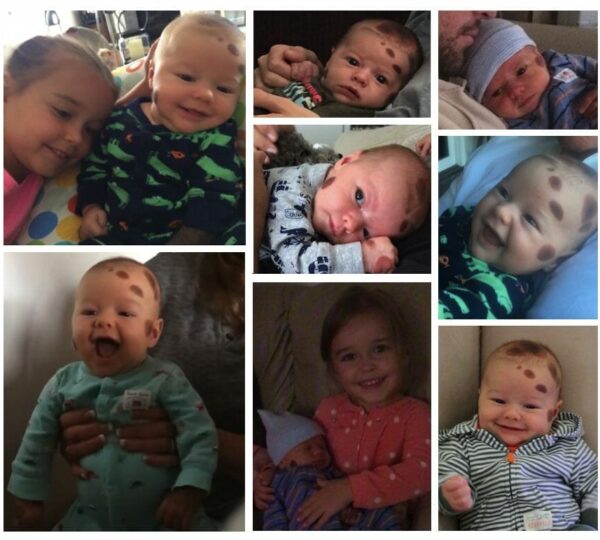
When Stephanie and Dan Dworsky held their newborn son, Kacy, for the first time on June 9, 2016, they were overcome with love — but also confusion and fear. What should have been one of the happiest moments of their lives quickly turned into an emotional and medical rollercoaster. Their baby, just minutes old, had large, dark spots scattered across his tiny body — covering his face, legs, back, and especially one arm. These were not ordinary birthmarks. Doctors soon diagnosed him with congenital melanocytic nevus (CMN), a rare skin condition that only affects about 1 in every 500,000 babies.

Kacy was born with both “satellite nevi” (smaller black or brown spots) and a Giant Congenital Melanocytic Nevus on his left arm. The condition occurs during fetal development, caused by a mutation that leads pigment-producing cells (melanocytes) to cluster together abnormally in the skin. Although CMN is mostly a cosmetic issue, it can carry an increased — though small — risk of skin cancer, particularly melanoma. But for most parents, the emotional impact of the condition can be just as intense as the medical one.

Stephanie remembers the overwhelming mixture of emotions in the hospital delivery room. “I had spent nearly 10 months doing everything right — eating healthy, avoiding anything risky, preparing for a normal, happy delivery,” she said. “So when I saw his skin, I froze. I thought, ‘What did I do wrong?’”

Although doctors quickly reassured her that Kacy’s condition was not her fault, Stephanie admitted that the guilt lingered. As a mother, she couldn’t help but feel responsible, even when there was no scientific basis for blame. “I knew it wasn’t logical, but emotionally, it felt like I had failed him somehow.” As Kacy was transferred for evaluation by pediatric dermatologists and specialists, Stephanie and Dan were flooded with information. They learned about CMN’s risks, possible treatments, and the uncertain road ahead. While some children with large nevi choose to undergo surgical removal of the affected skin — often involving multiple operations over years — others live their entire lives with the marks untouched.
“The hardest part wasn’t hearing about the medical risks,” Dan said. “It was realizing that people might treat our son differently just because of the way he looks. We knew we couldn’t protect him from every cruel comment or stare.”

Isolation and Fear: A Mother’s Struggle

In the first few weeks and months after Kacy’s birth, Stephanie found herself reluctant to leave the house. She feared how strangers might react to her son’s appearance. Would they ask invasive questions? Would they assume something was wrong with him? Would other children point, or worse — laugh?

“I felt this constant anxiety,” Stephanie shared. “I didn’t want people to look at him and see something ‘wrong.’ I didn’t want him to be pitied or stared at like he was some kind of medical mystery. So I stayed home. I isolated myself. And then I felt guilty for that too.”

There were days she cried just thinking about taking him out in public. She worried that other parents would stop their children from playing with him, not out of malice, but out of fear and misunderstanding.

“People fear what they don’t understand,” Dan added. “And if they see something unfamiliar, they assume it’s dangerous or contagious — which CMN is not.”

More Than Skin Deep: The Emotional Weight

Although CMN is visible on the surface, its emotional and social consequences go much deeper. Children with visible skin differences often face bullying, exclusion, and mental health challenges. Stephanie and Dan are painfully aware that as Kacy grows older, he may have to answer difficult questions, stand up to cruel remarks, and learn to live in a world that doesn’t always accept difference with kindness. But they’re doing everything in their power to build Kacy’s strength — emotionally, mentally, and physically.

“We want Kacy to know he is more than his skin,” Stephanie said. “He is smart, loving, funny — and his condition doesn’t define him.”

They also want to change how society sees children like Kacy. That’s why they’ve made the decision to speak openly about his condition, sharing his story publicly in hopes of raising awareness and spreading compassion.

Raising Awareness, One Story at a Time

By educating others about CMN, the Dworskys hope to create a future where children with visible differences are treated with the same love and respect as anyone else. They want people to know that Kacy’s marks are not painful. They are not contagious. They are not something to fear. They are simply a part of who he is — like eye color or freckles.

“When people see us out with Kacy now, they sometimes still stare,” Stephanie admits. “But I’ve learned to hold my head high. If I show pride and confidence, I hope others will follow.”

The family also uses social media and support groups to connect with others going through similar experiences. They’ve found strength in the stories of other parents, and hope that by sharing their own, they can offer encouragement and understanding to those just beginning the journey.

Looking Ahead with Love and Hope

Today, Kacy is a joyful, curious, and energetic child who loves to explore the world around him. While his skin still carries the marks of CMN, his spirit remains untouched. He’s learning to smile through the stares, to laugh through the whispers, and to know that he is deeply loved.

“This journey hasn’t been easy,” Dan said, “but it has taught us so much about resilience, empathy, and the power of unconditional love.”

Stephanie agrees, adding,

“I still have fears. I still worry. But more than anything, I’m proud. Proud to be his mom, proud of his strength, and proud of the way he’s already changing the world — just by being himself.”

What Is Congenital Melanocytic Nevus (CMN)?

CMN is a rare skin condition present at birth, caused by an overgrowth of melanocytes — the pigment-producing cells in the skin. It appears as dark, sometimes raised patches that can vary in size, shape, and location. Large or giant nevi may increase the risk of melanoma and can sometimes be accompanied by neurological concerns if pigment cells are present in the brain or spinal cord. However, in many cases, the condition is mainly cosmetic. Treatment can include monitoring, surgical removal, laser therapy, or no treatment at all, depending on the size and location of the nevi, as well as patient and family preference.

Spreading Awareness Matters

Families like the Dworskys remind us how important it is to lead with empathy, not judgment. By learning about rare conditions like CMN, we can foster a society where children — regardless of appearance — are welcomed, accepted, and celebrated for who they are. Kacy’s journey is still just beginning, but his story already speaks volumes: every child deserves to feel seen, safe, and loved — exactly as they are.

When Stephanie and Dan Dworsky held their newborn son, Kacy, for the first time on June 9, 2016, they were overcome with love — but also confusion and fear. What should have been one of the happiest moments of their lives quickly turned into an emotional and medical rollercoaster. Their baby, just minutes old, had large, dark spots scattered across his tiny body — covering his face, legs, back, and especially one arm. These were not ordinary birthmarks. Doctors soon diagnosed him with congenital melanocytic nevus (CMN), a rare skin condition that only affects about 1 in every 500,000 babies.

Kacy was born with both “satellite nevi” (smaller black or brown spots) and a Giant Congenital Melanocytic Nevus on his left arm. The condition occurs during fetal development, caused by a mutation that leads pigment-producing cells (melanocytes) to cluster together abnormally in the skin. Although CMN is mostly a cosmetic issue, it can carry an increased — though small — risk of skin cancer, particularly melanoma. But for most parents, the emotional impact of the condition can be just as intense as the medical one.

Stephanie remembers the overwhelming mixture of emotions in the hospital delivery room. “I had spent nearly 10 months doing everything right — eating healthy, avoiding anything risky, preparing for a normal, happy delivery,” she said. “So when I saw his skin, I froze. I thought, ‘What did I do wrong?’”

Although doctors quickly reassured her that Kacy’s condition was not her fault, Stephanie admitted that the guilt lingered. As a mother, she couldn’t help but feel responsible, even when there was no scientific basis for blame. “I knew it wasn’t logical, but emotionally, it felt like I had failed him somehow.” As Kacy was transferred for evaluation by pediatric dermatologists and specialists, Stephanie and Dan were flooded with information. They learned about CMN’s risks, possible treatments, and the uncertain road ahead. While some children with large nevi choose to undergo surgical removal of the affected skin — often involving multiple operations over years — others live their entire lives with the marks untouched.

“The hardest part wasn’t hearing about the medical risks,” Dan said. “It was realizing that people might treat our son differently just because of the way he looks. We knew we couldn’t protect him from every cruel comment or stare.”

Isolation and Fear: A Mother’s Struggle

In the first few weeks and months after Kacy’s birth, Stephanie found herself reluctant to leave the house. She feared how strangers might react to her son’s appearance. Would they ask invasive questions? Would they assume something was wrong with him? Would other children point, or worse — laugh?

“I felt this constant anxiety,” Stephanie shared. “I didn’t want people to look at him and see something ‘wrong.’ I didn’t want him to be pitied or stared at like he was some kind of medical mystery. So I stayed home. I isolated myself. And then I felt guilty for that too.”

There were days she cried just thinking about taking him out in public. She worried that other parents would stop their children from playing with him, not out of malice, but out of fear and misunderstanding.

“People fear what they don’t understand,” Dan added. “And if they see something unfamiliar, they assume it’s dangerous or contagious — which CMN is not.”

More Than Skin Deep: The Emotional Weight

Although CMN is visible on the surface, its emotional and social consequences go much deeper. Children with visible skin differences often face bullying, exclusion, and mental health challenges. Stephanie and Dan are painfully aware that as Kacy grows older, he may have to answer difficult questions, stand up to cruel remarks, and learn to live in a world that doesn’t always accept difference with kindness. But they’re doing everything in their power to build Kacy’s strength — emotionally, mentally, and physically.

“We want Kacy to know he is more than his skin,” Stephanie said. “He is smart, loving, funny — and his condition doesn’t define him.”

They also want to change how society sees children like Kacy. That’s why they’ve made the decision to speak openly about his condition, sharing his story publicly in hopes of raising awareness and spreading compassion.

Raising Awareness, One Story at a Time

By educating others about CMN, the Dworskys hope to create a future where children with visible differences are treated with the same love and respect as anyone else. They want people to know that Kacy’s marks are not painful. They are not contagious. They are not something to fear. They are simply a part of who he is — like eye color or freckles.

“When people see us out with Kacy now, they sometimes still stare,” Stephanie admits. “But I’ve learned to hold my head high. If I show pride and confidence, I hope others will follow.”

The family also uses social media and support groups to connect with others going through similar experiences. They’ve found strength in the stories of other parents, and hope that by sharing their own, they can offer encouragement and understanding to those just beginning the journey.

Looking Ahead with Love and Hope

Today, Kacy is a joyful, curious, and energetic child who loves to explore the world around him. While his skin still carries the marks of CMN, his spirit remains untouched. He’s learning to smile through the stares, to laugh through the whispers, and to know that he is deeply loved.

“This journey hasn’t been easy,” Dan said, “but it has taught us so much about resilience, empathy, and the power of unconditional love.”

Stephanie agrees, adding,

“I still have fears. I still worry. But more than anything, I’m proud. Proud to be his mom, proud of his strength, and proud of the way he’s already changing the world — just by being himself.”

What Is Congenital Melanocytic Nevus (CMN)?

CMN is a rare skin condition present at birth, caused by an overgrowth of melanocytes — the pigment-producing cells in the skin. It appears as dark, sometimes raised patches that can vary in size, shape, and location. Large or giant nevi may increase the risk of melanoma and can sometimes be accompanied by neurological concerns if pigment cells are present in the brain or spinal cord. However, in many cases, the condition is mainly cosmetic. Treatment can include monitoring, surgical removal, laser therapy, or no treatment at all, depending on the size and location of the nevi, as well as patient and family preference.

Spreading Awareness Matters

Families like the Dworskys remind us how important it is to lead with empathy, not judgment. By learning about rare conditions like CMN, we can foster a society where children — regardless of appearance — are welcomed, accepted, and celebrated for who they are. Kacy’s journey is still just beginning, but his story already speaks volumes: every child deserves to feel seen, safe, and loved — exactly as they are.