
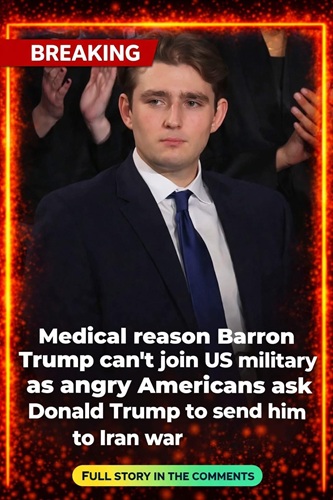
In the midst of one of the most intense geopolitical crises of the modern era, a strange phrase has been trending across social media: #SendBarron.
On its surface, the hashtag appeared as a provocative call to send Barron Trump, the teenage son of President Donald Trump, into military service — not as a serious policy proposal, but as a satirical commentary on leadership, privilege, and war.
Despite its origins in parody, the viral reaction to the phrase reveals deeper, long‑standing anxieties about who bears the cost of military decisions and how societies perceive fairness in times of conflict.
What #SendBarron Actually Is
The idea of drafting Barron Trump into the U.S. military started not as a political petition or official proposal, but as a satirical website launched by Toby Morton, a writer and creator of parody political commentary sites.
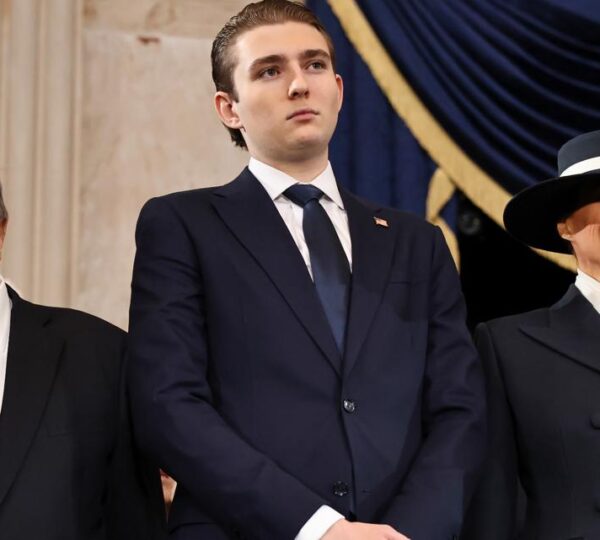
Known for registering domain names that mimic real political initiatives, Morton’s site DraftBarronTrump.com uses exaggerated patriotic language and fabricated quotes attributed to the Trump family to poke fun at the idea that political leaders should share the risks of the wars they authorize.
The homepage of the site declares, in over‑the‑top patriotic tone, that “America is strong because its leaders are strong” and that Barron Trump is “more than ready to defend the country his father so boldly commands.” It includes clearly fabricated quotes styled to mock political messaging and trigger a reaction online.
Because the site is satire — not an official policy statement or serious military draft effort — there is no formal movement to draft Barron, no registration or legal mechanism being pursued, and no indication that the Trump family endorses or supports any such campaign.
The parody also exaggerates or fabricates language purportedly from members of Trump’s own family, something those parody sites often do as part of their commentary rather than presenting factual journalism.
Despite this, the hashtag #SendBarron took off on platforms like X, where social media users amplified it to criticize perceived hypocrisy in leadership and casualty risk during ongoing U.S. military involvement abroad.
Some reactions pointed back to past controversies — such as President Trump’s deferment from the Vietnam draft in 1968 after receiving a diagnosis of bone spurs — as substantive reasons why the satire struck a chord with audiences.
The Broader Conflict Context: Iran and Escalating Tensions
Part of the reason for the strong reaction to #SendBarron lies in the backdrop against which it emerged. In late February 2026, the United States and Israel launched a major military campaign against Iran that has rapidly escalated into one of the most serious conflicts in recent global history.
Reports confirmed that Iran’s Supreme Leader, Ayatollah Ali Khamenei, was killed in a joint U.S.–Israeli operation on February 28, 2026. This marked the first assassination of an Iranian head of state since the late 19th century and plunged the region into a significant political and military crisis.
The U.S. and Israeli governments described the operation as a strategic strike designed to degrade Iran’s military capabilities and disrupt its nuclear and missile programs.
Many Iranian state sources confirmed Khamenei’s death, while U.S. officials framed it as an opportunity for the Iranian people to “take back their country” from a regime they labeled oppressive.
Following the attack, Iran responded with missile and drone strikes against allied targets in the region, including visits to strategic sites in neighboring countries.
These exchanges of fire have drawn in actors such as Hezbollah in Lebanon, raised tensions around the Strait of Hormuz, and contributed to broader instability that has impacted global markets, travel, and diplomatic relations around the world.
There have been confirmed casualties on both sides, including American service members, and reports of civilian deaths as well.
Why the Satire Resonated
The social backlash captured by #SendBarron illustrates a deeper frustration among some members of the public.
When war becomes headline news — especially one that carries the potential for broader escalation — questions about leadership accountability and shared sacrifice resurface.
For many Americans, especially those with family members who served in past conflicts, the notion that political elites are insulated from the personal cost of military service can provoke strong emotion.
In particular, President Trump’s own history regarding the Vietnam War draft has been a point of controversy for decades. During that era, he received a medical deferment after being diagnosed with bone spurs — a decision that was later scrutinized given his father’s influence and his family’s connections.
While those events took place more than half a century ago, they remain part of the public record and are sometimes referenced in political debate about equity in military service.
The DraftBarronTrump.com parody plays on this historical memory by suggesting, with tongue in cheek, that if a particular political leader believes in wartime strength and sacrifice, then his own family should bear the same risks.
The satire intentionally exaggerates the idea to provoke thought and discussion, rather than to advance literal drafting legislation.
Reality of Military Service Requirements
In reality, the United States has not implemented a military draft since 1973, when the Selective Service System transitioned to an all‑volunteer force.
Drafting an individual — especially the child of a political leader — would require Congressional authorization, legal frameworks, and specific criteria that do not currently exist.
There are no active proposals in Congress to institute a draft, and no official measures are being pursued to compel Barron Trump — who is currently a college student — to join the military.
Furthermore, military enlistment requirements include height restrictions. According to recruitment standards, most U.S. military branches typically set a maximum allowable height of around 6 feet 8 inches for enlistment, whereas Barron Trump is reportedly 6 feet 9 inches tall, which would technically place him outside the standard eligibility limits for many branches due to safety and uniformity concerns.
These technical details are unrelated to the satire but are sometimes mentioned in online discussions for context.
Public Debate and Leadership Responsibility
The louder and more personal anger sparked by the parody reflects a broader public debate over leadership decisions, wartime accountability, and the human cost of military conflict.
In times of war, political leaders must balance national security considerations with domestic sentiment, and public confidence often hinges on how transparently and responsibly those decisions are communicated.
For many observers, ongoing U.S. involvement in the conflict with Iran — which has seen retaliatory strikes, civilian casualties, and significant regional instability — raises fundamental questions about how decisions for war are made and who ultimately pays the cost.
This sentiment is not unique to any one administration; public skepticism about war decisions and executive authority stretches back through American history, often intensifying when military engagements lack clear congressional authorization or broad public support.
The #SendBarron reaction, while rooted in satire, touches on these deeper themes: fairness, shared risk, leadership accountability, and the perception that political elites may be detached from the consequences of decisions that affect ordinary families.
The Line Between Satire and Serious Discourse
Understanding satire — especially political satire — is important in distinguishing factual reporting from commentary designed to provoke or amuse.
Websites like DraftBarronTrump.com are created specifically to use parody as a lens through which to critique political behavior. They are not designed to be taken literally, nor are they indicators of official political positions or organized movements.
Satire has a long history in public discourse, from the writings of Jonathan Swift to modern television shows and internet commentary. It operates by exaggerating real sentiments or highlighting contradictions to stimulate reflection or debate.
In the case of #SendBarron, the satire takes aim not at Barron Trump as an individual, but at the broader dynamics of privilege, leadership, and sacrifice in wartime.
However, it’s also true that satire can blur with reality in the age of social media. A hashtag like #SendBarron can quickly spread beyond its creator’s intent, becoming a symbol used by diverse groups — some serious, some ironic, and some outraged. This blending of satire and earnest critique reflects the complexity of online discourse today.
Meanwhile, the Iran Conflict Continues
While online reactions swirl and hashtags trend, the reality on the ground remains somber and consequential. The U.S.–Israeli military campaign against Iran has not ended with the assassination of Ayatollah Ali Khamenei; it continues to fuel unrest, retaliatory violence, and diplomatic tension.
Neighboring countries have responded with varying degrees of condemnation, cooperation, or caution, while international bodies such as the United Nations have called for restraint and investigation into civilian casualties.
In response to Iran’s ongoing missile and drone strikes, international markets have reacted to concerns over energy supply disruptions, and global policymakers are assessing the broader implications of what some analysts fear could become a prolonged regional conflict.
Concluding Thoughts: Satire, War, and Public Sentiment
The uproar over #SendBarron is less about one teenager and more about public frustration with war leadership, perceived inequality in how burdens are shared, and the emotional weight of sending loved ones into harm’s way.
The satirical campaign that sparked the hashtag is not a factual movement to draft Barron Trump, nor does it have any legal or institutional backing.
It’s instead a commentary — exaggerated, provocative, and deliberately humorous — designed to channel broader debates about war, privilege, and accountability.
In the midst of rising tensions in the Middle East, these debates take on heightened intensity. When headlines declare strikes against foreign powers while reminding the public of the realities of military service and sacrifice, it is understandable that citizens turn to satire, protest, and viral commentary to express their concerns, fears, and critiques.
Whether or not Barron Trump ever wears a uniform — which, according to current military standards and laws, he is neither being drafted nor being asked to — the hashtag #SendBarron will likely remain a marker of this moment in public discourse: a moment when ordinary people grappled with complex questions about leadership, responsibility, and the human cost of conflict in an interconnected, hyper‑visible world.
