
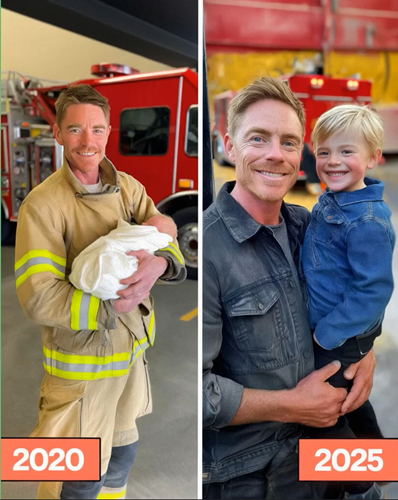
The wind had been restless that evening, sweeping through the empty streets and rattling loose debris along the sidewalk.
The station itself was unusually calm—no emergency calls, no sirens cutting through the darkness. I was finishing routine checks when I heard a faint, irregular sound near the front steps.
At first, I assumed it was the wind catching something loose or perhaps a stray animal looking for shelter. Still, something about the sound felt different—softer, more fragile.
I stepped outside, the cool air biting through my jacket, and followed the noise toward the entrance. That’s when I saw it: a small woven basket placed carefully near the steps, partially shielded from the wind. Inside, wrapped in a thin, worn blanket, was a newborn baby.

For a moment, I froze.
My training as a firefighter had conditioned me to respond quickly to danger, but nothing in my experience prepared me for the quiet weight of that moment.
The baby stirred slightly and opened his eyes—wide, alert, and searching, as if trying to understand where he was. When I gently lifted him, his tiny fingers instinctively curled around mine.
That simple, reflexive gesture sent a wave of emotion through me that I can still feel when I think about it.
There was awe, fear, disbelief, and an overwhelming urge to protect him—all at once.
I checked him carefully, making sure he was breathing normally and showed no immediate signs of distress. He was cold, but stable.
I brought him inside, wrapped him in a warmer blanket, and immediately contacted medical services and Child Protective Services, following protocol exactly as I was trained to do.
Throughout it all, I spoke softly to him, not because I thought he understood my words, but because it felt instinctively right to let him know he wasn’t alone.
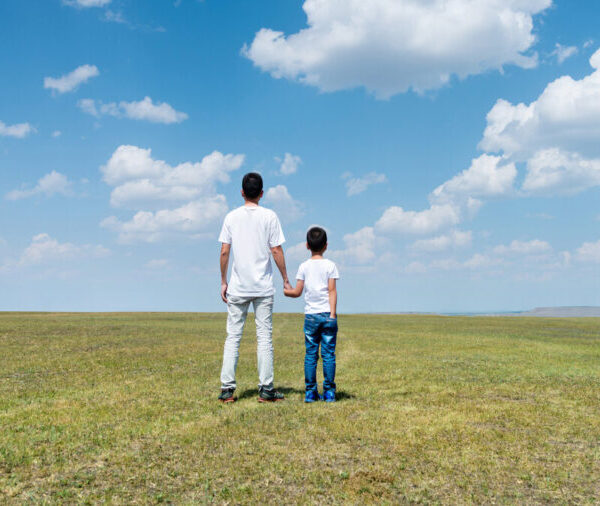
I told myself it was just shock. That it would pass.
It didn’t.
In the days and weeks that followed, I couldn’t stop thinking about him. I remembered the weight of him in my arms, the way he had gripped my finger, the quiet trust in his eyes.
I asked about him through proper channels and learned I was allowed to visit. I did—whenever my schedule allowed.
I would sit beside his crib, reading softly or simply talking to him about my day, about the firehouse, about the world he had just entered. I never made promises I couldn’t keep, but I did tell him he mattered. That he was safe. That someone cared.
My best friend and fellow firefighter, Joe, noticed the change in me before I fully admitted it to myself. I talked about the baby constantly—how small his hands were, how he yawned in his sleep, how peaceful he looked when he rested.
One evening after shift, Joe put a hand on my shoulder and said, “You’re already his dad in your heart. If you feel this strongly, you owe it to both of you to try.”
Those words stayed with me.
The decision to pursue adoption wasn’t impulsive or romanticized. It was careful, deliberate, and terrifying. I understood the responsibility, the permanence, and the sacrifices involved. Still, every part of me knew I couldn’t walk away.
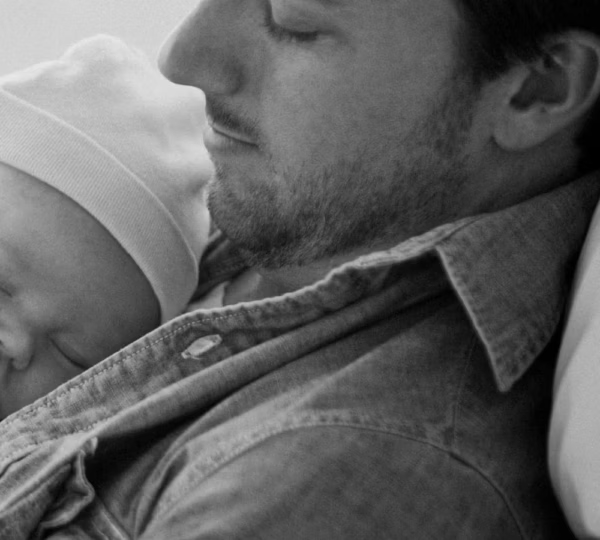
The process was long and emotionally demanding. There were background checks, home studies, interviews, paperwork, and months of uncertainty.
I had to confront my own doubts—whether I was ready, whether I was enough, whether a single firefighter could truly provide the stability a child deserved.
But each step reinforced the same truth: this wasn’t about convenience or timing. It was about commitment.
When the approval finally came, I felt relief unlike anything I had ever known. The day I officially became his father, I held him again—this time knowing I wasn’t letting go.
I named him Leo, a name that symbolized strength, courage, and resilience. It felt fitting for a child who had already endured more than most ever would.
Raising Leo as a single dad wasn’t easy, and I never pretended it was. There were sleepless nights, rushed mornings, and constant adjustments.
The firehouse became part of his world, just as he became part of mine. My schedule revolved around daycare pickups, school events, and bedtime routines.
Our home was rarely tidy. Mismatched socks seemed to multiply overnight. Breakfast often meant cereal spills and sticky countertops. But it was filled with laughter, warmth, and a sense of belonging that made every challenge worthwhile.
We built traditions that became anchors in our lives. Bedtime stories under makeshift blanket forts. Long walks where Leo stopped to examine every bug, leaf, or cloud that caught his attention.
Sunday mornings spent making pancakes that inevitably ended up on the floor—and sometimes on us.
Every milestone felt extraordinary. His first steps. His first word. The first time he rode a bike without training wheels. The first school play where he searched the audience until his eyes found mine.
Through it all, his laughter became the soundtrack of my life.
By the time Leo turned five, we had settled into a rhythm that felt steady and complete. I believed, quietly and confidently, that our story had found its shape.
Then one evening, everything shifted again.
We were sitting on the living room floor, building an elaborate cardboard dinosaur world—complete with hand-drawn volcanoes and paper trees—when there was a knock at the door. I opened it to find a woman standing there, visibly nervous, holding back tears.
She introduced herself as Leo’s birth mother.

She wasn’t angry. She wasn’t demanding anything. She simply asked—hesitantly—if there might be room for her in Leo’s life.
My first reaction was fear.
I felt protective, uncertain, and overwhelmed by the thought of change. But there was sincerity in her voice, humility in her posture, and a quiet respect for the life Leo and I had built.
We moved slowly. Carefully. With clear boundaries and honest conversations. Over time, she became a positive presence—not a disruption.
She never tried to replace me or rewrite history. She offered support, shared stories from Leo’s earliest days, and gave him answers he would someday need.
As Leo grew older, he learned an important truth: family isn’t defined by a single role. It’s defined by love, responsibility, and trust.
By the time he reached high school, our unconventional family had become something strong and respectful. At his graduation, Leo stood in his cap and gown, smiling proudly. I sat in the front row beside the woman who had given him life.
We cheered together.
In that moment, I understood that family doesn’t always follow tradition—but it can still be real, resilient, and deeply meaningful.
Through every challenge, every late-night conversation, and every shared victory, Leo taught me that the most powerful bonds often grow from the most unexpected beginnings.
