
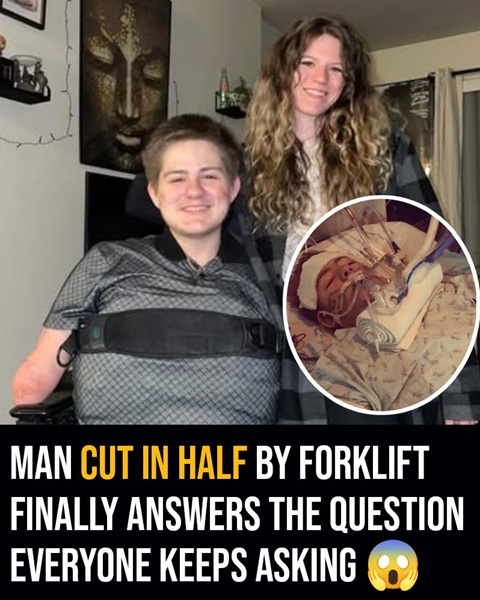
The story of Loren Schauers is one that has captured international attention over the past several years—not because of spectacle, but because of resilience, transparency, and an unwavering commitment to life after unimaginable trauma.
What began as a routine workday in 2019 turned into a catastrophic accident that would permanently alter his body and the course of his future.
Today, years later, Loren continues to answer questions about his recovery, his daily life, and the reality of living with life-altering injuries—while also setting clear boundaries about what he chooses to keep private.
The Accident That Changed Everything
In September 2019, Loren Schauers was working near Great Falls, Montana, operating a forklift on a bridge construction site.
At the time, he was just 19 years old and building his career in the construction industry.
According to multiple interviews he has given since the incident, the forklift veered off the edge of the bridge, causing him to fall approximately 50 feet to the ground below.
The impact was devastating. The heavy machinery reportedly landed on top of him, crushing the lower half of his body.
Loren has described the moment in interviews as surreal—he was conscious and aware of what had happened. He has said that in those critical moments, he believed he was going to die.
Emergency responders arrived quickly and transported him to a hospital. The injuries were catastrophic.
Doctors determined that the damage to his pelvis, legs, and lower abdomen was so severe that survival would only be possible through an extremely rare and radical surgical procedure known as a hemicorporectomy—an operation that involves removing the lower half of the body.
A Life-or-Death Decision
Before proceeding with surgery, physicians explained the gravity of the situation. Loren would lose everything below the waist, along with one of his arms, which had also been severely damaged in the accident.
The choice presented to him was stark: undergo the surgery and attempt to survive, or succumb to the injuries.
In interviews, Loren has explained that the decision, while monumental, felt clear in the moment. It was not about quality-of-life speculation—it was about whether he wanted the chance to live. He chose survival.
His partner at the time, Sabia, later shared publicly that Loren told doctors he did not care what condition he would be in physically—he wanted to live. That determination became the foundation of his recovery journey.
The emergency surgery was extensive and medically complex. Hemicorporectomy procedures are extraordinarily rare and typically performed only when no other option remains.
The operation involves removal of the pelvis, lower limbs, and portions of the lower spine, followed by reconstructive steps to allow the body to function without those structures.
Loren survived.
The Reality of Recovery
Survival, however, was only the beginning. After surgery, Loren faced months of hospitalization, medical monitoring, and rehabilitation.
The physical challenges were immense. His body had to adjust to an entirely new physiological state. In addition to losing the lower half of his body, he lost one arm due to injury complications.
Medical adaptations were necessary for basic bodily functions. Loren has openly explained that he lives with a colostomy, meaning his colon is diverted to an opening in the abdominal wall to allow waste elimination into a bag.
He also has bilateral nephrostomy tubes—small tubes inserted into the kidneys to drain urine into external collection bags.
While these medical realities can be difficult for some to discuss, Loren and Sabia have chosen to speak openly about them in educational contexts.
They believe that transparency can help reduce stigma surrounding medical devices and disability.
At the same time, they draw firm boundaries when it comes to deeply personal matters. One of the most frequently asked questions they receive online concerns intimacy and their private relationship.
Sabia has addressed this directly in interviews, stating clearly that such questions are inappropriate. She has emphasized that no couple—regardless of physical circumstances—owes strangers explanations about their private life.
Their approach has been consistent: they are willing to educate about medical realities, but they will not entertain invasive or disrespectful curiosity.
Building a Platform
A few years after the accident, Loren and Sabia launched a YouTube channel where they share aspects of their daily life.
The channel quickly gained a large following. Viewers are drawn not only to the uniqueness of Loren’s medical situation but also to the couple’s candid, sometimes humorous, and always honest perspective.
They answer questions about accessibility, physical care, emotional recovery, and adapting to daily routines. They discuss how Loren transfers, how he manages equipment, and how they navigate ordinary activities.
Importantly, their content is not framed around tragedy. Instead, it focuses on normalization—showing that life continues, relationships continue, and joy can coexist with profound loss.
Marriage and Partnership
In 2021, Loren and Sabia married. Their wedding marked a significant milestone—not just romantically, but symbolically. It demonstrated that their relationship had endured the most extreme circumstances and emerged stronger.
Sabia plays an essential role in Loren’s daily care, including assisting with medical needs such as changing colostomy bags and monitoring equipment.
However, in interviews, both have emphasized that their relationship is not defined solely by caregiving. They describe themselves as partners first.
Loren has publicly expressed deep gratitude for Sabia’s loyalty and resilience. On social media, he has reflected on anniversaries of the accident, acknowledging how much their lives changed in an instant—and how fortunate he feels to have a partner who stayed by his side.
He has stated that while things could have been worse, he considers himself blessed to share life with someone who supported him through the most vulnerable period of his existence.
Addressing Public Curiosity
Public interest in Loren’s story is understandable. Cases involving hemicorporectomy are extremely rare, and many people have never encountered someone living in such a condition. However, curiosity can sometimes cross into insensitivity.
The couple has worked to strike a balance between education and privacy. They explain medical facts plainly when appropriate, but they also remind viewers that they are human beings—not educational exhibits.
Sabia has pointed out that people would not typically approach a random couple on the street to ask about intimate details. She encourages viewers to consider empathy before posing personal questions.
Their willingness to speak about medical logistics has nonetheless helped many people. Individuals with ostomies, kidney drainage tubes, or other medical devices often experience isolation or embarrassment.
Seeing someone speak openly about these realities can reduce stigma and foster understanding.
Emotional and Psychological Strength
Beyond the physical adaptation, Loren’s journey has required significant emotional resilience. Sudden disability at a young age can bring complex feelings—grief, anger, confusion, and uncertainty about the future.
In various interviews, Loren has acknowledged difficult moments but maintains that he does not dwell on what was lost. Instead, he focuses on what remains possible.
His mindset centers on gratitude and forward momentum rather than regret.
Psychological adaptation to traumatic injury often involves redefining identity. For Loren, that has meant embracing advocacy and storytelling.
By sharing his life online, he has found purpose in helping others confront their own challenges with perspective.
Medical Rarity and Awareness
Hemicorporectomy procedures are seldom performed, usually as a last resort following severe trauma or advanced medical conditions.
Survival rates historically have been low due to the complexity of the surgery and risk of complications. Loren’s survival, therefore, represents both medical skill and extraordinary personal determination.
His case has drawn attention from medical professionals and disability advocates alike. While he does not present himself as a medical authority, his lived experience provides insight into long-term adaptation following extreme surgical intervention.
Accessibility, specialized equipment, and consistent medical follow-up are essential components of his life.
The couple has occasionally spoken about the logistical challenges of navigating healthcare systems and securing necessary supplies.
A Message of Gratitude
Each year, on the anniversary of the accident, Loren shares reflections online. Rather than framing the date solely as a tragedy, he often emphasizes gratitude—for survival, for his wife, and for continued opportunity.
In one such message, he wrote about discovering he had a partner willing to stand by him through everything. He acknowledged that life could have taken an even darker turn and expressed appreciation for the love that sustained him.
His words consistently return to the same theme: he is alive, and that matters.
Redefining Strength
Loren Schauers’ story challenges common assumptions about physical limitation and quality of life. While no one would choose such an outcome, his experience demonstrates that survival does not automatically mean despair.
Through humor, honesty, and partnership, Loren and Sabia have built a life that defies expectations. They continue to answer questions when appropriate, decline others respectfully, and remind viewers that dignity is not dependent on physical form.
Their journey is not about sensationalism—it is about adaptation. It is about a young man who chose life in the face of impossible odds and a woman who chose to walk beside him through uncertainty.
Years after the forklift accident that severed his body in half, Loren remains here—speaking, sharing, and living. In doing so, he has transformed a catastrophic event into a platform for awareness, empathy, and resilience.
And perhaps the most powerful answer he offers to the many questions people ask is not about medical details at all. It is simply this: he chose to live—and he continues to do so, one day at a time.
