
In the quiet and picturesque town of Santa Fe, Argentina, residents are accustomed to the gentle rhythm of life that comes with a small community nestled along the Paraná River.
Yet, even in a town where days often pass without incident, nature has a way of surprising those who pay attention.
For 46-year-old Lujan Eroles, one such moment came unexpectedly, right in the comfort of her own garden. It was a morning like any other when Eroles decided to tend to her garden, checking the flowers, trimming a few shrubs, and enjoying the quiet chirping of birds.
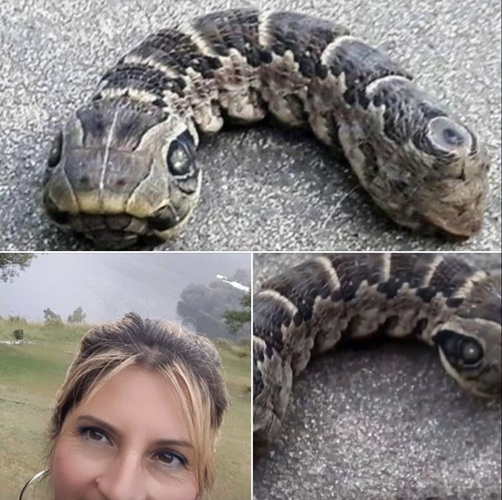
Amid the usual sights of greenery and insects, something unusual caught her eye. At first glance, she thought she had encountered a snake—a moment that immediately caused her heart to race and her instincts to kick in. For a fleeting second, the garden seemed to transform from a familiar haven into a scene of potential danger.
As she drew closer, however, Eroles noticed something strange. The creature was about 10 centimeters long and had snake-like features that made it appear threatening at first glance.
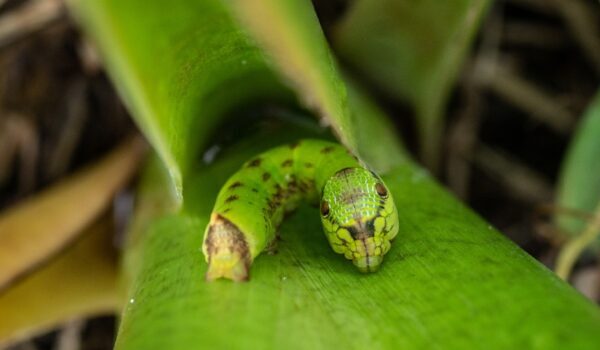
Its body undulated subtly, its head seemed defined, and most strikingly, its eyes were peculiar, almost human-like in their exaggerated design. Fear mingled with curiosity as she froze, unsure whether to retreat or investigate further.
“I have never seen anything like it. It was just like a snake and its eyes were so strange,” Eroles recounted to National Geographic.
“I looked down and I encountered the strange animal, fear struck me knowing that it could have been poisonous. We all thought it was a mutant animal, which is why we filmed it and put it online for people to give us their opinions.”
The video she captured showcased the bizarre appearance of the creature, immediately attracting the attention of neighbors and passersby.
Within minutes, a small crowd had gathered, equally fascinated and cautious, their conversations buzzing with speculation. Was it venomous? Could it be a rare species unknown to the region? Or was it some unusual mutation, a creature that defied explanation?
The uncertainty amplified the intensity of the moment, demonstrating the primal human response to potential threats in nature.
Once the initial shock wore off, Eroles’ curiosity began to take precedence. She realized that this was no ordinary garden find, and the idea of sharing the footage with the wider world seemed both exciting and necessary.
Posting the video online allowed her to connect with a global community of nature enthusiasts, entomologists, and casual observers eager to investigate the mystery.
The video quickly circulated, sparking debates, guesses, and eventual clarification from experts.
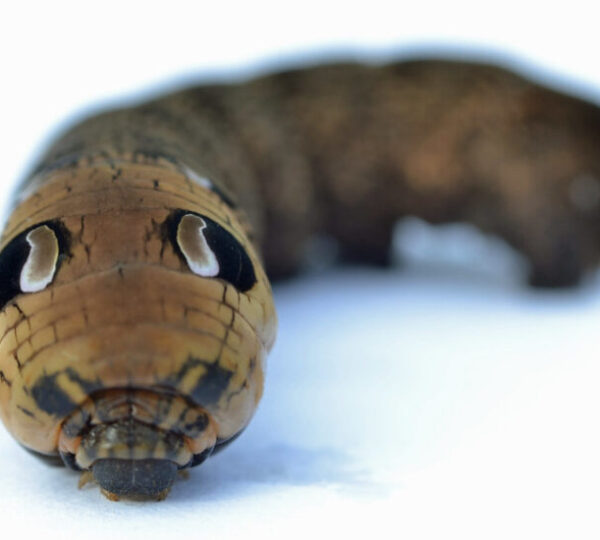
Through the lens of scientific inquiry, the creature’s identity was eventually revealed. It was a caterpillar—a juvenile stage of a moth—belonging to a species known for its remarkable mimicry.
Specifically, the caterpillar was identified as an Elephant Hawk-Moth Caterpillar (Deilephila elpenor), a species native to Central America and known for its fascinating defense mechanisms.
Its snake-like appearance is an extraordinary example of what scientists call “protective mimicry,” an evolutionary strategy that helps vulnerable species avoid predation.
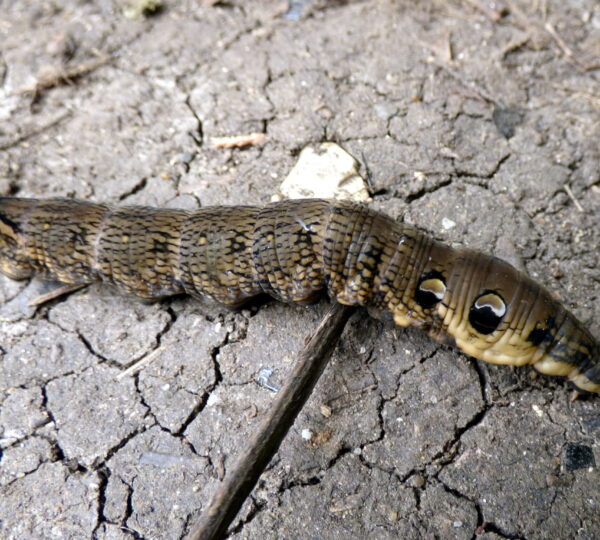
The caterpillar achieves this by displaying two large “eye spots” behind its head. When threatened, it can inflate or position its body to exaggerate the size of these markings, creating the illusion of a much larger and potentially dangerous predator.
By imitating the face of a snake—a creature widely recognized as dangerous or venomous—the caterpillar deters birds and other predators from attacking.
Without venom, claws, or other traditional defenses, this clever adaptation allows the caterpillar to survive in an environment where every misstep could be fatal.
What makes the Elephant Hawk-Moth Caterpillar particularly fascinating is the level of detail in its mimicry. Its “eyes” are not simply painted spots but are positioned and contoured to catch light in a way that enhances the illusion of depth.
Its head and thorax can be raised to further simulate the hood of a small snake, and even its movement imitates the serpentine sway that predators associate with a dangerous reptile.
For a human observer like Eroles, these features are uncanny; for potential predators, they are often enough to trigger avoidance.
Lujan Eroles’ discovery highlights the incredible biodiversity that exists even in everyday environments. Many people pass through life unaware of the complexity and ingenuity present in the natural world, yet encounters like hers provide a glimpse into the adaptive strategies that have evolved over millions of years.
The caterpillar’s ability to manipulate perception for survival demonstrates the intersection of biology, evolution, and environmental pressures in a way that is both mesmerizing and educational.
The online reaction to Eroles’ video underscores how modern technology can amplify such discoveries. Amateur naturalists, scientists, and enthusiasts from around the world quickly joined the conversation, offering explanations, sharing similar sightings, and providing context about the species’ behavior and habitat.
Many were surprised to learn that such a small and seemingly fragile creature could evoke such a strong reaction through mimicry alone.
Others marveled at the precision with which evolution had “designed” a survival strategy that, while simple in concept, is executed with remarkable accuracy.
Experts have emphasized that this form of mimicry is not unique to the Elephant Hawk-Moth Caterpillar but is part of a broader pattern observed across the insect world.
Many caterpillars, for instance, adopt exaggerated shapes, vivid colors, or false eyes to intimidate predators. Some species even produce sounds or vibrations that further reinforce the illusion of being a more formidable animal.
Each adaptation represents a delicate balance between risk and survival, highlighting the intricate interplay of biology and environment.
In Eroles’ case, the caterpillar’s presence in a suburban garden also illustrates the intersection of human habitation and wildlife.
Urban and semi-urban areas often host an unexpectedly rich diversity of species, many of which remain unnoticed until serendipity brings them to attention.
Encounters like this challenge the perception that extraordinary wildlife can only be found in remote or exotic locales; sometimes, it can appear in one’s backyard, prompting curiosity, education, and awe.
Beyond the biological significance, the discovery offers an opportunity to explore the psychological effects of encountering unusual animals.
Eroles’ initial fear, followed by fascination and a desire to share her experience, is a classic example of how humans respond to novel stimuli.
The blend of fear and curiosity can provoke learning, social interaction, and cultural exchange, as evidenced by the viral spread of her video. Such encounters also foster appreciation for the complexity of ecosystems, even at the scale of a single garden or neighborhood.
The caterpillar’s mimicry can also be viewed as a lesson in perspective. What appears to be a threatening creature at first glance—a snake with potentially lethal venom—is, in reality, a harmless and vulnerable insect.
Similarly, the natural world often contains layers of meaning and function that are not immediately visible. By taking the time to observe carefully, humans can gain insight into the strategies, behaviors, and adaptations that govern life in ways that are not obvious at first sight.
Lujan Eroles’ willingness to share her experience has broader implications for education and environmental awareness. Her video has been used in classrooms, online forums, and social media discussions to illustrate topics ranging from evolution and mimicry to human psychology and the intersection of wildlife with urban spaces.
Students and enthusiasts alike can learn about adaptation, predator-prey relationships, and the creativity of nature in ways that are accessible and engaging.
Moreover, the story underscores the importance of documenting and protecting biodiversity. Species like the Elephant Hawk-Moth Caterpillar may appear common in certain regions, yet their habitats are often vulnerable to environmental changes, urbanization, and pesticide use.
By drawing attention to the presence and behavior of such species, individuals contribute to broader awareness and conservation efforts, fostering a sense of stewardship for even the smallest and seemingly insignificant creatures.
The discovery also highlights the importance of public curiosity in scientific observation. Citizen science—where individuals like Eroles record and share observations—has become a powerful tool for researchers.
Videos, photographs, and detailed accounts of encounters can help scientists track distribution, behavior, and population trends, creating valuable datasets that inform conservation and ecological understanding. Eroles’ chance encounter is a small yet significant example of how everyday people contribute to the collective understanding of nature.
The fascination with the caterpillar is amplified by its aesthetic qualities. Its body, a subtle blend of greens and browns, blends seamlessly with foliage, while the bold eye spots demand attention.
This combination of camouflage and startling display illustrates the dual strategies employed by the species: hiding when possible, intimidating when necessary.
Such strategies underscore the sophistication of evolutionary adaptations, reflecting the pressures faced by even the tiniest of creatures.
From a broader perspective, encounters like this enrich human experience by reconnecting people to the natural world.
In an age dominated by screens and artificial environments, witnessing the ingenuity of living organisms fosters awe, curiosity, and humility. Eroles’ initial fear transformed into fascination and respect, a progression that mirrors the ideal human response to encountering unknown aspects of nature.
Ultimately, Lujan Eroles’ encounter with the snake-like caterpillar offers multiple lessons. It demonstrates the ingenuity of evolution, the complexity of ecosystems, and the value of observation.
It highlights the ways in which ordinary spaces—backyards, gardens, and local parks—can host extraordinary phenomena. And it reminds us that even the smallest creatures have evolved remarkable strategies for survival, strategies that demand both attention and respect from those fortunate enough to witness them.
The story also exemplifies the power of sharing experiences. Through her video, Eroles connected with a global audience, sparking dialogue, learning, and inspiration.
It shows how modern technology can bridge the gap between everyday encounters and worldwide awareness, turning a personal moment of curiosity and caution into a source of education and wonder for countless others.
In the end, the snake-like caterpillar is more than a curiosity. It is a symbol of adaptation, resilience, and the intricate beauty of life on Earth.
Lujan Eroles’ discovery in Santa Fe reminds us that remarkable natural phenomena are not confined to distant jungles or isolated forests—they can appear in our own gardens, waiting to teach us, astonish us, and remind us of the subtle genius embedded in the living world around us.
From the shock of a first glance to the revelation of a harmless caterpillar employing one of nature’s cleverest survival strategies, this encounter captures the full spectrum of human emotion, the richness of biodiversity, and the endless fascination of life itself.
It is a testament to the wonder that can be found when we take the time to observe, inquire, and appreciate the hidden marvels of our planet.
