

Aira’s doll-like appearance first caught the attention of the modeling world when she was just two years old, an age when most children are still learning to form full sentences and explore their surroundings through play.
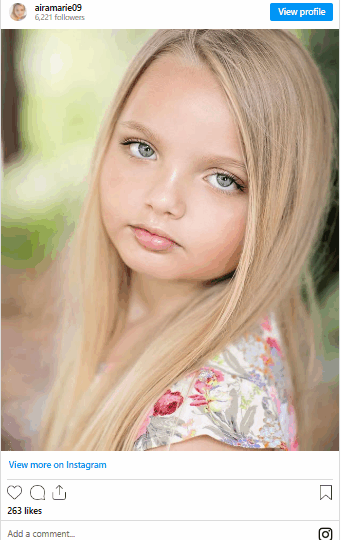
With porcelain skin, strikingly large blue eyes, and facial features so symmetrical they appeared almost unreal, she stood out instantly.
Long before she could understand what fame was, her image began circulating widely across the internet, turning her into a viral sensation. Born Aira Marie Brown, her story unfolded at the intersection of childhood, social media, and an industry constantly searching for the next extraordinary image.
Her parents believed her appearance was rare, something special that deserved recognition. Acting on that belief, they brought her to a modeling agency, where casting directors and photographers were immediately captivated.
In a highly competitive industry, Aira did not need to audition in the traditional sense. Cameras seemed drawn to her instinctively.

She did not need extensive coaching or direction. Even as a toddler, she appeared comfortable in front of the lens. Photographers described her as unusually still, expressive, and responsive, qualities that helped shape the persona that would define her early public identity: the “living doll.”
When her photographs were first shared online, the response was immediate and intense. Millions of people viewed, shared, and commented on her images.
The reaction, however, was not universally positive. Alongside admiration came disbelief. Many viewers were convinced that no child could naturally look like that.
Accusations followed quickly, suggesting heavy photo editing, digital manipulation, or the use of filters. Others claimed her parents were fabricating an illusion to attract attention, profit, or social media clout.
In an online culture already saturated with altered images, skepticism was understandable. Eventually, however, video footage and unedited photographs emerged, quieting much of the speculation.
Aira’s appearance, as extraordinary as it seemed, was real. Yet reality brought consequences that were far more complex than the viral attention itself.
As her popularity grew, Aira’s daily life changed dramatically. Modeling agencies, photographers, stylists, and brand representatives became constant presences in her childhood.

Her schedule filled quickly with photo shoots, fittings, travel arrangements, and structured timelines. Activities typical of early childhood, such as unstructured play, naps, and spontaneous exploration, were increasingly replaced by professional obligations.
Studios became more familiar than playgrounds. Bright lights replaced bedtime stories. Instead of finger paints and building blocks, she was surrounded by wardrobes, makeup tools, and camera equipment. Her days were shaped not by curiosity, but by coordination.
Unlike most children her age, Aira did not attend school in a traditional environment. She did not experience classrooms filled with peers, shared lunches, or the gradual social learning that comes from growing up among other children.
Friendships, when they existed, were often temporary or situational. Playdates were rare. Spontaneity was almost nonexistent.
Her independence was limited not only by her age, but by the demands of a career she never consciously chose. Decisions were made for her by adults who believed they were acting in her best interest.
While many of those decisions may have been motivated by opportunity or financial security, intention does not eliminate consequence. Childhood, once missed, cannot be replayed.

As the years passed, Aira grew older, and with growth came natural physical changes. Her facial proportions subtly shifted, her features matured, and the extreme doll-like quality that once made her famous softened.
She still looked distinctive, but no longer matched the very specific image that had captured public fascination.
In an industry driven by novelty and visual extremes, this change mattered. Attention is fleeting, especially when it is built on appearance rather than longevity or talent.
Gradually, the calls slowed. Invitations became less frequent. Agencies and brands shifted their focus to new viral faces. The same system that had rushed toward her so eagerly now quietly moved on.
For Aira, this transition was significant. Fame had entered her life before memory and left before she could fully understand it.
The pressure, structure, and constant observation that once defined her daily routine faded away. What remained was a young person faced with the challenge of forming an identity beyond the one assigned to her.
Today, Aira maintains a presence online, but it looks very different from her early modeling years. Her content reflects fragments of ordinary teenage life, personal thoughts, and moments that suggest a desire for normalcy.
Notably, the highly stylized images from her early childhood modeling career are largely absent.
That absence is meaningful. It suggests a conscious separation from a past that no longer represents who she is. Whether this distance is protective, intentional, or simply natural, it highlights the complexity of growing up in the public eye before developing a stable sense of self.
Psychologists who study child fame and early exposure to public attention often note consistent patterns. Children who become widely recognized before forming a personal identity may struggle later with self-definition.
Identity confusion, anxiety, difficulty setting boundaries, and dependence on external validation are common risks.
When a child’s value is repeatedly reinforced through appearance or public reaction, separating self-worth from approval can become a lifelong challenge.
Aira has not publicly detailed her emotional experience during those early years, and silence should not be interpreted as trauma. Distance does not automatically imply harm.
In many cases, it is simply a way of reclaiming autonomy. Choosing not to revisit that period may reflect a healthy desire to define herself on her own terms.
Her story, however, raises broader questions that extend beyond one individual or one family. In the age of social media, children can become brands overnight.
Viral fame often arrives without consent, understanding, or long-term safeguards. Platforms benefit from engagement. Audiences consume the content. Industries monetize attention. Meanwhile, the child grows up inside a narrative shaped by others.

There is rarely a single villain in these stories. Instead, there is a system that rewards visibility without fully accounting for developmental impact.
Algorithms do not consider emotional maturity. Popularity does not pause to ask what happens when attention fades.
What happens when the child grows older? When novelty wears off? When the image that captured the internet no longer exists?
Aira’s life today appears quieter, more private, and more grounded than her early years. Whether this shift was a deliberate choice or a natural outcome of changing circumstances, it reflects a movement away from public spectacle and toward personal agency.
Her experience serves as a reminder that fame, especially when imposed during childhood, is not neutral.
It alters development, reshapes relationships, and influences self-perception in ways that often become visible only years later. The effects may not always be dramatic, but they are rarely insignificant.
The story is bittersweet not because attention arrived, but because childhood slipped away while the world watched. Childhood is not a rehearsal. It is not content.
It is not a marketing strategy. It is a one-time chapter that shapes everything that follows.
In the end, Aira’s journey stands as a cautionary reflection for parents, industries, and audiences alike. Beauty can open doors, but it can also close off experiences that cannot be replaced.
Fame may bring opportunity, but when it arrives too early, it can quietly take something far more valuable in return.
And when the spotlight moves on, the child must still grow into an adult, carrying experiences they never chose, and lessons learned before they could understand them.
That is the part of the story that deserves the most attention.
