
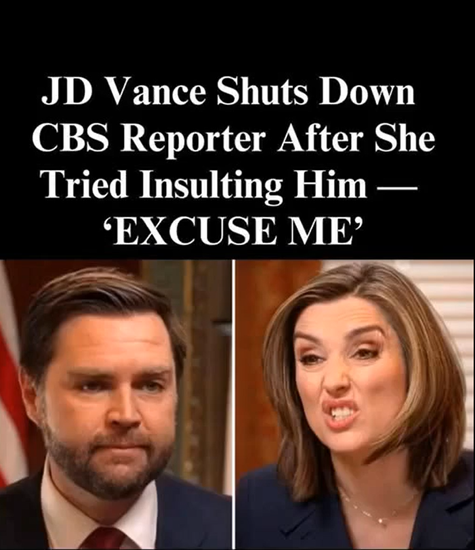
Vice President J.D. Vance publicly pushed back against questioning from Margaret Brennan during a televised interview on CBS News, where the discussion focused heavily on Tulsi Gabbard and her potential nomination for a top intelligence role.
The exchange highlighted ongoing political tensions surrounding Gabbard’s qualifications, past statements, and the broader debate over trust in U.S. intelligence institutions.
Brennan referenced criticism from prominent conservative publications, raising concerns about Gabbard’s past positions and public statements.
Specifically, Brennan cited editorials from The Wall Street Journal and National Review, both of which have published critical perspectives on Gabbard’s record and suitability for a senior intelligence leadership position within the federal government.
During the interview, Brennan questioned whether such critiques gave Vance any hesitation about supporting Gabbard. Her line of questioning referenced concerns about Gabbard’s past remarks regarding intelligence findings and controversial figures tied to national security debates.

Vance responded firmly, stating that media outlets and opinion publications do not determine executive branch appointments. He emphasized that those decisions ultimately rest with the president, in this case Donald J. Trump, alongside the constitutional role of the Senate.
He argued that certain publications had consistently opposed Trump and therefore should not be viewed as neutral arbiters in evaluating his administration’s decisions. According to Vance, their influence over public policy outcomes has diminished significantly in recent years.
Brennan countered by reminding viewers that, under the U.S. Constitution, the Senate holds the responsibility of providing advice and consent on major nominations, including positions within the intelligence community and executive branch leadership.
Vance acknowledged that role, noting that Senate confirmation remains a critical step in the process. However, he expressed confidence that Gabbard would ultimately secure the necessary support to move forward if formally nominated.
He proceeded to outline what he described as Gabbard’s qualifications, highlighting her military background and years of service. Gabbard previously served in the armed forces, which Vance framed as evidence of her experience with national security matters.

According to Vance, Gabbard has held high-level security clearances during her career, which he suggested demonstrates familiarity with classified information and the responsibilities associated with sensitive intelligence operations.
He also emphasized her record of public service, describing her as someone with strong character and a commitment to the country. These qualities, he argued, would be essential in restoring confidence in U.S. intelligence agencies.
A key part of Vance’s argument centered on trust in government institutions. He claimed that public confidence in intelligence agencies has declined in recent years, becoming a point of concern for many Americans across the political spectrum.
Vance suggested that leadership changes could help rebuild that trust. He argued that an outsider perspective, such as Gabbard’s, might bring accountability and reform to institutions that critics believe have grown overly bureaucratic.
Brennan raised concerns about whether Gabbard herself has expressed skepticism toward intelligence agencies. She pointed to past comments in which Gabbard questioned certain intelligence conclusions or criticized aspects of the intelligence community.
This line of questioning reflected a broader debate about whether skepticism toward intelligence agencies disqualifies a candidate or, alternatively, positions them as a reform-minded leader capable of improving institutional performance.

In response, Vance reframed the issue, arguing that recognizing flaws within institutions does not equate to rejecting their importance. Instead, he said, it can indicate a desire to strengthen their effectiveness and accountability.
He maintained that intelligence agencies play a vital role in national security but must operate within clear boundaries. According to Vance, ensuring those boundaries are respected is essential for maintaining public confidence.
The discussion also touched on the concept of “weaponization” of government institutions, a phrase used by some political figures to describe perceived misuse of authority for political purposes. This claim remains a subject of significant political debate.
Vance argued that part of restoring trust involves addressing these concerns directly. He suggested that leadership committed to reform could help ensure intelligence agencies remain focused on their core mission of protecting national security.
Brennan’s questioning reflected skepticism about whether Gabbard would support or challenge the intelligence community. This tension underscored a key issue in confirmation debates: balancing independence with institutional trust.
Throughout the exchange, both participants maintained a professional tone, though the discussion was clearly adversarial at times. Such exchanges are common in high-profile political interviews, particularly on sensitive national security topics.
The interview also highlighted the role of media in shaping public perception of political nominees. Editorials and opinion pieces often influence debate, even if they do not directly determine policy outcomes.
At the same time, elected officials frequently push back against media narratives they view as unfair or incomplete. Vance’s response can be seen as part of that broader dynamic between political figures and the press.
Gabbard herself has been a controversial figure in American politics, with positions that have drawn both support and criticism from across the political spectrum. Her views on foreign policy have been particularly scrutinized.
For example, past comments regarding international conflicts and intelligence findings have been debated extensively in media and political circles. Supporters argue she offers a nontraditional perspective, while critics raise concerns about judgment.
The mention of Edward Snowden in Brennan’s question reflects one such controversy, as Snowden remains a divisive figure in discussions about national security and government transparency.
Similarly, references to intelligence assessments related to the Syrian government have been a focal point in debates over foreign policy credibility and the role of intelligence agencies in shaping public understanding of global events.
These issues contribute to the complexity of evaluating any nominee for a top intelligence position. Senators typically consider a wide range of factors, including experience, judgment, and ability to work with existing institutions.
Vance’s defense of Gabbard focused primarily on her service record and his broader critique of institutional trust. He framed her as someone capable of bringing change rather than maintaining the status quo.
Brennan, meanwhile, emphasized the importance of scrutinizing nominees carefully, particularly for roles involving national security. Her questions reflected concerns that are likely to arise during any formal confirmation process.
Ultimately, the exchange illustrates the broader political environment in which nominations are debated. Media interviews serve as an early arena where arguments are tested and public opinion begins to take shape.
The outcome of any nomination process depends on multiple factors, including Senate dynamics, public perception, and the nominee’s own responses to scrutiny during hearings and investigations.
While Vance expressed confidence in Gabbard’s prospects, the final decision would rest with the Senate, consistent with constitutional procedures governing executive appointments in the United States.
The conversation also highlights the ongoing debate over the relationship between political leadership and intelligence agencies. This issue has become increasingly prominent in recent years across multiple administrations.
Some argue that stronger oversight and reform are necessary to maintain accountability, while others stress the importance of preserving the independence and expertise of intelligence professionals.
Gabbard’s potential nomination sits at the intersection of these competing perspectives, making it a particularly significant case study in contemporary U.S. politics and governance.
As discussions continue, both supporters and critics are likely to present detailed arguments regarding her record, qualifications, and approach to intelligence matters, contributing to a robust public debate.
In this context, interviews like the one between Vance and Brennan play an important role in informing the public, even as they reflect differing viewpoints and political priorities.
The exchange ultimately underscores the complexity of leadership decisions in national security, where experience, trust, accountability, and public perception all play critical roles in shaping outcomes.
