
Imagine waking up tomorrow with a singular, unchangeable rule: every piece of clothing you will ever wear must be the same color.
No patterns, no exceptions, no deviations—only a single tone repeated endlessly. At first, it feels limiting. The restriction of choice can be unsettling, almost uncomfortable.
Humans are wired to seek variation and novelty, so committing to one color challenges that instinct in a profound, immediate way.
But the more you sit with the idea, the more it transforms. It becomes less about restriction and more about self-expression. The color you choose becomes a mirror of personality, preference, and life approach.

The decision cannot be casual. It reflects how you move through the world and how you wish the world to perceive you, embodying a subtle yet constant communication about identity and presence.
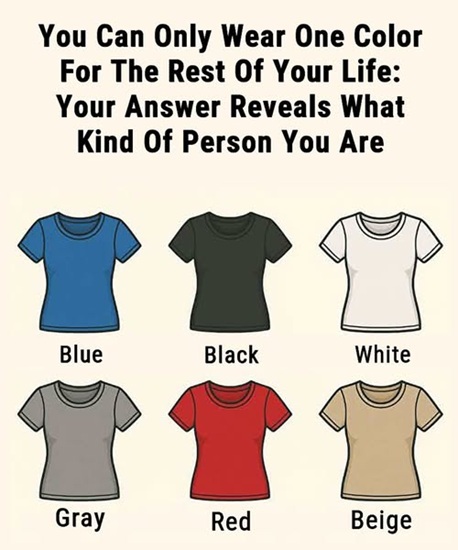
Let’s explore six possible colors and the qualities they often symbolize. Each carries its own psychological resonance, and choosing one may reveal underlying values, tendencies, or priorities in your daily life.
If you lean toward blue, there is often a quiet steadiness within you. Blue suggests calmness, trustworthiness, and depth. You may prefer reflection over chaos and approach life with patience and thoughtfulness.
People drawn to blue are typically reliable. Others seek their presence for guidance or reassurance, not because they are loud or demanding, but because they exude consistency and a sense of stability in uncertain moments.
Black represents a different energy altogether. It often symbolizes authority, independence, and self-confidence. Choosing black suggests a desire to maintain boundaries, clarity, and control over one’s environment and interactions.
Black conveys quiet power. Those who favor it tend to project strength without overtly demanding attention. There is an elegance in restraint, a belief that confidence does not need validation from external approval or social affirmation.

White is frequently associated with clarity, intention, and simplicity. People who choose white often prioritize honesty, order, and emotional transparency, creating spaces—both physical and emotional—that feel clean, open, and purposeful.
Those drawn to white may hold themselves and others to high standards, not rigidly, but out of a belief that life functions best when approached with mindfulness, integrity, and thoughtful consideration of consequences.
Gray occupies a middle ground, reflecting balance, neutrality, and composure. People attracted to gray often avoid extremes, preferring observation, measured decision-making, and practical problem-solving over impulsive action or dramatics.
Gray suggests emotional stability and adaptability. Its wearers often remain steady when situations fluctuate, providing perspective and calm guidance. Neutrality becomes a tool, enabling clear judgment and the ability to respond effectively.
Red immediately commands attention and conveys intensity. Those drawn to red are often passionate, bold, and fully engaged with life. This color reflects energy, emotion, and a willingness to experience reality with depth.

Choosing red is not about superficial recognition; it is about embracing life fully. People who gravitate toward red often accept both risk and reward, valuing aliveness over caution and authenticity over conformity.
Beige, often underestimated, suggests quiet confidence, warmth, and emotional stability. People drawn to beige may prioritize comfort, authenticity, and a grounded lifestyle, valuing substance over appearance and presence over performance.
Beige wearers often exude reassurance without effort. Their steadiness is not loud or performative, but it creates a sense of reliability and calm for both themselves and those around them.
No color exists in isolation from its cultural and psychological context. Colors influence perception, mood, and interaction, shaping how others interpret your presence and, subtly, how you interpret yourself.
The choice of a single, lifelong color forces introspection. It challenges assumptions about self-expression, status, and identity, stripping away external influences and prompting reflection on what truly matters.
Blue’s calmness can enhance focus, emotional balance, and analytical thinking. Black’s authority may reinforce independence and boundary-setting. White’s clarity supports mindfulness and intention. Each choice aligns with certain cognitive and behavioral tendencies.
Gray fosters resilience and adaptability, helping its wearers navigate social complexities and environmental uncertainties with equanimity. Red emphasizes emotional engagement, creativity, and the pursuit of meaningful experiences over mere safety or conformity.

Beige prioritizes comfort, emotional consistency, and understated presence, signaling contentment with simplicity and grounded self-awareness. These associations are supported by studies linking color perception to mood, behavior, and personality traits.
Living within one color also affects practical lifestyle choices. Maintenance, coordination, and decision-making simplify dramatically, reducing cognitive load and freeing mental energy for more meaningful or creative pursuits.
The choice might also influence social interactions. People naturally respond to color cues. Blue may invite trust, red commands engagement, black signals authority, white conveys openness, gray suggests neutrality, and beige encourages calm approachability.
Choosing one color forever may reveal latent priorities. It exposes what feels essential versus decorative. Trends, brands, or social expectations fall away, leaving only the aspects of self that resonate with authenticity and long-term comfort.
This constraint encourages intentionality. Each outfit decision becomes conscious, deliberate, and reflective. The repetition allows subtle variations to emerge in texture, material, and silhouette rather than hue, deepening aesthetic awareness.
The exercise highlights the symbolic and psychological layers of color. Clothing, often taken for granted, becomes a continuous, living expression of identity, mindset, and interpersonal signaling throughout life.

Consider the emotional impact of daily immersion in one color. Blue may reduce anxiety, increase calm, and support introspection. Red can enhance motivation, energy, and expressive behavior. Black reinforces focus and self-assuredness.
White’s presence can foster clarity of thought, orderliness, and intentional communication, while gray offers emotional stability, measured response, and adaptability. Beige emphasizes comfort, relaxation, and grounded engagement with life.
This thought experiment extends beyond fashion. It challenges assumptions about choice, self-expression, and the ways humans convey identity without words or actions, revealing the deep psychological power of color.
Adopting a lifelong color may also influence lifestyle routines, social presence, and even career perceptions. Subtle, consistent signals affect how others interpret your reliability, confidence, and approachability in social or professional contexts.
Over time, the choice becomes integrated with identity. Color is no longer merely external—it interacts with perception, habit, and self-concept, subtly shaping behavior, confidence, and life rhythm.
The exercise can prompt reflection on values. Which aspects of your personality, priorities, or emotional needs are most essential to convey? What qualities matter enough to signal consistently throughout life?
Ultimately, the exercise demonstrates that self-expression can be distilled to simplicity. Color, often a background consideration, transforms into an intentional, ongoing dialogue between inner identity and outer presentation.
When stripped of trends, variety, and cultural noise, a single color becomes a lens into personal priorities, emotional style, and the subtle ways humans communicate presence and intention to themselves and others.
Reflecting seriously on this choice can reveal quiet truths. Your selected color may align with emotional resilience, social strategy, energy management, or simply the traits you value most in yourself.
Color is more than aesthetic; it is psychological, social, and symbolic. It affects perception, emotion, and interpersonal dynamics, providing insights into personality and self-concept that many overlook in everyday life.
Choosing one color forever emphasizes the connection between simplicity and clarity. It challenges superficial considerations while elevating meaningful personal reflection, turning wardrobe decisions into a continuous act of mindful identity curation.
The thought experiment can also encourage mindfulness in other areas of life: habits, routines, relationships, and priorities. Each choice becomes intentional rather than reactive, fostering self-awareness and coherence across daily actions.
Ultimately, clothing becomes a continuous statement of values, personality, and mindset. It is not about style for approval, but about how you manage energy, engage with the world, and preserve authenticity.
Once considered deeply, the question of color feels less like preference and more like insight. It reveals tendencies, priorities, and psychological inclinations that influence countless decisions beyond clothing.
So, if you had to choose a single color—forever—what would it say about you? How does it reflect your values, emotional style, and how you wish to be perceived in every interaction?
