“I Helped a Struggling Grandma at the Grocery Store — Three Days Later, the Clerk Delivered Her Heartbreaking Request”
I thought covering a stranger’s $5 worth of groceries was just another rough-day decision in a broke single mom life…
Until someone showed up at my door three days later asking to fulfill her “last request.”
My name is Lily, 29, and I’m a single mom of three. Our life is loud, sticky, and always one bill away from disaster.
Every day is a balancing act between work, kids, and keeping our heads above water. Some days, it feels like the universe is testing how much chaos one person can survive without breaking.
Last Thursday started like hell.
Emma was crying because Josh had finished the good cereal, the kind that only lasts a couple of days before disappearing into small mouths.
Josh swore he didn’t, Max was doing laps in his underwear roaring like a dinosaur, and my phone buzzed incessantly on the counter: rent reminder, late electric notice, a text from my boss asking if I could cover another shift.
I opened the fridge. No milk. Checked the bread box. One sad heel of bread. “Of course,” I muttered to no one.
“I’m going to the store,” I called out. “Nobody open the door. Nobody touch the stove. Nobody jump off anything.”
“Can we come?” Emma asked, already halfway to the door. “Not this time, baby. I’ll be 10 minutes,” I said, grabbing my keys and slipping out.
The grocery store around the corner was bright and cold. Fluorescent lights buzzed, carts clanked against each other, and the air smelled faintly of bleach and produce.
I grabbed the cheapest loaf of bread, a gallon of milk, and headed to the front. Every line seemed longer than the last.
I picked the shortest one and got behind a couple arguing about which chips to buy. That’s when I noticed her.
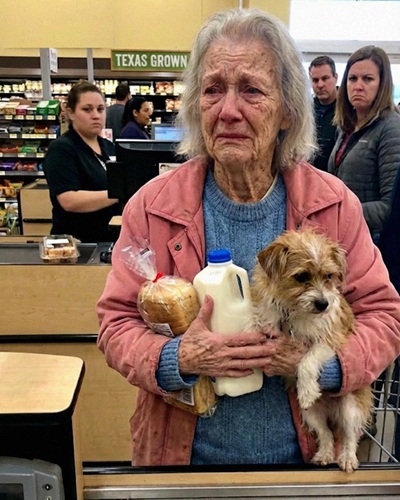
She was small. Old. Wrapped in a coat so worn the cuffs were almost strings. Her back was curved, as if life had been pressing down on her for decades. She put two items on the conveyor: bread and milk.
The male clerk, dark-haired and tired-looking, name tag reading ETHAN, scanned them and told her the total. She opened a tiny wallet, counting coins and a few wrinkled bills. Her hand shook.
“I… I’m short,” she whispered. “I am so sorry.”
Her voice was barely audible. The woman behind her rolled her eyes. “Seriously? You can’t even pay for that?”
Someone farther back snapped, “Come on, some of us have jobs! Move it!”
“Pathetic,” another muttered. The old woman flinched, pulling the bread closer to her chest like she was bracing for someone to snatch it away.
“I will just take the milk,” she said quietly. “Please. I’ll put the bread back.”
Ethan frowned. “Ma’am, we can—”
“It’s not okay,” the woman behind her cut in. “Some people have no shame.”
I’ve been that person at the register. I know the hot, trapped feeling of having everyone stare while you fumble with change. Without thinking, my mouth moved.
“I’ll get it,” I said, louder than I meant. Ethan looked up. “Sorry?” “I’ll pay for hers,” I said, stepping forward. “Just ring it with mine.”
The line went quiet for a beat, then mutters began. “You’re wasting your money,” someone said.
“She probably does this all the time,” another scoffed.
The old woman turned to me, eyes watery and sharp at the same time.
“No,” she said, shaking her head. “I cannot accept. You have your own things. Your own family.”
“You’re not taking,” I said. “I’m giving. Let me.” “You probably have children,” she said softly. “You should keep your money.”
“I want my kids to grow up in a world where this is normal,” I said. “Please. Let me.”
Her face softened a fraction. Ethan watched closely. “Are you sure?” he asked quietly.
I thought about my empty fridge, the rent, the late bills, the almost-maxed-out card. And I thought about her, walking home without bread because a bunch of strangers yelled at her.
“Yeah,” I said. “I’m sure.” Ethan nodded and rang her items with mine. The old woman cradled the bread and milk like they were fragile.
“No one has ever done something like this for me,” she whispered. “Not like this.”
“What’s your name?” I asked. “Hargrove,” she said. “Mrs. Hargrove.” “I’m Lily,” I said. “Nice to meet you.”
She smiled, trembly but genuine. “You have a good heart, Lily. Do not let this world close it.”
She shuffled away slowly, past the people who had called her pathetic, as if they didn’t exist. Ethan handed me my change.
“That was really kind,” he said. “I’ve been in her shoes,” I shrugged.
He nodded, understanding too well. Then it was back to real life: home, peanut butter sandwiches, breaking up three fights, and heading to my night shift at the diner.
Helping her felt like just another small, fleeting moment in the blur of survival. But three days later, it all changed.
A firm, serious knock on the door froze me mid-fold with a basket of laundry. Emma grabbed my leg, whispering, “Mom? Who is it?”
“I don’t know,” I said. “Stay here.” I cracked the door. Standing there was Ethan, still in his grocery polo, holding a plain white envelope.
“Lily?” he asked. “Yeah. Everything okay?” He looked tense, almost sad. “I’m Ethan. From the store. I’m here because of Mrs. Hargrove.”
My heartbeat sped up. “The older woman from the other day? Is she… okay?”
He exhaled slowly. “She passed away yesterday.” The hallway blurred for a second. “Oh,” I whispered. “Oh my God. I’m… so sorry.”
“She’d been getting weaker for a while. She was in the store when she collapsed.”
He lifted the envelope slightly. “She left this with my manager. Told him, ‘Give this to Lily. He’ll know her.’ She was very specific. We tracked you down thanks to the rewards card you used.”
I stared at the envelope, trembling. I took the envelope from Ethan’s hands, my fingers trembling. “Come in,” I said, letting him step into our tiny living room.
The kids peeked from the hallway, whispering to each other, their curiosity palpable.
I unfolded the envelope carefully. Inside was a folded letter and some official-looking documents. My eyes immediately fell on the handwritten note. The cursive was shaky but deliberate.
“Lily,” it began,
“You may not remember me, but I remember you. You looked at me like I was still a person. That does not happen much anymore.
You helped me when others called me names. You did not know if I was ‘deserving.’ You just saw someone who needed help.
I argued because I have always tried to stand on my own feet. I do not like to feel like a burden. But you gave me kindness, not pity. That is different.
My children are interested in my money, not in me. I decided I would rather leave what I have to someone with a good heart. You may think you did a small thing. To me, it was not small.
My last request is simple: Take care of your children.
And when you are able, help someone else in need, fully and selflessly, as you helped me.”
The words blurred in front of me. I blinked hard, trying to focus, feeling the weight of every letter. My chest tightened.
I reached for the papers beneath the letter. They were legal documents. My name jumped out at me in bold, typed letters.
“She left me… her house?” I whispered, voice barely audible.
“And her savings,” Ethan added gently. “It’s not a mansion or anything, but it’s enough. Enough to matter. Enough to change things.”
I couldn’t breathe. My mind raced. How could someone I barely knew leave this to me? How could she trust me, a single mom just scraping by, to handle it?
I sank into the couch, my children climbing around me. “Mom?” Josh asked. “What’s going on?”
I took a deep breath. “Come here,” I said. The three of them huddled around me. “Remember the grandma I told you about at the store? The one people were mean to?”
“The bread grandma?” Emma asked. “Yeah,” I said. “Her name was Mrs. Hargrove.” “Is she okay?” Max asked softly.
I swallowed hard. “She passed away. But she left us a letter… and something else.”
“What?” Josh asked, eyes wide. I looked at Ethan. He nodded. “She left us her house,” I said. “And some money.”
Their jaws dropped. “A house?” Emma squeaked.
“A real house,” I confirmed. “It’s not a mansion, but it means we won’t be one bill away from disaster anymore. I still have to work, still have responsibilities, but this… this changes things.”
“Why us?” Josh asked. “You only helped her once.” Ethan stepped forward quietly. “Sometimes, once is all someone needs to see who you are,” he said softly.
The kids went quiet, absorbing the magnitude of the moment. The idea that a stranger recognized kindness and chose to honor it left them thoughtful and amazed.
Ethan handed me the envelope with the lawyer’s information. “They’ll walk you through everything,” he said. “I just promised to deliver it myself.”
I nodded, my heart still racing. “Thank you. For everything. For looking out for her, and for me.”
He gave a small, sad smile. “She reminded me of my grandma. I just talked to her when she came through my line.”
Before leaving, he added, “She made me promise to tell you this exactly: ‘Tell Lily I did not take charity. I traded. She gave me kindness. I gave it back.’”
I couldn’t speak. I nodded, tears streaming down my cheeks. The kids erupted with questions:
“Do we get our own rooms?” “Can we move tomorrow?” “Can we have a dog?”
I laughed through my tears. “One thing at a time,” I said. “We have to talk to the lawyer, see the house. But yes… things are going to change.”
That night, after they fell asleep, I sat alone at our wobbly kitchen table, the letter open in front of me. I read it again and again, feeling the depth of her intention.
Take care of your children. Help someone else in need, fully and selflessly.
I thought about her at the register, her hands shaking, her dignity challenged by strangers who judged her over a few dollars.
I realized the “last request” wasn’t about the money or the house—it was about kindness, humanity, and the ripple effect of one small act.
I had thought that life had to be perfect before I could help anyone. But that day at the grocery store, my life was far from stable. I helped anyway.
And somehow, that simple act returned to me in the most unimaginable way.
Mrs. Hargrove’s gift didn’t just provide financial relief—it reminded me that every act of kindness matters.
That even in a world full of chaos, selfishness, and struggle, there’s power in seeing people as human, worthy of respect, and deserving of help.
That night, as I held her letter, I made a silent promise: I would honor her trust. I would take care of my children, and I would help others in need, just as she had asked.
Her final request became a guiding light, a challenge, and a lesson in generosity that I will carry for the rest of my life.
I paid for a poor grandma at the grocery store. Three days later, the clerk showed up with her final request and the keys to a different future.
Now, it’s on me to live up to the kind of person she believed I was—and to make sure her kindness keeps spreading.
I thought covering a stranger’s $5 worth of groceries was just another rough-day decision in a broke single mom life…
Until someone showed up at my door three days later asking to fulfill her “last request.”
My name is Lily, 29, and I’m a single mom of three. Our life is loud, sticky, and always one bill away from disaster.
Every day is a balancing act between work, kids, and keeping our heads above water. Some days, it feels like the universe is testing how much chaos one person can survive without breaking.
Last Thursday started like hell.
Emma was crying because Josh had finished the good cereal, the kind that only lasts a couple of days before disappearing into small mouths.
Josh swore he didn’t, Max was doing laps in his underwear roaring like a dinosaur, and my phone buzzed incessantly on the counter: rent reminder, late electric notice, a text from my boss asking if I could cover another shift.
I opened the fridge. No milk. Checked the bread box. One sad heel of bread. “Of course,” I muttered to no one.
“I’m going to the store,” I called out. “Nobody open the door. Nobody touch the stove. Nobody jump off anything.”
“Can we come?” Emma asked, already halfway to the door. “Not this time, baby. I’ll be 10 minutes,” I said, grabbing my keys and slipping out.
The grocery store around the corner was bright and cold. Fluorescent lights buzzed, carts clanked against each other, and the air smelled faintly of bleach and produce.
I grabbed the cheapest loaf of bread, a gallon of milk, and headed to the front. Every line seemed longer than the last.
I picked the shortest one and got behind a couple arguing about which chips to buy. That’s when I noticed her.
She was small. Old. Wrapped in a coat so worn the cuffs were almost strings. Her back was curved, as if life had been pressing down on her for decades. She put two items on the conveyor: bread and milk.
The male clerk, dark-haired and tired-looking, name tag reading ETHAN, scanned them and told her the total. She opened a tiny wallet, counting coins and a few wrinkled bills. Her hand shook.
“I… I’m short,” she whispered. “I am so sorry.”
Her voice was barely audible. The woman behind her rolled her eyes. “Seriously? You can’t even pay for that?”
Someone farther back snapped, “Come on, some of us have jobs! Move it!”
“Pathetic,” another muttered. The old woman flinched, pulling the bread closer to her chest like she was bracing for someone to snatch it away.
“I will just take the milk,” she said quietly. “Please. I’ll put the bread back.”
Ethan frowned. “Ma’am, we can—”
“It’s not okay,” the woman behind her cut in. “Some people have no shame.”
I’ve been that person at the register. I know the hot, trapped feeling of having everyone stare while you fumble with change. Without thinking, my mouth moved.
“I’ll get it,” I said, louder than I meant. Ethan looked up. “Sorry?” “I’ll pay for hers,” I said, stepping forward. “Just ring it with mine.”
The line went quiet for a beat, then mutters began. “You’re wasting your money,” someone said.
“She probably does this all the time,” another scoffed.
The old woman turned to me, eyes watery and sharp at the same time.
“No,” she said, shaking her head. “I cannot accept. You have your own things. Your own family.”
“You’re not taking,” I said. “I’m giving. Let me.” “You probably have children,” she said softly. “You should keep your money.”
“I want my kids to grow up in a world where this is normal,” I said. “Please. Let me.”
Her face softened a fraction. Ethan watched closely. “Are you sure?” he asked quietly.
I thought about my empty fridge, the rent, the late bills, the almost-maxed-out card. And I thought about her, walking home without bread because a bunch of strangers yelled at her.
“Yeah,” I said. “I’m sure.” Ethan nodded and rang her items with mine. The old woman cradled the bread and milk like they were fragile.
“No one has ever done something like this for me,” she whispered. “Not like this.”
“What’s your name?” I asked. “Hargrove,” she said. “Mrs. Hargrove.” “I’m Lily,” I said. “Nice to meet you.”
She smiled, trembly but genuine. “You have a good heart, Lily. Do not let this world close it.”
She shuffled away slowly, past the people who had called her pathetic, as if they didn’t exist. Ethan handed me my change.
“That was really kind,” he said. “I’ve been in her shoes,” I shrugged.
He nodded, understanding too well. Then it was back to real life: home, peanut butter sandwiches, breaking up three fights, and heading to my night shift at the diner.
Helping her felt like just another small, fleeting moment in the blur of survival. But three days later, it all changed.
A firm, serious knock on the door froze me mid-fold with a basket of laundry. Emma grabbed my leg, whispering, “Mom? Who is it?”
“I don’t know,” I said. “Stay here.” I cracked the door. Standing there was Ethan, still in his grocery polo, holding a plain white envelope.
“Lily?” he asked. “Yeah. Everything okay?” He looked tense, almost sad. “I’m Ethan. From the store. I’m here because of Mrs. Hargrove.”
My heartbeat sped up. “The older woman from the other day? Is she… okay?”
He exhaled slowly. “She passed away yesterday.” The hallway blurred for a second. “Oh,” I whispered. “Oh my God. I’m… so sorry.”
“She’d been getting weaker for a while. She was in the store when she collapsed.”
He lifted the envelope slightly. “She left this with my manager. Told him, ‘Give this to Lily. He’ll know her.’ She was very specific. We tracked you down thanks to the rewards card you used.”
I stared at the envelope, trembling. I took the envelope from Ethan’s hands, my fingers trembling. “Come in,” I said, letting him step into our tiny living room.
The kids peeked from the hallway, whispering to each other, their curiosity palpable.
I unfolded the envelope carefully. Inside was a folded letter and some official-looking documents. My eyes immediately fell on the handwritten note. The cursive was shaky but deliberate.
“Lily,” it began,
“You may not remember me, but I remember you. You looked at me like I was still a person. That does not happen much anymore.
You helped me when others called me names. You did not know if I was ‘deserving.’ You just saw someone who needed help.
I argued because I have always tried to stand on my own feet. I do not like to feel like a burden. But you gave me kindness, not pity. That is different.
My children are interested in my money, not in me. I decided I would rather leave what I have to someone with a good heart. You may think you did a small thing. To me, it was not small.
My last request is simple: Take care of your children.
And when you are able, help someone else in need, fully and selflessly, as you helped me.”
The words blurred in front of me. I blinked hard, trying to focus, feeling the weight of every letter. My chest tightened.
I reached for the papers beneath the letter. They were legal documents. My name jumped out at me in bold, typed letters.
“She left me… her house?” I whispered, voice barely audible.
“And her savings,” Ethan added gently. “It’s not a mansion or anything, but it’s enough. Enough to matter. Enough to change things.”
I couldn’t breathe. My mind raced. How could someone I barely knew leave this to me? How could she trust me, a single mom just scraping by, to handle it?
I sank into the couch, my children climbing around me. “Mom?” Josh asked. “What’s going on?”
I took a deep breath. “Come here,” I said. The three of them huddled around me. “Remember the grandma I told you about at the store? The one people were mean to?”
“The bread grandma?” Emma asked. “Yeah,” I said. “Her name was Mrs. Hargrove.” “Is she okay?” Max asked softly.
I swallowed hard. “She passed away. But she left us a letter… and something else.”
“What?” Josh asked, eyes wide. I looked at Ethan. He nodded. “She left us her house,” I said. “And some money.”
Their jaws dropped. “A house?” Emma squeaked.
“A real house,” I confirmed. “It’s not a mansion, but it means we won’t be one bill away from disaster anymore. I still have to work, still have responsibilities, but this… this changes things.”
“Why us?” Josh asked. “You only helped her once.” Ethan stepped forward quietly. “Sometimes, once is all someone needs to see who you are,” he said softly.
The kids went quiet, absorbing the magnitude of the moment. The idea that a stranger recognized kindness and chose to honor it left them thoughtful and amazed.
Ethan handed me the envelope with the lawyer’s information. “They’ll walk you through everything,” he said. “I just promised to deliver it myself.”
I nodded, my heart still racing. “Thank you. For everything. For looking out for her, and for me.”
He gave a small, sad smile. “She reminded me of my grandma. I just talked to her when she came through my line.”
Before leaving, he added, “She made me promise to tell you this exactly: ‘Tell Lily I did not take charity. I traded. She gave me kindness. I gave it back.’”
I couldn’t speak. I nodded, tears streaming down my cheeks. The kids erupted with questions:
“Do we get our own rooms?” “Can we move tomorrow?” “Can we have a dog?”
I laughed through my tears. “One thing at a time,” I said. “We have to talk to the lawyer, see the house. But yes… things are going to change.”
That night, after they fell asleep, I sat alone at our wobbly kitchen table, the letter open in front of me. I read it again and again, feeling the depth of her intention.
Take care of your children. Help someone else in need, fully and selflessly.
I thought about her at the register, her hands shaking, her dignity challenged by strangers who judged her over a few dollars.
I realized the “last request” wasn’t about the money or the house—it was about kindness, humanity, and the ripple effect of one small act.
I had thought that life had to be perfect before I could help anyone. But that day at the grocery store, my life was far from stable. I helped anyway.
And somehow, that simple act returned to me in the most unimaginable way.
Mrs. Hargrove’s gift didn’t just provide financial relief—it reminded me that every act of kindness matters.
That even in a world full of chaos, selfishness, and struggle, there’s power in seeing people as human, worthy of respect, and deserving of help.
That night, as I held her letter, I made a silent promise: I would honor her trust. I would take care of my children, and I would help others in need, just as she had asked.
Her final request became a guiding light, a challenge, and a lesson in generosity that I will carry for the rest of my life.
I paid for a poor grandma at the grocery store. Three days later, the clerk showed up with her final request and the keys to a different future.
Now, it’s on me to live up to the kind of person she believed I was—and to make sure her kindness keeps spreading.


