
It started as an ordinary morning, the kind of quiet, reflective morning one might imagine only in the pages of a book, yet it was real, painfully real.
I had gone to the cemetery to bid farewell to my father, whose passing six months ago had left a void in my life that nothing seemed able to fill.
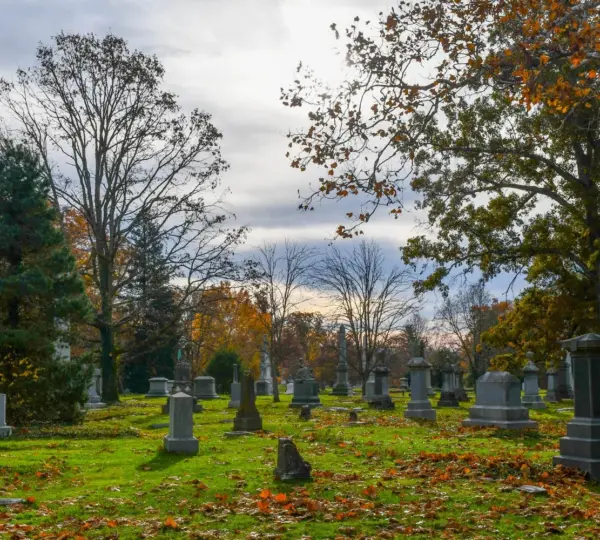
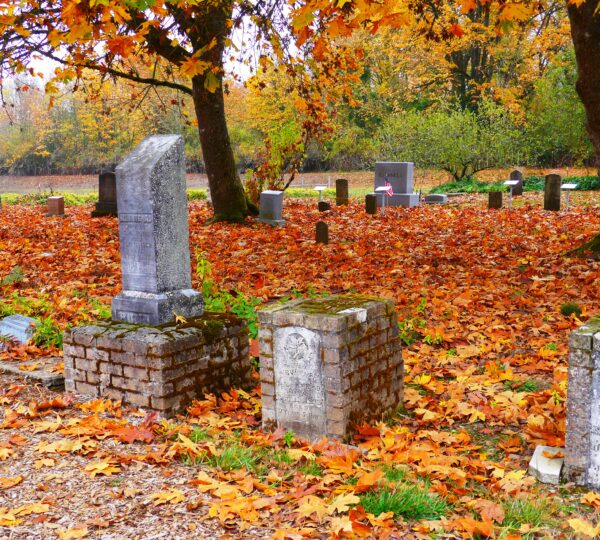
The air was crisp, carrying the faint scent of damp earth, fallen leaves, and the faint aroma of early winter frost beginning to claim the edges of the grass. Mist hovered in low patches above the graves, giving the place an ethereal, almost otherworldly quality.
My father’s grave was still fresh to me—not in the literal sense, though the stone had weathered a little since I first placed it, but in the way that grief can make the heart feel raw and unhealed.
As I approached the row where his headstone stood, clutching a bouquet of white lilies—his favorite—I felt that familiar tightness in my chest. A sharp, poignant ache that gnawed at my chest like an unwelcome visitor.
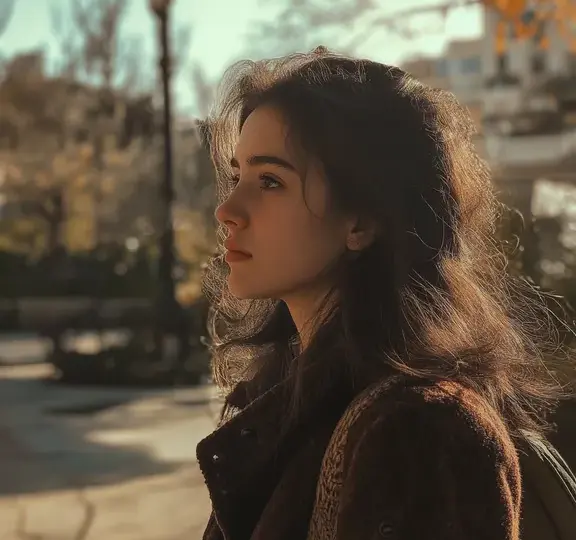
I knelt, brushing away a solitary tear as sunlight filtered through the bare branches of towering oaks overhead, casting moving patterns of shadow and light across the gravestones.
“Goodbye, Dad,” I whispered, my voice low, trembling with a sorrow I had long carried silently. “I hope you can forgive me for all the things left unsaid.”
As I rose to leave, preparing to fold myself back into the normal rhythms of the world outside the cemetery gates, my eyes caught a frail figure a few rows away.
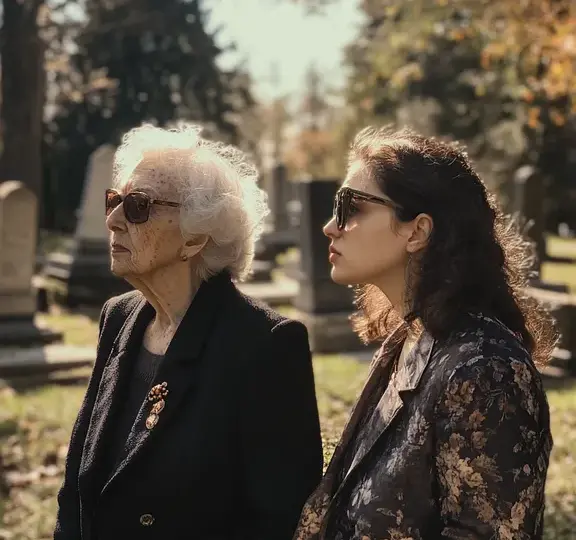
She was an elderly woman, her back slightly hunched, a white cane tapping gently against the stones and gravel as she made her way carefully between the graves.
Dark glasses concealed her eyes, but the curve of her shoulders and the careful, measured steps she took spoke to her vulnerability. There was a loneliness about her stance, a quiet fragility that seemed almost a physical presence in the crisp morning air.
I hesitated for a moment, then moved toward her. “Excuse me, ma’am,” I said softly. “Do you need help?” My voice seemed unusually loud in the stillness of the cemetery.
She turned her head slowly toward me, and a faint smile flickered across her lips. It was small, grateful, and yet tinged with exhaustion. “Oh, thank you, dear. I’d appreciate it if you could walk me home. My sons were supposed to pick me up, but I think they forgot,” she said, her voice quivering just enough to make me pause in surprise.
A pang of anger coursed through me—not at her, but at her sons. How could they abandon their blind mother, leaving her alone in a place meant for mourning and reflection? My own grief for my father momentarily softened into indignation on her behalf. “Of course,” I said without hesitation. “I’ll help you.”
As we stepped onto the quiet streets outside the cemetery, she introduced herself as Kira. Her story unfolded like a delicate, fragile thread, revealing that she had recently lost her husband, Samuel, a man who had been her anchor for more than forty-two years.
“He was my world,” she said, her voice trembling. “Losing him… it feels as though the ground beneath me has shifted. Nothing feels stable anymore.”
I squeezed her arm gently, wishing that my words could somehow bridge the gap between her grief and the world that had become suddenly harsh and confusing. “I’m so sorry for your loss,” I murmured.
“They didn’t even wait with me at the cemetery,” Kira continued bitterly. “My sons, Ethan and Mark, promised they’d return in half an hour. I waited two.”
Her bitterness was sharp, but it came more from disappointment than malice. There were stories here, layers I couldn’t yet see, but I understood enough to stay quiet, to let her words breathe without pressing for more.
We arrived at her modest brick home, a cozy little house framed by roses in full bloom. It smelled faintly of lavender and honey, with an air of calm that belied the tension in her words. She offered me tea, and despite a lingering sense of hesitation, I accepted.
Inside, photographs adorned the walls—faded images of a life fully lived. One caught my eye particularly: a younger Kira, radiant and smiling, holding hands with a man who could only be Samuel, standing proudly in front of the Eiffel Tower.
“Samuel installed cameras all over the house,” she said almost casually, as she prepared the tea. Her voice carried an undercurrent of wary humor. “He didn’t trust my sons. He used to say, ‘They’re more interested in what’s mine than in me.’”
Her words stayed with me long after I left that day, and I found myself thinking about them as I walked back through the quiet streets. That simple act of kindness—walking her home, sharing tea, and offering a listening ear—felt fulfilling, yet innocent, completely unaware of the chaos it would soon draw me into.
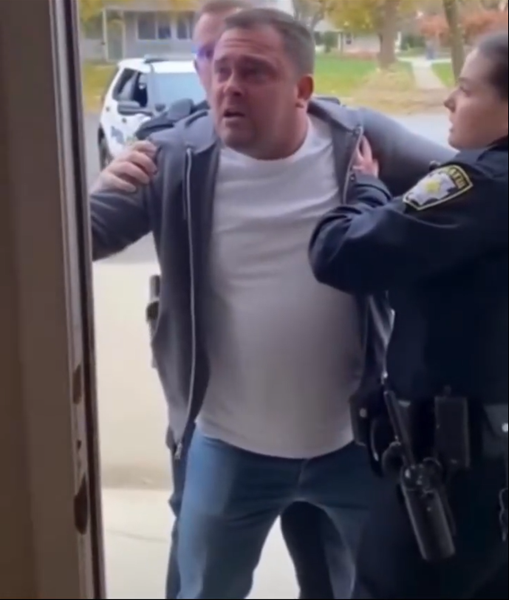
The next morning, I awoke to a sound that made my heart leap into my throat: a violent pounding on my front door. My pulse raced as I stumbled, still half-asleep, toward the sound.
“Open up!” a male voice barked. Confused, alarmed, I swung the door open to reveal two men, one broad-shouldered and furious, gesturing at me with accusatory fingers. Behind them stood a police officer, calm but firm.
“That’s her! She was in our mother’s house yesterday!” the older man shouted. I blinked, disbelief making my words catch in my throat. “Good morning, ma’am,” the officer said, his voice calm but unmistakably serious. “Are you acquainted with a woman named Kira?”
“Yes,” I stammered. “I walked her home from the cemetery yesterday.” The younger man stepped closer, his face red with anger. “And then what? You decided to rob her blind?”
I froze. “What? I would never—”
“Don’t play innocent,” the older man snapped. “Mom said you were in her house. Who else could’ve taken the money and jewelry?”
My stomach sank. “This has to be a mistake. I didn’t take anything!”
The officer raised a hand to silence the men. “Ma’am, I’m going to need you to come with us to clarify this situation.”
A chill ran down my spine as I grabbed my coat. How could a simple, human act of kindness have turned into something so fraught with danger?
At the station, Kira was already seated in the corner, her cane resting against her knee. Relief washed over me when she saw me. “Thank goodness,” she said softly, reaching for my hand. “I told them you didn’t do it.”
“Then why am I here?” I asked, confusion and anxiety tangled in my chest.
“Because my sons are fools,” she said sharply, turning toward Ethan and Mark, who stood stiffly by the door. “And greedy.”
Her words carried weight. They were not merely accusations but declarations born of long years of witnessing selfishness masquerade as love. She instructed the officer to check the home’s surveillance cameras—Samuel’s precautionary measure that would ultimately save me from false accusation.
An hour later, the videos confirmed the truth: I had helped Kira make tea and left shortly after, waving goodbye. Moments later, Ethan and Mark were caught rifling through drawers, pocketing cash and jewelry.
“You idiots,” Kira muttered, voice laced with exasperation. The officer confronted the brothers. “Care to explain?”
Ethan stammered. “We… we were looking for paperwork.”
“For paperwork in a jewelry box?” the officer shot back, incredulous.
Mark buried his face in his hands. “It wasn’t supposed to go like this.”
“No,” Kira said coldly, her eyes hard and unyielding. “It wasn’t. You’ve betrayed me, and you’ve dishonored your father’s memory.”
The brothers were arrested on the spot, charged with theft and filing a false report. I sat beside Kira, stunned at how quickly the truth had surfaced. “I’m so sorry, dear,” she said, squeezing my hand tightly. “They’ve always been this way—taking without giving back. Samuel warned me, but I didn’t want to believe it.”
Over the following weeks, I visited her regularly. Each visit brought new stories, quiet conversations, laughter, and shared reflections. Her home, once shadowed with tension and fear, began to feel like a sanctuary.
“Peace doesn’t come easy,” she said one afternoon, sunlight streaming through lace curtains. “Samuel and I built this life together, and yet it was threatened by the people we loved most.”
I reached across the table to squeeze her hand. “You’re stronger than you know, Kira. Samuel knew that too.”
She smiled faintly. “Maybe he sent you to me. Maybe that’s why you were there.”
When I left that day, she pulled me into a gentle embrace. “Thank you,” she whispered. “For being my light in a dark moment.” I walked home beneath the fading sun, feeling lighter than I had in months. Her words lingered: “Sometimes, strangers become family in ways you never expect.”
The experience changed me. It reminded me that grief and kindness are not opposites but companions. That love can persist even in the shadow of betrayal, and that the smallest gestures—a helping hand, a shared cup of tea, a listening ear—can have consequences far greater than we anticipate.
And sometimes, the bonds we forge in unexpected circumstances are the strongest, carrying us through sorrow, mistrust, and the harsh lessons life insists on teaching.
That morning at the cemetery, I thought I was saying goodbye to my father. What I didn’t realize was that I was stepping into a new chapter, one that would test my judgment, my courage, and my capacity to see beyond appearances. I learned that day that kindness, though sometimes misunderstood, is never wasted.
And I learned, too, that when darkness threatens to overwhelm, the light often comes from the most unlikely sources—a blind woman, a stranger, a bond formed in trust amidst grief and uncertainty.
Even now, when I walk past that cemetery, I remember not only the ache of loss but the resilience of the human heart.
I remember Kira, her stories, her strength, and the lesson she imparted without meaning to: that connection, empathy, and courage can flourish even in the bleakest of circumstances, often when we least expect it.
And in those quiet, reflective moments, I feel my father’s presence as if he, too, is silently approving, reminding me that even in the darkest hours, humanity and kindness can prevail.
